
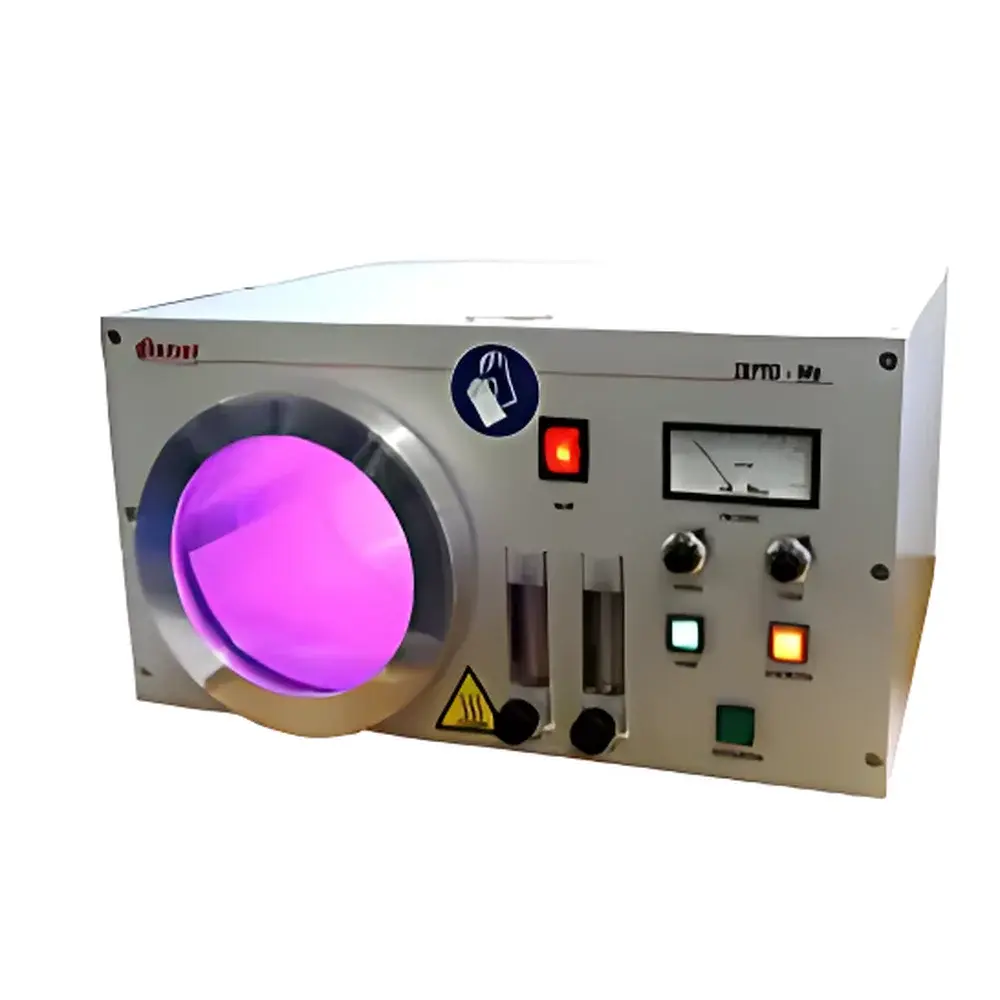
Diener Zepto W6 Plasma Surface Treater
| Brand | Diener |
|---|---|
| Origin | Germany |
| Model | Zepto W6 |
| RF Frequency | 13.56 MHz |
| Power Output | 0–100 W (adjustable) |
| Chamber Volume | 4 L |
| Chamber Material | Quartz |
| Dimensions (W×D×H) | 425 × 450 × 185 mm |
| Gas Inlets | 2 independent channels |
| Control Interface | Manual analog controls |
| Operating Gases | Air, Ar, N₂, or custom gas mixtures |
Overview
The Diener Zepto W6 Plasma Surface Treater is a compact, benchtop-capable radiofrequency (RF) plasma system engineered for precision surface modification in R&D and quality control laboratories. Operating at the internationally standardized industrial frequency of 13.56 MHz, it generates low-pressure, non-thermal plasma via capacitive coupling between aluminum/stainless steel electrodes surrounding a quartz reaction chamber. This configuration ensures uniform plasma density distribution (±2% spatial variation), enabling reproducible surface activation, cleaning, and functionalization across substrates ranging from silicon wafers and polymer films to bioactive glass slides and microfluidic devices. Designed for integration into cleanroom-adjacent lab environments, the Zepto W6 features an all-in-one architecture—integrating RF generator, impedance-matched controller, and vacuum-compatible chamber—eliminating external cabling and minimizing footprint without compromising process stability.
Key Features
- Integrated 13.56 MHz RF generator with continuous 0–100 W power adjustment via calibrated analog knob—optimized for gentle yet effective treatment of delicate substrates including photoresists, PDMS, and protein-coated surfaces.
- Quartz reaction chamber (Ø160 mm × L180 mm, 4 L volume) offering superior UV transparency, thermal stability up to 800 °C, and chemical inertness against halogen-based or oxygen-rich plasmas.
- Dual independent gas inlets equipped with precision float-type flowmeters, supporting sequential or simultaneous introduction of air, argon, nitrogen, or pre-mixed gases for tailored surface chemistry (e.g., O₂ for oxidation, Ar for physical sputtering, NH₃ for amine functionalization).
- Capacitively coupled electrode design with circumferential metal shielding ensures homogeneous plasma generation—critical for consistent contact angle reduction (30% increase in peel force for epoxy-bonded composites), and removal of sub-monolayer organic contaminants (e.g., hydrocarbons, photoresist residues).
- Built-in mechanical vacuum interface compatible with standard two-stage rotary vane pumps (oil or dry); ultimate base pressure ≤5 × 10⁻² mbar achievable within 60 seconds using optional integrated vacuum gauge.
Sample Compatibility & Compliance
The Zepto W6 accommodates substrates up to 150 mm in diameter and 25 mm in height—including wafers, microscope slides, MEMS packages, fiber optic connectors, and 96-well plates—without requiring fixture adaptation. Its quartz chamber eliminates metallic contamination risks associated with stainless-steel alternatives, making it suitable for semiconductor front-end-of-line (FEOL) pre-bonding cleaning per SEMI F20-0202 guidelines. The system supports GLP-compliant operation when paired with optional timer and vacuum monitoring modules; all manual parameter settings are directly traceable via operator logbooks. While not certified to IEC 61000-6-3 or UL 61010-1 out-of-the-box, its CE marking confirms compliance with EU Electromagnetic Compatibility (EMC) Directive 2014/30/EU and Low Voltage Directive 2014/35/EU.
Software & Data Management
As a manually operated platform, the Zepto W6 does not include embedded firmware or digital data logging. Process parameters—including applied RF power, gas composition, exposure duration, and base pressure—are recorded externally by users following SOP-driven documentation protocols. For labs requiring audit-ready records, Diener recommends pairing the unit with third-party vacuum gauges featuring RS-232/USB output (e.g., Pfeiffer TPG300 series) and time-stamped acquisition software compliant with FDA 21 CFR Part 11 requirements. Optional accessories—including mechanical timers with ±0.5 s repeatability and analog vacuum gauges with 0.1 mbar resolution—extend traceability without introducing electronic complexity.
Applications
- Semiconductor manufacturing: Removal of photoresist residuals and native oxide layers prior to metallization or dielectric deposition.
- Microfabrication: Hydrophilization of PDMS microchannels for enhanced capillary filling and reduced bubble formation in lab-on-a-chip systems.
- Biomaterials research: Introduction of carboxyl (–COOH) or amine (–NH₂) groups onto polystyrene culture dishes to improve cell attachment efficiency and monolayer uniformity.
- Optics & photonics: Cleaning of AR-coated lenses and ATR crystals without inducing surface scratching or stoichiometric alteration.
- Medical device development: Sterilization-level decontamination of polyurethane catheters and silicone implants prior to biocompatibility testing per ISO 10993-5.
- Composite bonding: Increasing surface energy of carbon-fiber-reinforced polymers (CFRPs) from ~35 mN/m to >72 mN/m, enabling robust epoxy interfacial adhesion validated via ASTM D1002 lap-shear testing.
FAQ
What vacuum level is required for stable plasma ignition?
Stable plasma discharge initiates at ≤1 × 10⁻¹ mbar; optimal processing occurs between 5 × 10⁻² and 2 × 10⁻¹ mbar, depending on gas type and power setting.
Can the Zepto W6 be used with oxygen plasma for ashing applications?
Yes—oxygen plasma effectively removes organic residues; however, prolonged exposure (>5 min at >80 W) may etch quartz chamber walls. Use recommended exposure limits per Diener Technical Note TN-PLASMA-07.
Is remote control or automation possible?
No—the Zepto W6 is strictly manually operated. For automated sequences, consider Diener’s larger Pico or Femto platforms with programmable PLC interfaces.
What maintenance is required for long-term reliability?
Annual inspection of RF cable shielding integrity, electrode surface oxidation, and quartz chamber transparency is advised. Replace O-rings every 12 months under continuous use.
Does the system comply with ISO 13485 or GMP requirements?
The Zepto W6 itself is not a regulated medical device, but its design supports GMP-aligned workflows when integrated into validated processes with documented change control and calibration records.



