
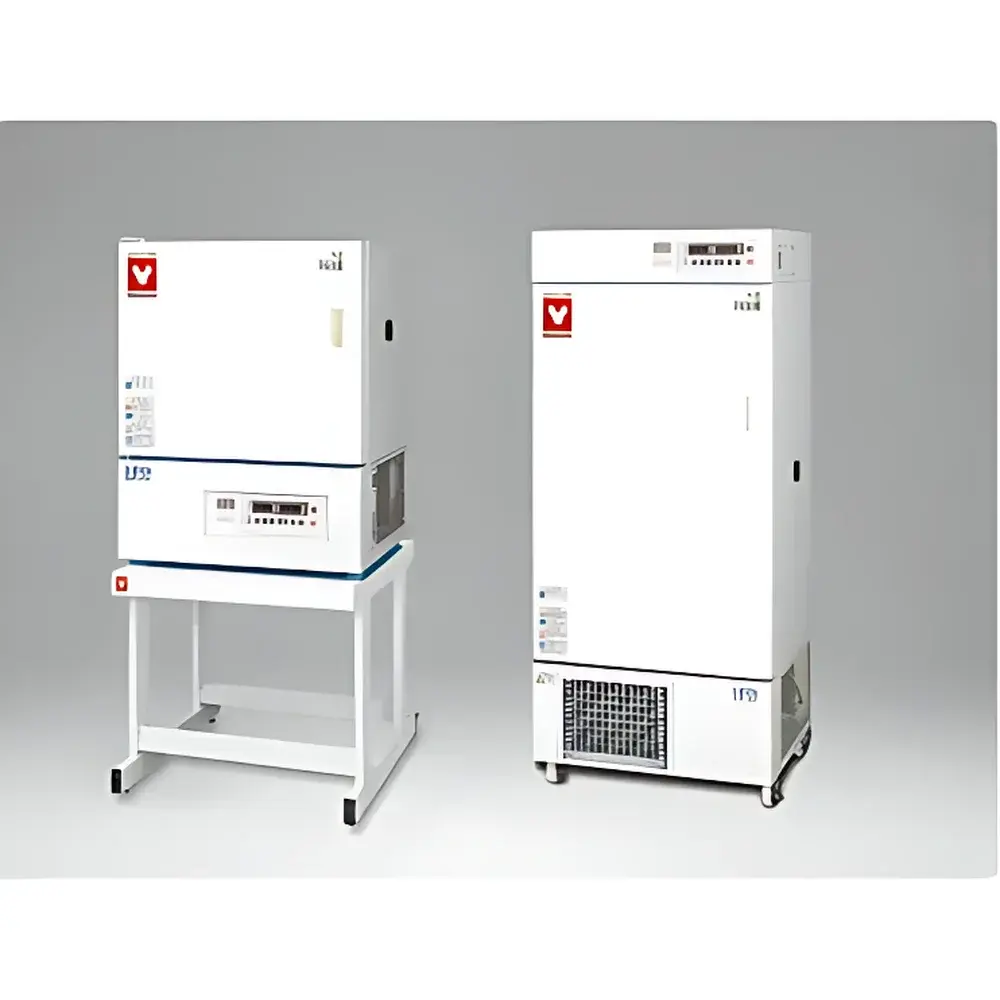
YAMATO IN812C Low-Temperature Incubator
| Brand | YAMATO |
|---|---|
| Origin | Japan |
| Model | IN812C |
| Temperature Range | –10 to 50 °C |
| Temperature Uniformity | ±1.0 °C |
| Humidity Control | Not equipped (Dry Operation Only) |
| Chamber Capacity | 143 L |
| Power Supply | Standard 200–240 V AC, 50/60 Hz |
| Safety Compliance | IEC 61010-1, UL 61010-1 (as per YAMATO global certification), IP20 enclosure rating |
Overview
The YAMATO IN812C Low-Temperature Incubator is an engineered environmental chamber designed for precise, stable thermal control across a broad operating range from –10 °C to +50 °C. Unlike standard ambient or high-temperature incubators, the IN812C integrates a robust refrigeration system with forced-air convection architecture to maintain consistent temperature distribution in demanding life science applications—including low-temperature microbial cultivation, enzyme stability studies, cold-adapted cell line maintenance, and accelerated shelf-life testing. Its core thermal regulation relies on a PID-controlled dual-stage heating/cooling system coupled with a high-efficiency axial fan assembly, ensuring minimal thermal gradient (<±1.0 °C) throughout the 143 L stainless-steel chamber. The unit operates exclusively in dry mode—no integrated humidity generation or monitoring—making it suitable for applications where condensation, moisture-induced contamination, or dew-point interference must be strictly avoided.
Key Features
- Forced-air convection system with optimized airflow path design ensures rapid thermal equilibration and exceptional spatial uniformity (±1.0 °C at setpoint, measured per ISO 15272:2021 Annex B).
- Dual-glass outer door with triple-glazed inner observation door minimizes radiant heat transfer and reduces internal temperature fluctuation during visual inspection.
- Manual and programmable defrost functionality enables flexible maintenance scheduling without interrupting long-term experiments.
- Power-failure recovery mode automatically resumes operation at the pre-interruption setpoint and timing sequence upon grid restoration—critical for unattended overnight or multi-day assays.
- Multi-layer safety architecture includes compressor overload protection, independent mechanical over-temperature cutoff (separate from main controller), residual-current circuit breaker (RCCB), and real-time self-diagnostic monitoring of sensor integrity, heater continuity, SSR status, and thermal runaway conditions.
- Front-panel interface with LED display supports intuitive parameter entry, real-time monitoring of chamber temperature, and alarm history review with timestamped event logging.
Sample Compatibility & Compliance
The IN812C accommodates standard laboratory vessels—including Petri dishes, multi-well plates, Erlenmeyer flasks (up to 2 L), and stacked culture racks—within its fully accessible, corrosion-resistant 304 stainless-steel interior. Removable, adjustable shelves (three included) allow vertical configuration optimization. As a Class II, Group II equipment per IEC 61010-1, the incubator meets essential safety requirements for laboratory use in regulated environments. While not certified for GMP manufacturing zones, its design supports GLP-compliant workflows through traceable temperature logging (via optional RS-232/USB data export), alarm acknowledgment records, and user-accessible calibration offset adjustment—enabling alignment with internal SOPs and audit-ready documentation practices.
Software & Data Management
The IN812C operates via embedded firmware without proprietary PC software dependency. However, optional serial communication (RS-232) or USB-to-serial adapter enables integration with third-party data acquisition platforms (e.g., LabVIEW, MATLAB, or custom Python scripts) for time-stamped temperature streaming and remote setpoint modulation. Alarm events—including over-temperature, sensor fault, and power loss—are stored in non-volatile memory with up to 100 entries and timestamps. Calibration verification reports can be generated manually using NIST-traceable reference thermometers, supporting periodic performance qualification (PQ) as required under ISO/IEC 17025 or FDA 21 CFR Part 11–aligned validation protocols (when paired with compliant electronic record systems).
Applications
- Cultivation of psychrotrophic microorganisms (e.g., Pseudomonas fluorescens, Yersinia enterocolitica) in food safety and clinical microbiology labs.
- Low-temperature enzymatic reaction profiling and kinetic analysis under thermally stabilized conditions.
- Stability testing of biologics, vaccines, and diagnostic reagents per ICH Q5C guidelines.
- Environmental simulation for material aging studies involving polymer crystallinity or lipid phase transitions.
- Pre-chilling of samples prior to cryopreservation, centrifugation, or chromatographic injection to minimize thermal degradation.
FAQ
Does the IN812C support humidity control?
No. The IN812C is a dry incubator with no built-in humidification or dehumidification system. It is intended for applications requiring strict moisture exclusion.
Can the temperature uniformity specification be verified independently?
Yes. Uniformity is validated per ISO 15272:2021 using nine calibrated PT100 probes placed at standardized positions; users may replicate this protocol using accredited external sensors.
Is the unit suitable for use in cleanroom environments?
It meets IP20 ingress protection and has no internal oil-lubricated components, but lacks HEPA filtration or positive-pressure capability—thus classified for general lab use, not ISO Class 5+ cleanrooms.
What is the typical recovery time after door opening?
From ambient (25 °C) to –10 °C setpoint, full recovery with door open for 30 seconds is ≤12 minutes under standard load conditions (per YAMATO technical bulletin TB-IN812C-REV4).
Are calibration certificates provided with shipment?
Factory calibration is performed pre-shipment, but formal NIST-traceable certification requires optional purchase of a certified calibration report (YAMATO Certificate of Conformance, Cat. No. CAL-IN812C).




