
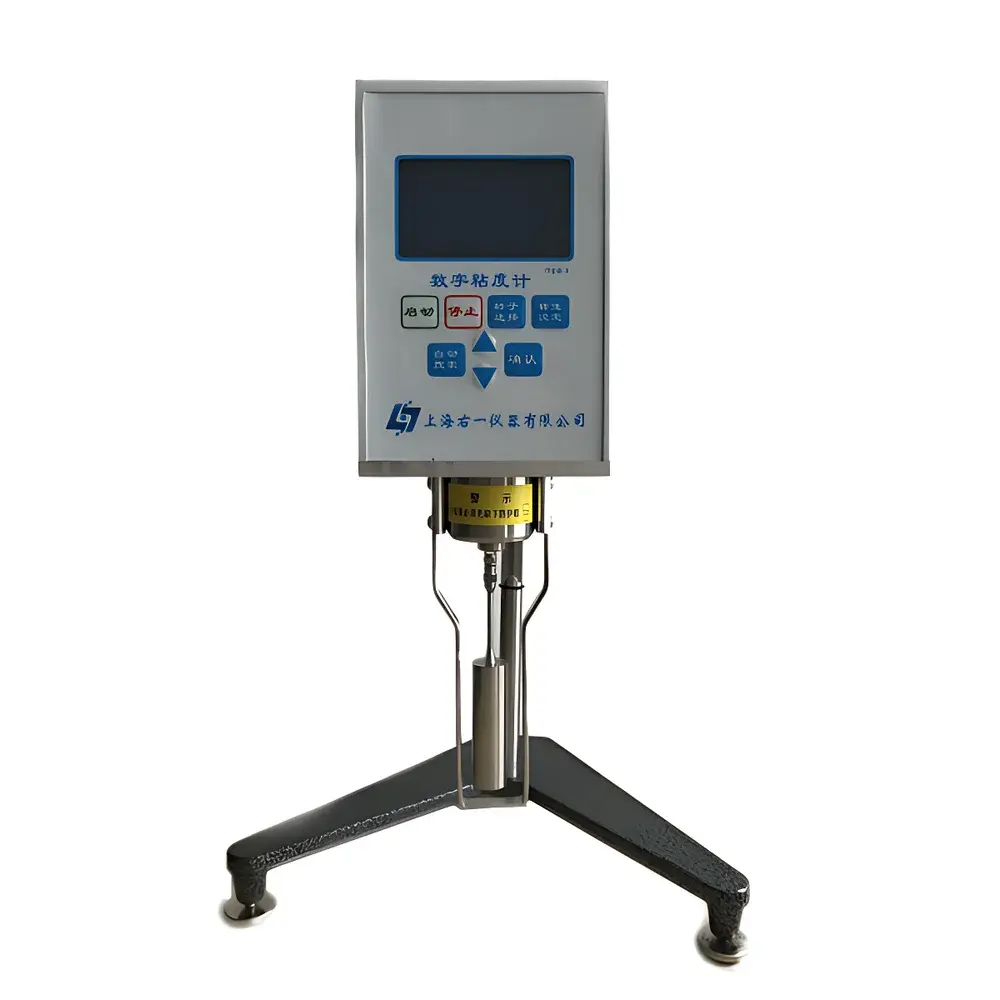
Yoyi NDJ-9S Digital Display Rotational Viscometer
| Brand | Yoyi |
|---|---|
| Origin | Shanghai, China |
| Manufacturer Type | Direct Manufacturer |
| Model | NDJ-9S |
| Viscosity Range | 1–6,000,000 mPa·s (with optional #0 spindle down to 1 mPa·s) |
| Accuracy | ±3% FS |
| Repeatability | ±0.5% FS |
| Resolution | 1 mPa·s (0.1 mPa·s with #0 spindle) |
| Spindle Set | Standard #1–#4 |
| Speed Settings | 9 steps (0.1, 0.3, 0.6, 1.5, 3, 6, 12, 30, 60 rpm) |
| Dimensions (W×D×H) | 95 × 130 × 155 mm (excl. base) |
| Net Weight | 2 kg (excl. base) |
| Power Supply | 110–220 V AC, ±10%, 50–60 Hz |
Overview
The Yoyi NDJ-9S Digital Display Rotational Viscometer is a microprocessor-controlled, benchtop rotational viscometer engineered for precision viscosity measurement across a broad dynamic range—from low-viscosity solvents (1 mPa·s with optional #0 spindle) to highly viscous pastes and gels up to 6 × 10⁶ mPa·s. It operates on the principle of rotational viscometry using coaxial cylinder (Couette flow) geometry: torque required to rotate a spindle at a defined angular velocity within a sample is measured and converted to dynamic viscosity (mPa·s) via calibrated spindle constants and instrument-specific calibration coefficients. Designed for routine QC laboratories, R&D facilities, and production environments in chemical, pharmaceutical, food, and coating industries, the NDJ-9S delivers stable speed control, real-time digital readout, and intelligent auto-search functionality—enabling rapid identification of optimal spindle/speed combinations for unknown samples without prior viscosity estimation.
Key Features
- Microcontroller-based architecture with embedded firmware for real-time data acquisition, calculation, and Chinese/English bilingual display (configurable)
- Nine discrete rotational speeds (0.1–60 rpm), each digitally regulated to maintain ±0.2% speed stability under load
- Auto-search algorithm analyzes torque response during initial rotation to recommend appropriate spindle and speed combination based on measured resistance
- Standard four-spindle set (#1–#4) covers mid-to-high viscosity ranges; optional #0 spindle extends lower detection limit to 1 mPa·s with 0.1 mPa·s resolution
- Wide input voltage tolerance (110–220 V AC, ±10%, 50–60 Hz) ensures operational reliability across global laboratory power infrastructures
- Compact footprint (95 × 130 × 155 mm) and lightweight design (2 kg net) support flexible placement on fume hoods, laminar flow benches, or mobile QC carts
- Calibration traceable to national standards; factory calibration certificate provided with each unit
Sample Compatibility & Compliance
The NDJ-9S accommodates Newtonian and mildly non-Newtonian fluids typical of industrial formulations—including water-based emulsions (latex, cosmetics), solvent-borne systems (paints, adhesives), food suspensions (starch slurries, dairy products), and polymer solutions. Sample volume requirement is 20–30 mL for standard spindles (minimum 15 mL with #0 spindle). While not certified for GLP/GMP-regulated environments out-of-the-box, the instrument supports audit-ready documentation when integrated into validated workflows: all measurements are timestamped, spindle/speed parameters are logged, and raw torque values are retained internally. For regulated applications, users may implement supplementary procedural controls aligned with ISO 2555, ASTM D2196, or USP for rotational viscosity testing.
Software & Data Management
The NDJ-9S operates as a standalone instrument with no proprietary PC software dependency. All measurement data—including viscosity value, spindle ID, rotational speed, temperature (when used with optional external PT100 probe), and timestamp—are displayed and stored in internal memory (up to 200 records). Data export is performed manually via visual recording or optional RS-232 interface (available on request) for integration with LIMS or Excel-based reporting templates. The firmware supports user-defined pass/fail thresholds and audible alerts for out-of-spec results. Though lacking FDA 21 CFR Part 11-compliant electronic signatures, the device meets baseline data integrity requirements for non-GxP environments where manual verification and paper-based SOPs govern recordkeeping.
Applications
- Quality control of adhesive formulations (e.g., PVA, acrylic, epoxy blends) to ensure batch-to-batch consistency in open-time and wet-shear strength
- Rheological screening of architectural coatings during formulation development—assessing sag resistance, leveling behavior, and sprayability
- Monitoring starch gelatinization kinetics in food processing lines by tracking viscosity rise during controlled heating ramps
- Stability evaluation of cosmetic emulsions (creams, lotions) through accelerated aging studies with periodic viscosity trending
- Verification of dilution accuracy in inkjet ink manufacturing, where viscosity deviations >±5% directly impact printhead clogging risk
- Educational use in university polymer science labs for introducing fundamental concepts of shear-dependent flow behavior
FAQ
What spindle configurations are included with the NDJ-9S, and how do I select the correct one for my sample?
The instrument ships with #1–#4 spindles. Selection follows ASTM D2196 guidelines: choose the spindle/speed combination that yields a torque reading between 10% and 100% of full scale. The auto-search function assists in this process by recommending optimal settings after an initial low-speed trial.
Can the NDJ-9S measure non-Newtonian fluids such as shear-thinning paints or thixotropic gels?
Yes—it provides single-point viscosity values at selected shear rates. For full flow curve characterization (e.g., viscosity vs. shear rate), a programmable rheometer with continuous ramp capability is recommended.
Is temperature control integrated, or must it be added externally?
No built-in temperature regulation is provided. For temperature-sensitive measurements, pair the NDJ-9S with a circulating water bath and optional PT100 temperature probe (sold separately) to log concurrent thermal data.
How often does the instrument require recalibration?
Annual recalibration is recommended for routine QC use. More frequent verification (e.g., daily or per-shift) using NIST-traceable silicone oil standards is advised for critical applications.
Does the NDJ-9S comply with ISO/IEC 17025 requirements for accredited testing laboratories?
The device itself is not accredited, but its metrological performance (accuracy ±3% FS, repeatability ±0.5% FS) satisfies the technical requirements outlined in ISO/IEC 17025:2017 Clause 6.4 for equipment suitability—provided users maintain documented calibration, environmental monitoring, and uncertainty budgets.



