
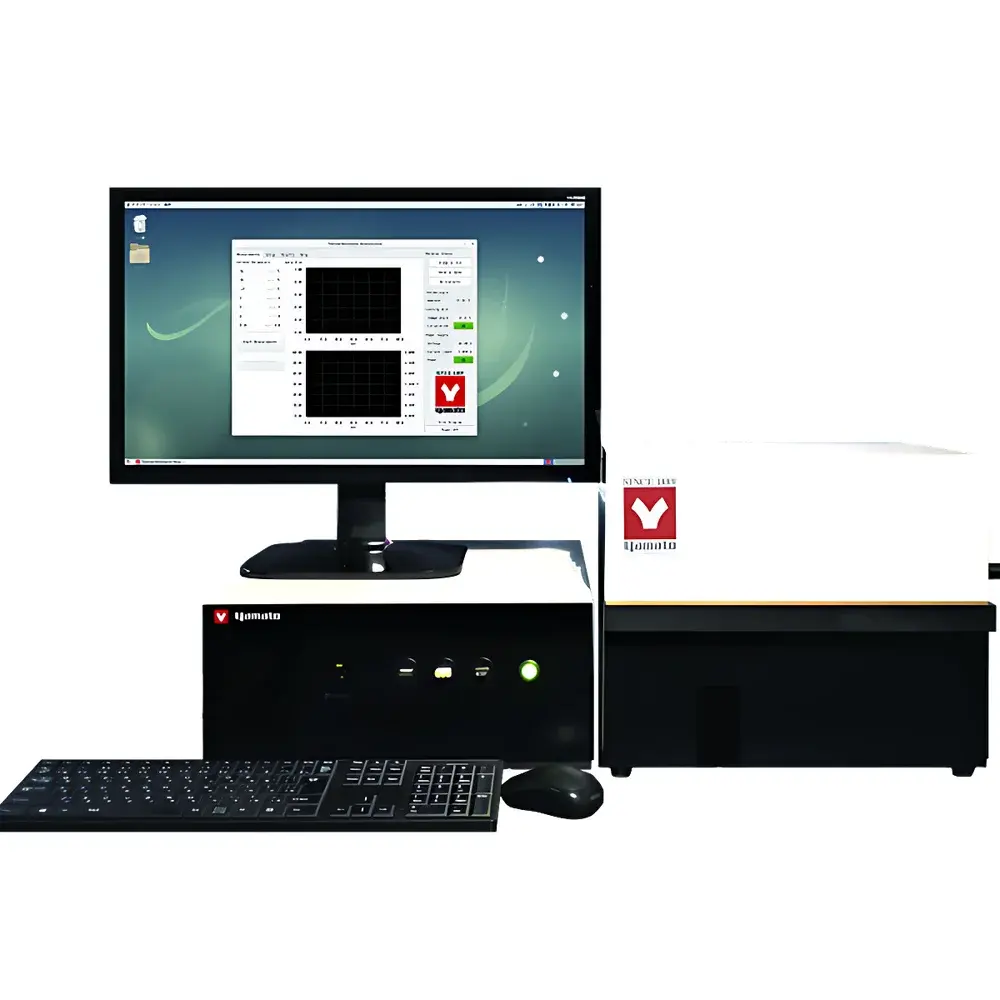
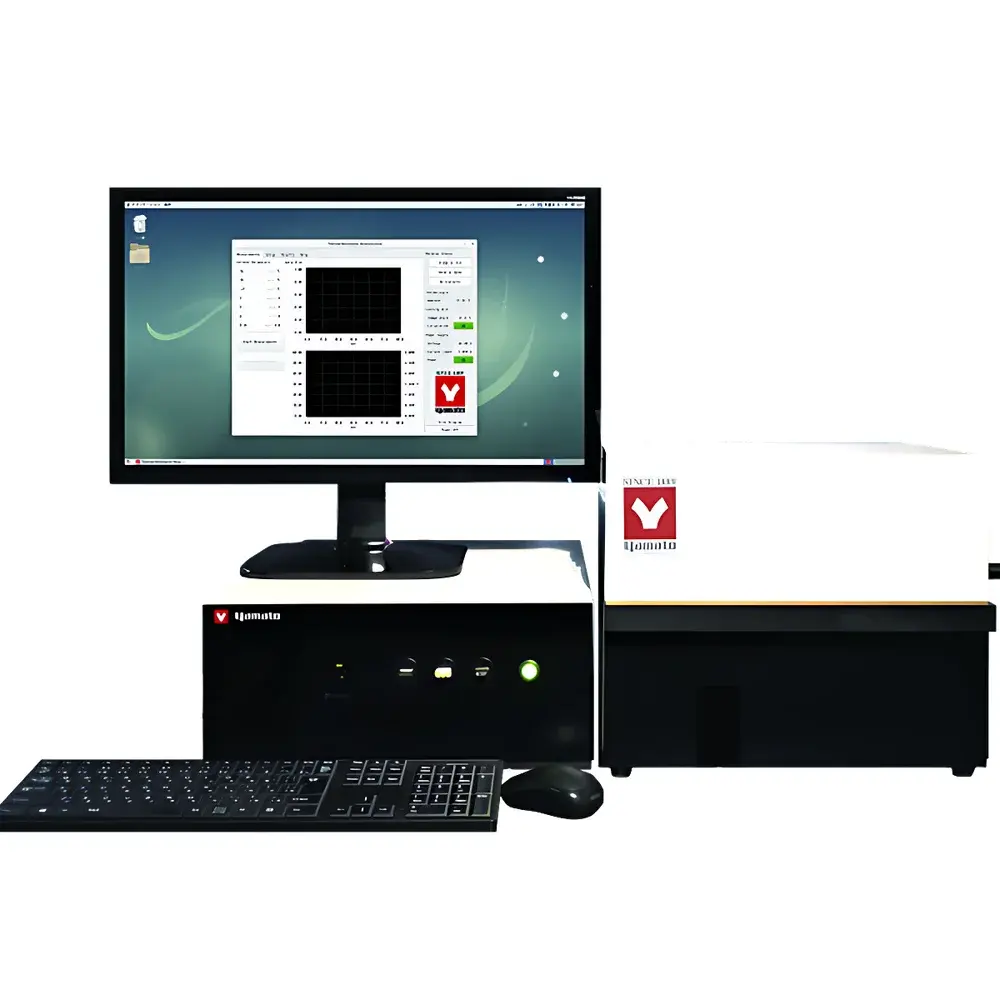
YAMATO TE100 Thermal Characterization System for Power Semiconductor Substrates
| Brand | YAMATO |
|---|---|
| Origin | Japan |
| Model | TE100 |
| Compliance | ISO 4825-1:2023-01 |
| Sample Size | 30 × 30 mm |
| Load Force | 10 kg |
| Temperature Resolution | ≥0.01 °C |
| Thermal Resistance Measurement Accuracy | ±0.1 mΩ (70–130 Ω range) |
| Sampling Rate | 100 samples/sec (max) |
| TEG Chip Dimensions | 5 × 5 × 0.35 mm |
| TEG Heat Generation Density | 1 kW/cm² |
| Max Input Power | ~250 W |
| Thermal Ramp Rate | 1.4 × 10⁴ K/sec |
| Controller Dimensions | W380 × D470 × H180 mm |
| Measurement Unit Dimensions | W380 × D400 × H320 mm |
| External Circulator | NeoCool CFA302 (Closed-loop, air-cooled) |
| Circulator Temp Range | −10 to +60 °C |
| Circulator Power Supply | AC 100 V, 13.8 A |
| Circulator Dimensions | W380 × D565 × H725 mm |
Overview
The YAMATO TE100 Thermal Characterization System is a precision-engineered instrument designed specifically for the quantitative evaluation of thermal resistance (Rth) in power semiconductor substrates and discrete packaging structures. It operates on the principle of transient thermoreflectance-based thermal impedance measurement, combined with controlled mechanical loading and high-fidelity thermoelectric generator (TEG)-driven heating. The system implements the methodology defined in ISO 4825-1:2023-01 — “Semiconductor devices — Mechanical and climatic test methods — Part 1: Thermal resistance measurement of power semiconductor packages” — ensuring metrological traceability and inter-laboratory comparability. Unlike steady-state thermal testers, the TE100 captures dynamic thermal response under pulsed high-power excitation (up to ~250 W), enabling extraction of junction-to-case (Rth(j-c)) and substrate-level thermal path resistances with sub-millisecond temporal resolution. Its architecture integrates a calibrated 10 kg axial load mechanism to replicate real-world mounting pressure, critical for eliminating interfacial contact resistance artifacts during thermal interface material (TIM) evaluation or direct die attach characterization.
Key Features
- Full compliance with ISO 4825-1:2023-01 for standardized thermal resistance reporting in power electronics qualification.
- Integrated high-density TEG chip (5 × 5 × 0.35 mm) capable of localized heat generation up to 1 kW/cm², enabling rapid thermal transients (up to 1.4 × 10⁴ K/sec).
- High-resolution temperature sensing with ≥0.01 °C thermal resolution and synchronized 100 Hz data acquisition for precise transient curve fitting.
- Dual-unit modular design: compact measurement head (W380 × D400 × H320 mm) coupled with a dedicated controller (W380 × D470 × H180 mm) for optimized signal integrity and EMI isolation.
- External closed-loop circulator (NeoCool CFA302) provides stable, programmable baseplate temperature control from −10 °C to +60 °C, supporting thermal boundary condition studies under non-ambient conditions.
- Electrical resistance measurement accuracy of ±0.1 mΩ within the 70–130 Ω range supports precise calibration of TEG voltage-current-temperature relationships per IEC 60584 and ASTM E230.
Sample Compatibility & Compliance
The TE100 accepts rigid planar substrates conforming to the ISO 4825-1:2023-01 reference geometry of 30 mm × 30 mm, accommodating common ceramic (Al₂O₃, AlN, Si₃N₄), metal-core (IMS), and silicon carbide (SiC) substrate formats used in IGBT, MOSFET, and wide-bandgap power modules. Its mechanical loading system ensures repeatable 10 kg contact force across the entire sample surface, minimizing variability caused by uneven clamping. The system supports both bare substrate evaluation and fully assembled module-level testing when mounted on compatible cold plates. All measurement protocols align with international standards governing power device reliability: ISO 4825-1:2023-01, JEDEC JESD51-14 (transient dual-interface test), and IEC 60747-9 (discrete semiconductor thermal testing). Data logs include full audit trails compliant with GLP and GMP documentation requirements.
Software & Data Management
The TE100 is operated via YAMATO’s proprietary Windows-based control software, which provides real-time visualization of thermal transients, automatic Rth calculation using the structure function method (per JEDEC JESD51-14), and export of time-resolved voltage, current, and temperature datasets in CSV and HDF5 formats. Software features include configurable pulse width modulation (PWM) sequencing, multi-cycle averaging for noise reduction, and built-in uncertainty propagation analysis based on NIST-traceable calibration certificates. Raw data files embed metadata such as operator ID, timestamp, ambient conditions, and ISO-compliant test parameters — facilitating 21 CFR Part 11–compliant electronic records when deployed in regulated environments.
Applications
- Thermal resistance validation of SiC and GaN substrate materials prior to wafer-level packaging.
- Comparative evaluation of thermal interface materials (TIMs) under realistic compressive loads.
- Junction-to-case thermal characterization of discrete power devices and half-bridge modules.
- Failure mode analysis of solder voiding or delamination via thermal transient anomaly detection.
- Qualification testing for automotive AEC-Q102 and industrial IEC 60747-9 compliance programs.
- Research into anisotropic thermal conductivity in advanced ceramic substrates and embedded heat spreaders.
FAQ
Does the TE100 support automated pass/fail judgment against ISO 4825-1 limits?
Yes — the software allows user-defined upper/lower thresholds for Rth values, generating immediate visual alerts and PDF summary reports upon test completion.
Can the system measure thermal resistance of non-square substrates?
Only samples conforming to the 30 × 30 mm reference footprint are supported per ISO 4825-1; custom fixtures require deviation documentation and re-validation.
Is the NeoCool CFA302 circulator included with the base TE100 configuration?
Yes — the CFA302 is supplied as an integral component; its closed-loop air-cooling architecture eliminates dependency on facility chilled water.
What calibration documentation is provided with delivery?
Each unit ships with factory calibration certificates for temperature sensors, load cell, and electrical measurement subsystems, traceable to JCSS (Japan Calibration Service System) standards.
Is remote operation supported over Ethernet or USB?
The controller includes Gigabit Ethernet connectivity; remote monitoring and script-driven batch testing are enabled via TCP/IP API (SDK available upon request).



