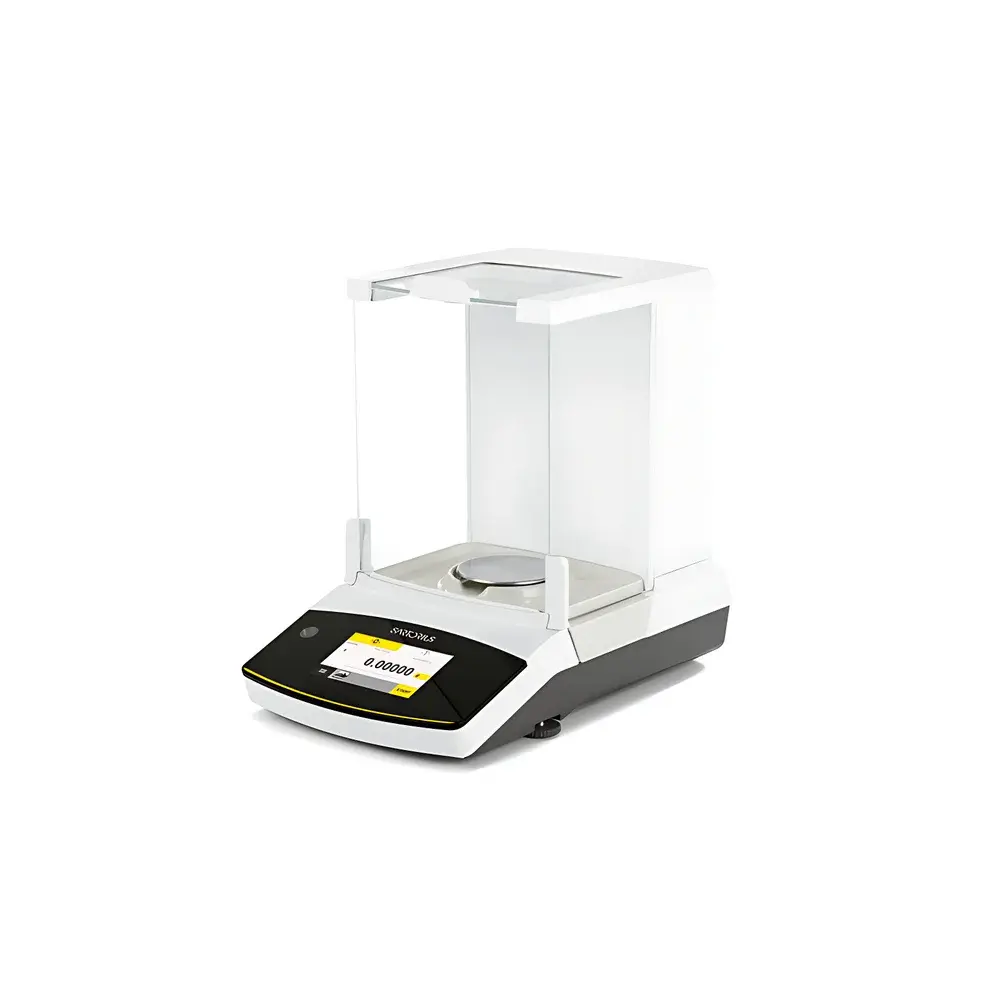
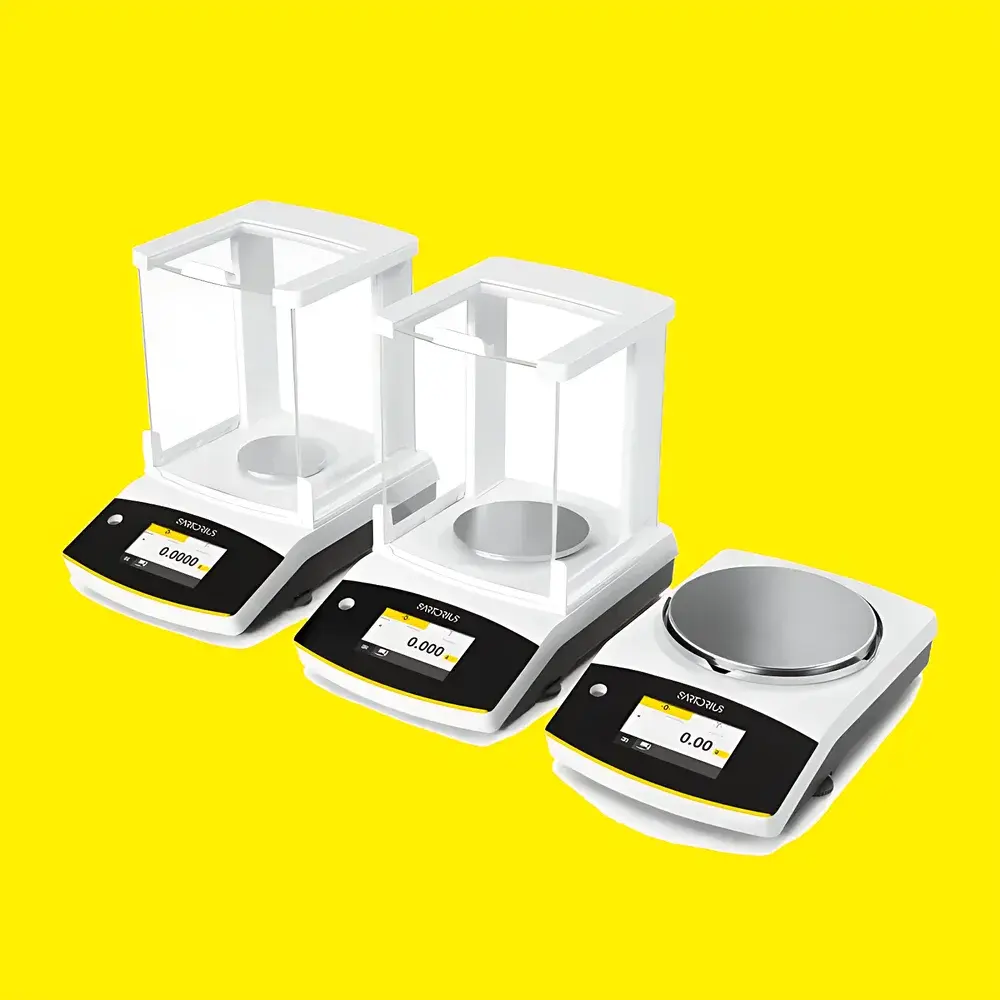
Sartorius Quintix Analytical Balance (Discontinued; Superseded by Quintix Pro Series)
| Brand | Sartorius |
|---|---|
| Origin | Beijing, China |
| Manufacturer Type | Authorized Distributor |
| Product Category | Domestic |
| Model | Quintix |
| Instrument Type | Analytical Balance |
| Maximum Capacity | 6100 g |
| Readability | 0.1 mg |
| Repeatability | ≤ ±0.1 mg |
| Calibration | Fully Automatic Internal Calibration (isoCAL) |
| Compliance | EC Type Approval for Legal Metrology |
| Interface | Mini-USB |
| Software Integration | Direct Data Transfer to Microsoft Excel® (Text or Numeric Format, No Additional Software Required) |
| Built-in Applications | Density, Percentage, Statistics, Formulation, Counting, Checkweighing, Peak Hold, Dynamic Weighing, Unit Conversion |
| Environmental Robustness | Validated for >1,000,000 load cycles |
| Audit Trail | Cal Audit Trail with ISO/IEC 17025-aligned calibration event logging |
Overview
The Sartorius Quintix Analytical Balance is an engineered precision instrument designed for routine and regulated laboratory environments where traceable accuracy, operational efficiency, and long-term stability are critical. Based on electromagnetic force compensation (EMFC) technology, the Quintix delivers high-resolution mass measurement across its analytical range (e.g., 220 g × 0.1 mg), with repeatability ≤ ±0.1 mg and linearity error as low as ±0.2 mg — performance validated under ISO 17025–compliant test protocols. Although superseded by the Quintix Pro series, the Quintix remains widely deployed in quality control laboratories, pharmaceutical manufacturing support units, and academic research facilities requiring EC-type-approved instrumentation for legal metrology applications. Its core architecture integrates a high-stability aluminum die-cast sensor housing, temperature-compensated transducer electronics, and isoCAL — a fully automated, time- and temperature-triggered internal calibration system that maintains metrological integrity without manual intervention.
Key Features
- isoCAL Internal Calibration System: Automatically initiates calibration upon power-on, after predefined time intervals, or in response to ambient temperature drift (>1.5 °C change), ensuring continuous traceability and compliance with ISO 9001, GLP, and GMP documentation requirements.
- Cal Audit Trail: Records all calibration events — including timestamp, ambient temperature, calibration weight value, deviation, and operator ID (if configured) — stored internally for audit-ready export via USB.
- Touchscreen User Interface: 4.3-inch capacitive display with icon-driven navigation, plain-text prompts, and context-sensitive help — developed in collaboration with laboratory end-users to minimize training time and eliminate reliance on printed manuals.
- Direct Excel® Data Transfer: Native integration with Microsoft Excel via mini-USB; transmits weight values in user-selected numeric or text format without third-party drivers, macros, or configuration files — compliant with FDA 21 CFR Part 11 when used with validated IT infrastructure.
- Robust Mechanical Design: Tested for over 1,000,000 load cycles under variable stress conditions; anti-static, chemical-resistant housing; removable, autoclavable weighing pan; splash-proof draft shield (for models with design types 1 & 2).
- Application Suite: Pre-installed workflows include density determination (with Sartorius density kit), formulation weighing (with full component tracking), statistical analysis (mean, SD, CV%), checkweighing (± tolerance bands), dynamic weighing (for live animals or vibrating samples), and piece counting (with reference sample calibration).
Sample Compatibility & Compliance
The Quintix supports a broad spectrum of sample types — from fine powders and hygroscopic solids to volatile liquids and small biological specimens — within its designated weighing chamber dimensions (e.g., 90 mm or 180 mm diameter pans, up to 209 mm height). Draft shields are motorized or sliding-door configurations depending on model variant, minimizing airflow disturbance while enabling ergonomic access. All Quintix models carry EC Type Approval (MID Directive 2014/32/EU), certifying their suitability for legally regulated tasks such as raw material release, batch record entry, and pharmacopeial testing (USP , EP 2.1.1). The balance meets IP42 ingress protection rating, operates reliably at 15–30 °C (59–86 °F) and 30–80% RH non-condensing, and conforms to electromagnetic compatibility standards IEC 61326-1 and safety standard IEC 61010-1.
Software & Data Management
Data integrity is maintained through hardware-level USB interface control: no background software daemon is required, eliminating compatibility risks with OS updates. Weight data streams directly into Excel cells using SBI (Sartorius Basic Interface) or XBPI (Excel Binary Protocol Interface), both supporting configurable transmission intervals (0.1–10 s) and automatic carriage return. Audit trail logs are exportable as CSV or PDF. Administrator lock prevents unauthorized modification of calibration parameters, application settings, or unit definitions. Optional YDP30/YDP40 printers are auto-detected and configured via guided setup — supporting GLP-compliant label printing with sample ID, date/time stamp, operator code, and net/gross/tare metadata. Firmware updates are performed offline via USB stick, preserving validation status.
Applications
The Quintix serves as a foundational tool across regulated and non-regulated workflows: quantitative formulation in API synthesis labs; density profiling of polymer melts and electrolyte solutions; statistical process control (SPC) sampling in medical device packaging lines; USP repeatability verification for tablet weight variation; and QC release testing of excipients per Ph. Eur. 2.1.1. Its dynamic weighing mode enables reliable murine mass monitoring during preclinical studies, while the peak-hold function supports tension-force proxy measurements in tensile testing setups. In educational labs, the intuitive interface accelerates student competency development in gravimetric analysis, stoichiometric preparation, and uncertainty propagation exercises — all without compromising metrological rigor.
FAQ
Is the Quintix still supported for service and calibration?
Yes — Sartorius continues to provide spare parts, certified calibration services, and technical support for Quintix instruments globally, though firmware updates are limited to critical security or compliance patches.
Does the Quintix meet FDA 21 CFR Part 11 requirements?
The hardware and firmware support electronic signatures and audit trails; full Part 11 compliance requires implementation within a validated laboratory information management system (LIMS) or electronic lab notebook (ELN) environment.
Can I use the Quintix for density measurements of irregular solids?
Yes — when paired with the Sartorius Density Kit (including sinker, pycnometer, and immersion stand), the built-in density application calculates density per ASTM D792 and ISO 1183 using Archimedean displacement principles.
What is the difference between isoCAL and manual external calibration?
isoCAL uses internal reference weights and real-time thermal monitoring to adjust sensor gain automatically, eliminating human error and environmental variability inherent in manual calibration with external masses.
Is the EC Type Approval valid for international trade?
EC Type Approval certifies conformity with EU Measuring Instruments Directive; for non-EU markets, local type approval (e.g., NIST Handbook 44 in the US, JIS B 7721 in Japan) must be obtained separately through authorized metrology bodies.