
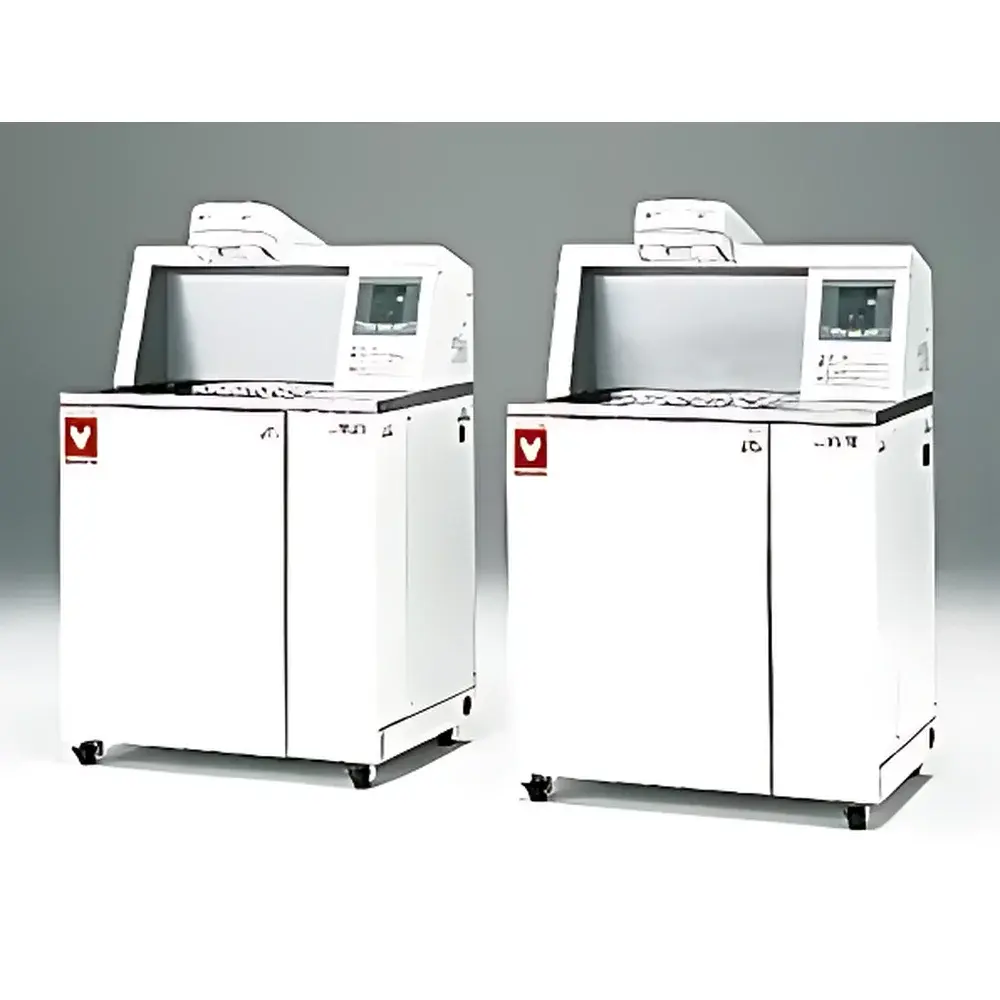
YAMATO WG511 & WG711 Ultra-Pure Water Systems
| Brand | YAMATO |
|---|---|
| Origin | Japan |
| Model | WG511, WG711 |
| Purified Water Grade | ASTM Type I / ISO 3696 Grade 1 |
| Resistivity | 18.2 MΩ·cm @ 25°C |
| Heavy Metals & Soluble Silica | <0.1 ppb |
| Total Organic Carbon (TOC) | ≤0.05 mg C/L |
| Microbial Count | <1 CFU/mL |
| Endotoxin | <0.001 EU/mL |
| Particulates (>0.1 µm) | <0.1 particles/mL |
| Feed Water Pressure Range | 100–500 kPa |
| Power Supply | Single-phase AC 200 V, 50/60 Hz (WG511: ~20 A |
| WG711 | ~40 A) |
| Dimensions (W×D×H) | 903 × 603 × 1430 mm |
| Net Weight | ~110 kg |
Overview
The YAMATO WG511 and WG711 Ultra-Pure Water Systems are engineered for laboratories requiring continuous, on-demand production of ASTM Type I and ISO 3696 Grade 1 water—specifically for critical applications including HPLC mobile phase preparation, trace elemental analysis (ICP-MS, AAS), cell culture media formulation, and molecular biology workflows. These systems integrate dual-purification pathways: the WG511 employs a hybrid process combining ion exchange, distillation, and submicron filtration, while the WG711 utilizes advanced ion exchange with integrated high-efficiency pre-treatment and a dedicated 0.1 µm final membrane filter. Both models deliver water with resistivity ≥18.2 MΩ·cm at 25°C, TOC ≤0.05 mg C/L, endotoxin <0.001 EU/mL, and microbial levels <1 CFU/mL—meeting or exceeding requirements for USP , CLSI EP22-A, and ISO 15195:2018 validation frameworks.
Key Features
- Integrated 0.1 µm final-point filtration to prevent airborne recontamination of purified water in distribution lines
- Digital, temperature-compensated conductivity/resistivity monitoring with dual-unit display (µS/cm and MΩ·cm) and automatic calibration reference
- Five-stage LED water level indicator for real-time reservoir status monitoring
- Programmable dispensing volume (0.1–99.9 L per cycle) via touch-activated interface with flow rate control
- Multi-layer safety architecture: overheat protection, dry-run prevention, leak detection, ground-fault interruption, and ceramic heater redundancy
- Modular consumables design—including large-capacity mixed-bed ion exchange columns (10 L), activated carbon + membrane pre-filters, and replaceable distillation condensers—enabling rapid service without system downtime
- Distillation modules constructed from borosilicate glass (WG511/WG711) and ceramic heating elements rated for >10,000 operating hours
Sample Compatibility & Compliance
These systems are compatible with municipal tap water, softened water, and reverse osmosis (RO) permeate as feed sources—provided inlet pressure remains within 100–500 kPa and total dissolved solids (TDS) do not exceed 500 ppm. All wetted materials comply with USP Class VI biocompatibility standards. The WG511/WG711 meet ISO 9001-certified manufacturing protocols and support full GMP/GLP documentation packages, including audit-ready maintenance logs, calibration records, and performance qualification (PQ) templates aligned with FDA 21 CFR Part 11 data integrity principles. Endotoxin and microbial specifications satisfy USP and , respectively.
Software & Data Management
While the WG511 and WG711 operate via embedded microcontroller-based firmware (no external PC dependency), all operational parameters—including dispensing volume, cumulative output, alarm history, and real-time resistivity/TOC trends—are stored in non-volatile memory with timestamped entries. Data export is supported via USB port (CSV format) for integration into LIMS or electronic lab notebooks (ELN). Audit trails record operator ID (via optional RFID badge reader), parameter changes, and maintenance events—fully compliant with ALCOA+ data governance criteria.
Applications
- HPLC, UHPLC, and LC-MS mobile phase and blank preparation
- Atomic spectroscopy (ICP-OES, ICP-MS) standard dilution and instrument rinsing
- Electrophysiology and patch-clamp solutions requiring ultra-low ionic background
- Cell culture media, transfection reagents, and monoclonal antibody purification buffers
- Next-generation sequencing library prep and qPCR master mix formulation
- Calibration of conductivity meters and reference electrode storage solutions
FAQ
What feed water quality is required for optimal performance?
Municipal tap water with TDS ≤500 ppm and chlorine ≤3 mg/L is acceptable; however, RO pre-treatment is strongly recommended to extend consumable life and ensure consistent TOC <0.05 mg C/L.
Can the system be validated per IQ/OQ/PQ protocols?
Yes—YAMATO provides full validation documentation kits, including factory test reports, material certifications (3.1 EN 10204), and PQ test procedures aligned with ASTM D1193 and ISO 3696.
Is remote monitoring or Ethernet connectivity available?
No native Ethernet or cloud interface is included; however, analog 4–20 mA outputs for resistivity and level signals are provided for integration into building management systems (BMS) or SCADA platforms.
How often must consumables be replaced?
Pre-filters: every 6 months or 10,000 L; mixed-bed ion exchange column: 6–12 months depending on feed water quality; 0.1 µm final filter: annually or after 20,000 L—replacement intervals are tracked automatically and displayed on the front panel.
Does the system support sterile filtration for cell culture use?
The built-in 0.1 µm filter meets ISO 8573-1 Class 2 particulate specification but is not sterilizing-grade; for aseptic applications, users must add a 0.22 µm sterilizing filter downstream of the dispensing valve.



