
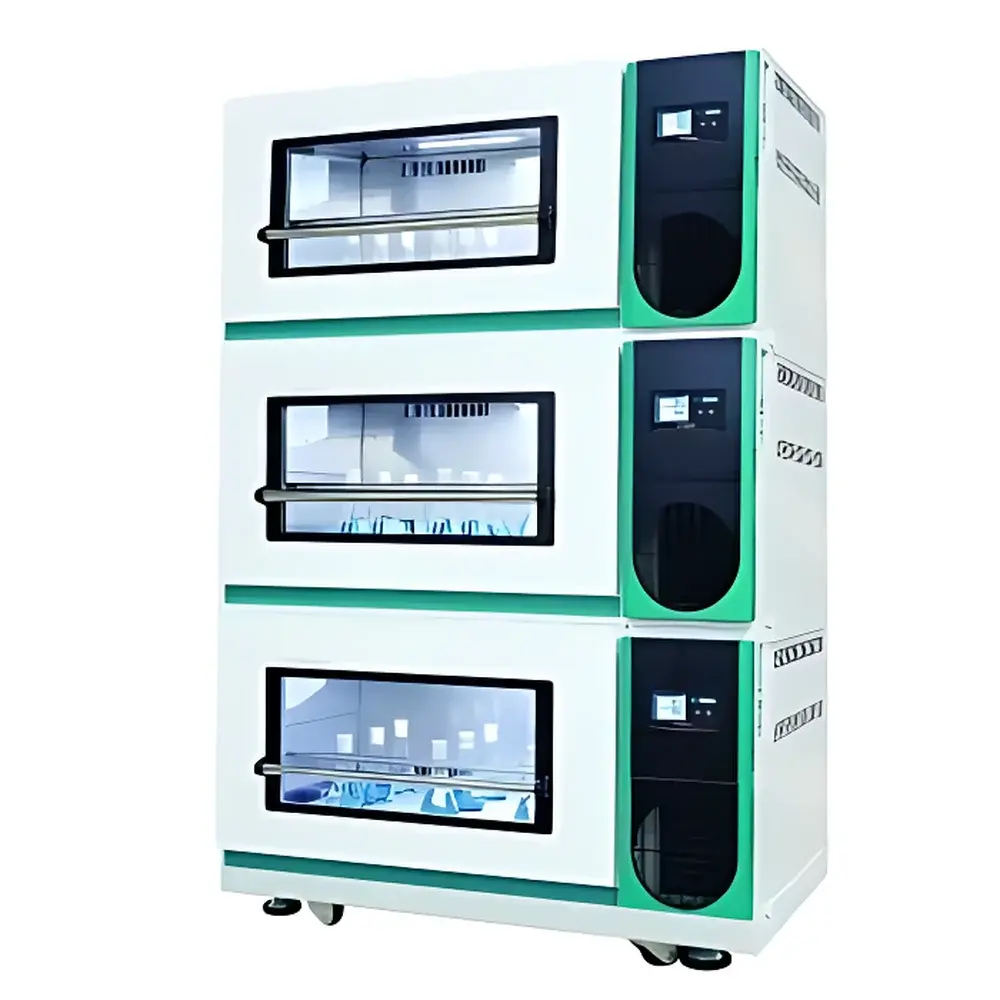
JeioTech ISS-7100/R Stackable Orbital Shaking Incubator
| Brand | JeioTech |
|---|---|
| Origin | South Korea |
| Model | ISS-7100/R |
| Temperature Range | ±0.1 °C (at 37 °C) |
| Temperature Control Range | Ambient −20 °C (min. 4 °C) to 80 °C |
| Orbital Shake Amplitude | 25.4 mm |
| Speed Range | 30–400 rpm (30–250 rpm when stacked) |
| Chamber Volume | 198 L |
| Max Load | 20 kg (44.1 lb) at 400 rpm |
| Display | Touchscreen LCD with PID Controller |
| Compliance | FDA-registered device, GLP/GMP-ready data logging via RS-232/USB |
Overview
The JeioTech ISS-7100/R is a high-capacity, stackable orbital shaking incubator engineered for reproducible cell culture, microbial growth, enzyme assays, and biochemical reaction optimization under precisely controlled temperature and agitation conditions. Utilizing a robust three-cam camshaft drive system coupled with a direct-drive brushless motor, the ISS-7100/R delivers stable, low-vibration orbital motion across its full speed range—ensuring uniform suspension of cultures without shear-induced stress or splashing. Its chamber maintains exceptional thermal stability (±0.1 °C at 37 °C) and uniformity (±0.5 °C), validated per ISO 17025-compliant calibration protocols. The refrigerated variant (ISS-7100/R) employs an environmentally compliant non-CFC refrigerant and features automatic defrost cycling—designed to minimize thermal disturbance while preserving long-term operational integrity in regulated environments.
Key Features
- Stackable 3-tier configuration: Reduces footprint by up to 65% versus standalone units; includes reinforced stacking kits and load-balanced structural supports.
- 198 L chamber accommodates up to six 4 L flasks and thirty-nine 250 mL flasks simultaneously—optimized for high-throughput bioprocessing workflows.
- Lift-up vertical door + pull-out platform: Enables unobstructed access to rear-positioned vessels without disrupting adjacent layers during multi-tier operation.
- Intelligent speed compensation: Real-time load detection adjusts rotational velocity during imbalance events (e.g., uneven vessel distribution or uneven bench surfaces), maintaining consistent orbital kinetics.
- Three independent thermal safety layers: Electronic high/low temperature deviation alarm, digital overtemperature cutoff, and mechanical thermal fuse—fully compliant with IEC 61010-1 safety standards.
- Touchscreen PID controller with 3-point calibration, auto-tuning, and programmable ramp profiles—including smooth acceleration/deceleration to prevent media spillage.
- Integrated RS-232 and USB ports support audit-trail-capable data export (CSV/TXT) for 21 CFR Part 11–compliant laboratories; optional software enables remote monitoring and historical trend analysis.
Sample Compatibility & Compliance
The ISS-7100/R supports standard laboratory glassware (Erlenmeyer flasks, test tubes, culture bottles) and compatible shaker platforms (including universal clamps and spring-loaded holders). Its sealed silicone gasket door and forced-air circulation system ensure minimal humidity loss and spatial temperature homogeneity (<1.5 °C deviation across chamber volume, per ASTM E2232-18 validation methodology). As an FDA-registered device (Registration Number: D3275128), it meets essential design controls under 21 CFR Part 820 and supports GLP/GMP documentation requirements—including timestamped event logs for temperature excursions, door openings, and speed changes. Refrigerated models comply with EU F-Gas Regulation (EU No. 517/2014) and use R134a refrigerant.
Software & Data Management
The embedded controller stores up to 100 user-defined protocols with start/stop timing, speed ramping, and temperature setpoint sequences. All operational parameters—including real-time RPM, chamber temperature, elapsed time, and alarm history—are timestamped and exportable via USB flash drive or serial interface. Optional JeioLink™ PC software provides graphical trend visualization, automated report generation (PDF/Excel), and configurable alert thresholds aligned with internal SOPs. Data integrity safeguards include write-protected memory, password-protected parameter modification, and immutable audit trails meeting ALCOA+ principles.
Applications
- Mammalian and bacterial cell expansion under aerobic conditions requiring precise O2 transfer and thermal consistency.
- Protein expression in E. coli using autoinduction media—where sustained agitation prevents pellet formation and enhances solubility.
- Enzymatic kinetic studies requiring simultaneous temperature control and homogeneous mixing across multi-well formats.
- Seed train preparation for upstream biomanufacturing, including inoculum scaling from shake flasks to benchtop bioreactors.
- Environmental microbiology assays (e.g., BOD, COD, nitrification testing) demanding long-duration incubation with minimal operator intervention.
- Pharmaceutical stability testing per ICH Q1A(R2), where controlled agitation mimics transport-induced mechanical stress on formulations.
FAQ
What is the maximum allowable load when operating three units in a stacked configuration?
When fully stacked, the top unit supports up to 15 kg at 250 rpm; middle and base units retain full 20 kg capacity at 400 rpm—provided all leveling feet are engaged and floor loading exceeds 5 kN/m².
Does the ISS-7100/R support external temperature probes for chamber mapping validation?
Yes—two auxiliary PT100 input channels are available for third-party probe integration; calibration certificates traceable to NIST standards can be supplied upon request.
How does the automatic defrost cycle affect temperature stability during extended runs?
Defrost occurs only when condensation accumulation exceeds threshold limits; chamber temperature deviation remains within ±1.0 °C during active defrost, and recovery to setpoint takes ≤8 minutes post-cycle.
Is the unit suitable for use with volatile organic solvents?
No—this model is not explosion-proof; operation with flammable liquids requires Class I, Division 2–rated enclosures and must comply with NFPA 45 guidelines.
Can the touchscreen interface be locked during unattended overnight operation?
Yes—password-enabled “Operator Lock” mode disables all manual inputs while preserving real-time display and alarm functionality.




