
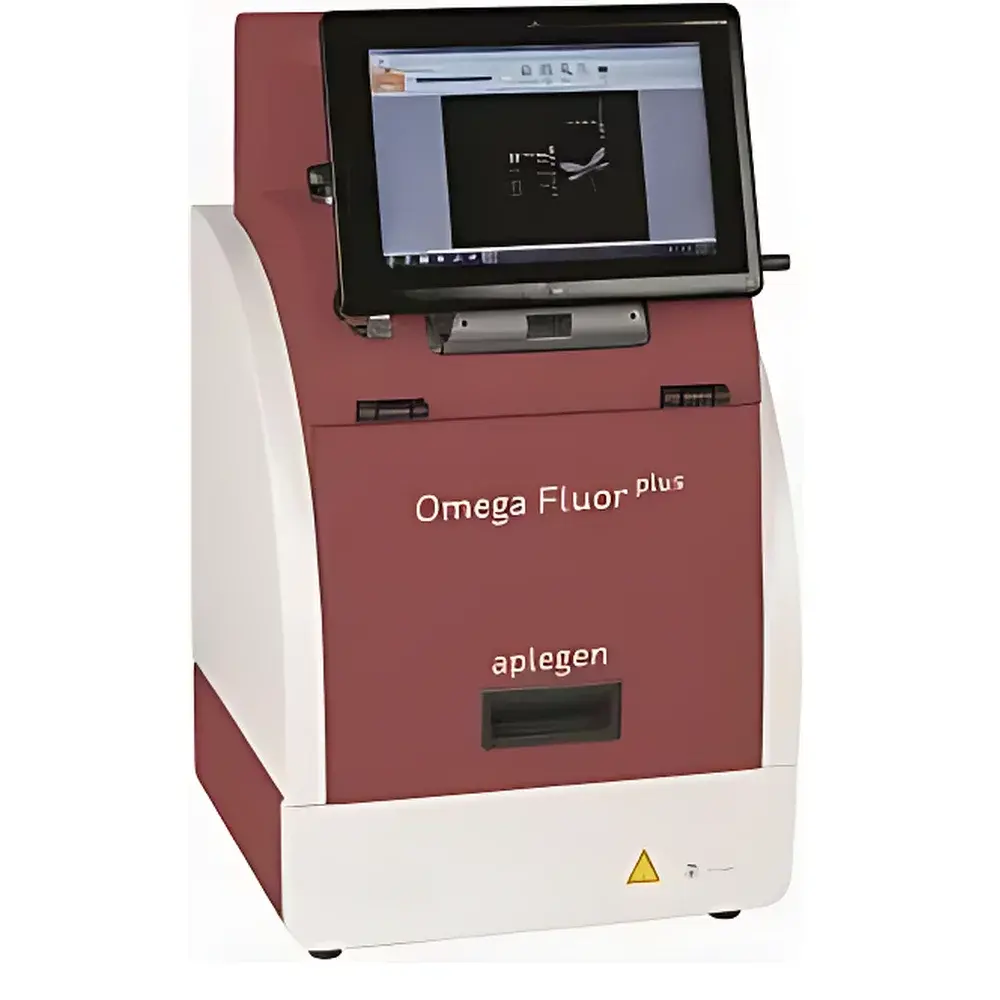
Aplegen Omega Fluor Plus Blue-Light Gel Imaging System
| Brand | Aplegen |
|---|---|
| Origin | USA |
| Manufacturer Type | Authorized Distributor |
| Instrument Type | Standard Gel Imaging System |
| CCD Resolution | 5.0 Megapixels |
| Bit Depth | 12-bit |
| Lens | Fixed F1.4 Aperture Lens |
| Excitation Source | 470 nm Blue LED Array |
| Safety Interlock | UV Door-Activated Power Cutoff |
| Integrated Control | Embedded Touchscreen Tablet |
| Compatible Stains | SYBR® Green, MaestroSafe™, GelGreen™, Ethidium Bromide (EtBr), Coomassie Brilliant Blue, Silver Nitrate |
Overview
The Aplegen Omega Fluor Plus Blue-Light Gel Imaging System is an engineered solution for nucleic acid and protein visualization in molecular biology laboratories. It operates on dual excitation modalities—470 nm high-intensity blue light LEDs for safe, non-mutagenic fluorescence excitation of next-generation DNA dyes, and standard 302 nm UV transillumination for legacy ethidium bromide (EtBr) applications. Unlike conventional UV-based systems, the Omega Fluor Plus eliminates operator exposure to carcinogenic short-wave UV radiation while maintaining quantitative fidelity across gel types. Its optical architecture employs a high-quantum-efficiency 5.0-megapixel monochrome CCD sensor with 12-bit analog-to-digital conversion, enabling linear dynamic range up to 4,096 intensity levels per pixel. The system is calibrated for consistent signal capture across exposure durations (0.1–60 s), supporting both qualitative documentation and semi-quantitative densitometry in compliance with ISO/IEC 17025-aligned laboratory practices.
Key Features
- Integrated 470 nm blue LED excitation module—optimized for SYBR® Green, GelGreen™, and MaestroSafe™ dyes without UV-associated DNA damage or photobleaching
- F1.4 fixed-aperture lens with low-distortion aspheric elements—ensures uniform illumination field and edge-to-edge resolution without motorized focus calibration
- Embedded Android-based touchscreen tablet—enables standalone operation with one-touch acquisition, real-time histogram preview, and auto-exposure optimization
- UV safety interlock circuitry—immediately de-energizes UV lamps upon door opening, meeting IEC 61010-1 Class II electrical safety requirements
- Modular emission filter tray—supports interchangeable bandpass filters (e.g., 520/40 nm for SYBR Green; 590/50 nm for EtBr) to minimize spectral crosstalk
- Compact benchtop footprint (38 × 33 × 35 cm)—designed for shared core facilities and teaching labs with space constraints
Sample Compatibility & Compliance
The Omega Fluor Plus accommodates standard electrophoresis formats including 10 × 10 cm, 15 × 15 cm, and 20 × 20 cm gels, as well as mini-gels (8 × 10 cm) and multi-well plates for colony counting. It supports imaging of agarose and polyacrylamide gels stained with fluorescent nucleic acid dyes, Coomassie Brilliant Blue R-250/G-250, silver nitrate, and fluorescent protein tags (e.g., GFP, mCherry). All image metadata—including exposure time, lens aperture, excitation wavelength, filter ID, and timestamp—is embedded in TIFF headers per EXIF 2.3 specification. The system complies with FDA 21 CFR Part 11 requirements for electronic records when paired with optional audit-trail-enabled software licensing, and meets GLP documentation standards for academic and contract research organizations.
Software & Data Management
Acquisition and analysis are managed through Aplegen’s proprietary GelStudio™ v4.x software suite, pre-installed on the onboard tablet and available for Windows/macOS desktop deployment. The software provides background subtraction, lane/profile analysis, molecular weight estimation using reference ladders, and relative band intensity quantification normalized to internal controls. Export options include publication-ready TIFF, PNG, and PDF formats—with embedded scale bars and annotation layers. Raw image files retain full 12-bit depth for retrospective reprocessing. For LIMS integration, the system supports DICOM-SR export and HL7-compatible metadata tagging, facilitating traceability in clinical research environments governed by CAP or CLIA regulations.
Applications
- DNA fragment analysis in PCR product verification, restriction digest validation, and CRISPR editing efficiency assessment
- RNA integrity evaluation via denaturing agarose gel electrophoresis with SYBR Gold staining
- Protein expression profiling using Coomassie- or silver-stained SDS-PAGE gels
- Colony-forming unit (CFU) enumeration from bacterial or yeast transformation plates
- Fluorescent reporter assay validation (e.g., GFP-tagged constructs under blue-light excitation)
- Educational demonstrations of electrophoretic mobility, dye chemistry, and photophysics principles
FAQ
Does the Omega Fluor Plus support quantitative analysis of band intensities?
Yes—GelStudio™ software applies pixel-value normalization against background and reference lanes, enabling comparative densitometry with coefficient-of-variation (CV) <8% across replicate acquisitions.
Can I use ethidium bromide with this system?
Yes—the integrated 302 nm UV transilluminator is fully functional and includes adjustable intensity control and timed exposure modes.
Is the blue light source sufficient for detecting low-abundance DNA bands?
With SYBR Green I at recommended concentrations (1×), detection sensitivity reaches 0.2 ng per 5 mm band—comparable to optimized UV/EtBr protocols and validated per ASTM D7785-14 guidelines for nucleic acid quantification.
What maintenance is required for long-term optical performance?
The sealed LED array and fixed lens require no alignment or recalibration; routine cleaning of the glass platen with 70% ethanol is the only scheduled maintenance.
How is data integrity ensured during regulatory audits?
All acquisitions generate immutable .TIFF files with embedded EXIF metadata, and optional software licensing enables user-authenticated audit trails compliant with 21 CFR Part 11 Subpart B §11.10 and §11.30.






