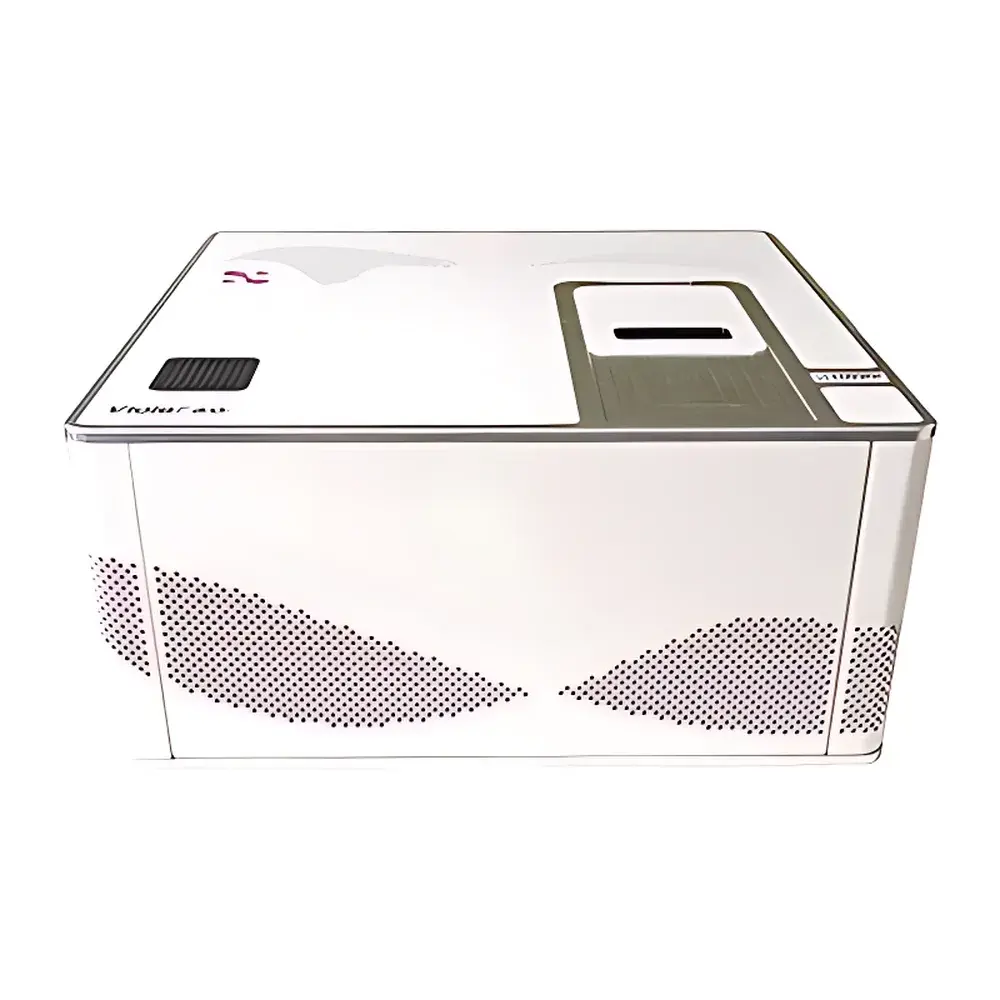
Hawk Biosystems Violet 3.0 In Situ Protein Functional Quantification System
| Brand | Hawk Biosystems |
|---|---|
| Origin | Spain |
| Model | Violet 3.0 |
| Application Field | Research |
| Technology | Fluorescence Lifetime Imaging Microscopy (FLIM) coupled with Förster Resonance Energy Transfer (FRET) |
| Scanning Mode | Whole-Slide Imaging |
| Throughput | High-throughput |
| Operation | Fully Automated |
| Form Factor | Benchtop |
| Spatial Resolution | < 10 nm (FRET-limited) |
| Slide Capacity | 4 standard microscope slides or 1 microplate |
| Motion Control | Precision motorized XYZ stage with autofocus and Z-stack acquisition |
Overview
The Hawk Biosystems Violet 3.0 is a benchtop, fully automated in situ protein functional quantification system engineered for high-precision, spatially resolved analysis of protein conformational states and molecular interactions directly within fixed biological specimens. It leverages time-resolved fluorescence detection—specifically Fluorescence Lifetime Imaging Microscopy (FLIM)—in combination with Förster Resonance Energy Transfer (FRET) to quantify functional protein dynamics at nanoscale resolution. Unlike intensity-based fluorescence assays, FLIM measures the exponential decay kinetics of donor fluorophore emission, rendering quantification insensitive to photobleaching, excitation intensity fluctuations, and variations in probe concentration. When two FRET-paired fluorophores (e.g., CFP/YFP or mTurquoise2/sYFP2) are brought into proximity (< 10 nm) due to protein–protein interaction, post-translational modification, or conformational rearrangement, the donor’s fluorescence lifetime shortens predictably. Violet 3.0 detects this lifetime shift with sub-nanosecond temporal resolution across entire tissue sections or cell monolayers, enabling quantitative mapping of functional protein states without requiring calibration standards or reference controls.
Key Features
- FRET-FLIM dual-modality platform optimized for endogenous and exogenous labeling strategies in fixed samples
- Sub-10 nm functional resolution enabled by picosecond-resolution time-correlated single-photon counting (TCSPC)
- Automated whole-slide scanning with intelligent focus tracking and adaptive Z-stack acquisition for thick tissue sections
- Four-channel LED excitation source (375 nm, 445 nm, 515 nm, 630 nm) supporting multiplexed FRET pair validation and spectral unmixing
- Benchtop architecture with integrated environmental shielding for stable thermal and vibration performance during long-duration acquisitions
- High-throughput sample handling: accommodates up to four 1 × 3 inch glass slides or one 96-/384-well microplate per run
- Patented signal amplification algorithm that enhances acceptor-sensitized emission while suppressing autofluorescence background from formalin-fixed paraffin-embedded (FFPE) tissues
Sample Compatibility & Compliance
Violet 3.0 is validated for use with routinely processed clinical and research specimens, including formalin-fixed paraffin-embedded (FFPE) tissue sections, frozen sections, fixed cell monolayers on coverslips, and adherent cells cultured in multiwell plates. The system supports standard immunofluorescence and proximity ligation assay (PLA)-compatible staining protocols. All optical and mechanical components comply with IEC 61000-6-3 (EMC emissions) and IEC 61000-6-2 (immunity) standards. Data acquisition workflows adhere to GLP-aligned documentation practices, with optional audit trail logging and user access control modules available to support 21 CFR Part 11 compliance for regulated preclinical studies.
Software & Data Management
The proprietary VioletStudio software suite provides end-to-end workflow automation—from acquisition parameter setup and real-time lifetime histogram visualization to pixel-wise τ-mean/τ-amplitude fitting and spatial correlation mapping. Built-in algorithms perform phasor plot analysis, biexponential decay deconvolution, and FRET efficiency calculation using both donor-only and donor–acceptor lifetime references. Export formats include TIFF (with embedded metadata), CSV (lifetime parameters per ROI), and standardized OME-TIFF for interoperability with QuPath, ImageJ/Fiji, and HALO digital pathology platforms. Raw TCSPC data files are stored in vendor-neutral SPC format, ensuring long-term archival integrity and third-party analysis compatibility.
Applications
- Protein–protein interaction profiling in tumor microenvironments using FFPE archival tissues
- Quantitative assessment of receptor dimerization kinetics following therapeutic antibody or ADC treatment
- Spatiotemporal mapping of phosphorylation-dependent conformational changes in signaling proteins (e.g., EGFR, AKT)
- Detection of protein–DNA binding events via FRET-coupled DNA-binding domain reporters
- Validation of CRISPR-edited protein variants exhibiting altered folding stability or interaction affinity
- Multi-target functional co-localization in multiplexed IHC/IF panels without spectral overlap constraints
FAQ
Does Violet 3.0 require specialized fluorophore labeling?
Yes—optimal performance requires FRET-compatible donor–acceptor pairs with well-characterized lifetimes and minimal spectral crosstalk. Hawk Biosystems provides validated antibody conjugates and recombinant protein tags (e.g., NanoBiT, SNAP-tag) optimized for Violet 3.0.
Can it image live cells?
No—Violet 3.0 is designed exclusively for fixed, static specimens. Its FLIM engine prioritizes photon collection efficiency and temporal precision over speed, making it unsuitable for dynamic live-cell imaging.
Is FFPE tissue compatibility validated across tissue types?
Yes—performance has been verified on human breast, lung, colon, and brain FFPE sections, with standardized antigen retrieval and staining protocols included in the system’s application notes.
How is data reproducibility ensured across instruments?
Each Violet 3.0 undergoes factory calibration using NIST-traceable fluorescent reference standards, and daily QC routines include lifetime reference slide validation to maintain inter-unit consistency within ±0.05 ns tolerance.
What level of technical support is provided for method development?
Hawk Biosystems offers remote application consulting, protocol optimization workshops, and collaborative validation studies through its European Application Support Center in Barcelona.
Related Products