
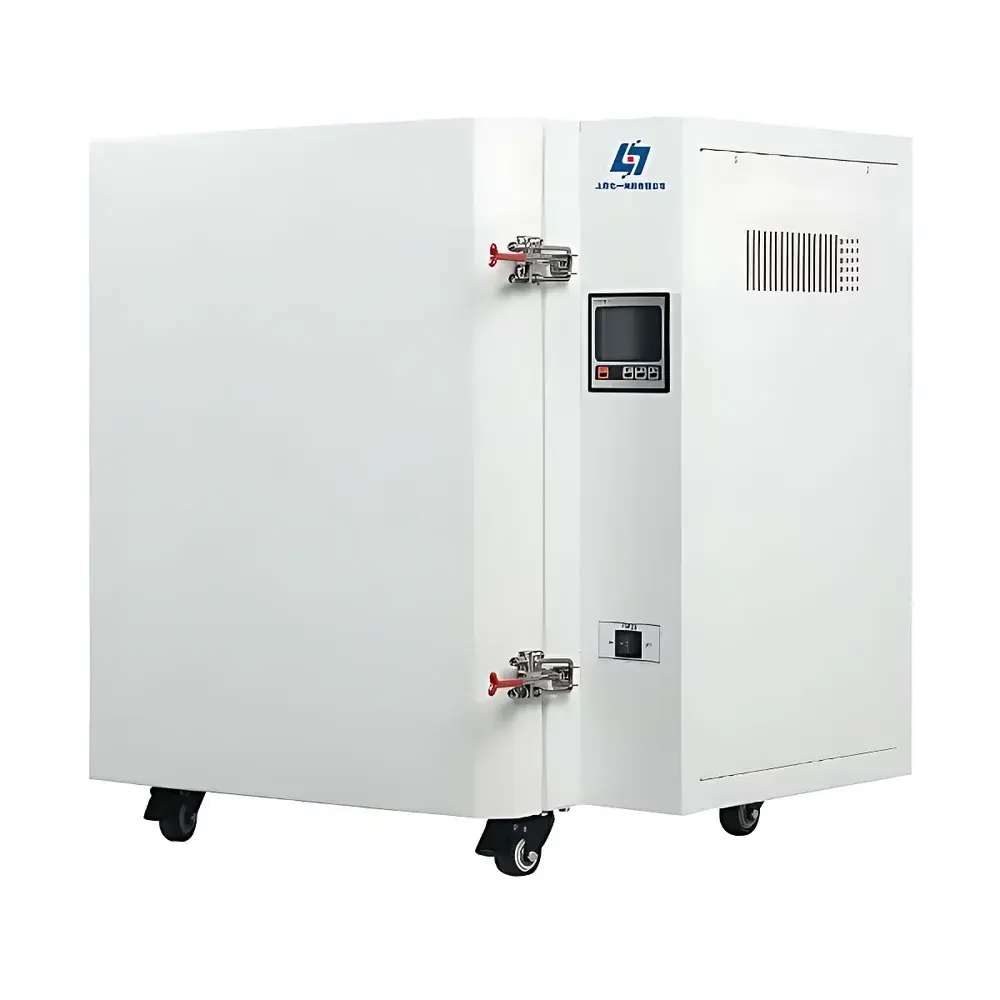
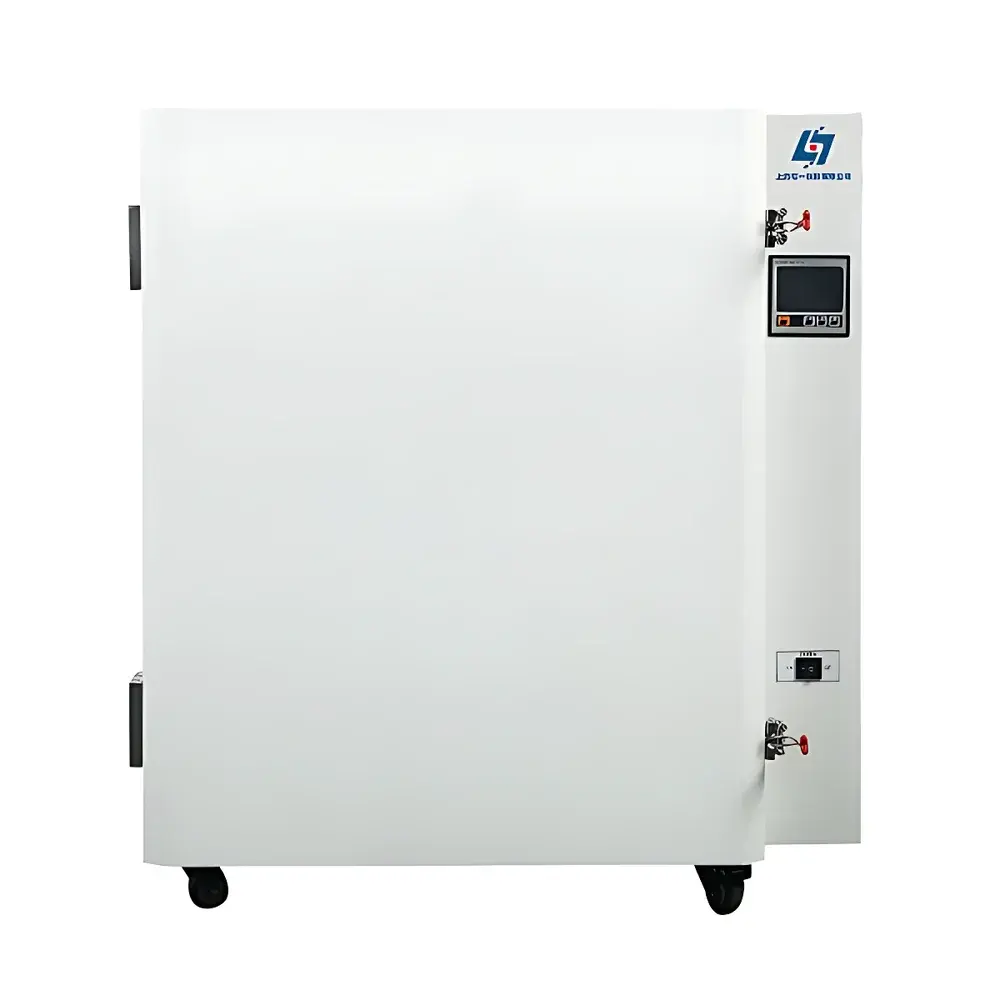
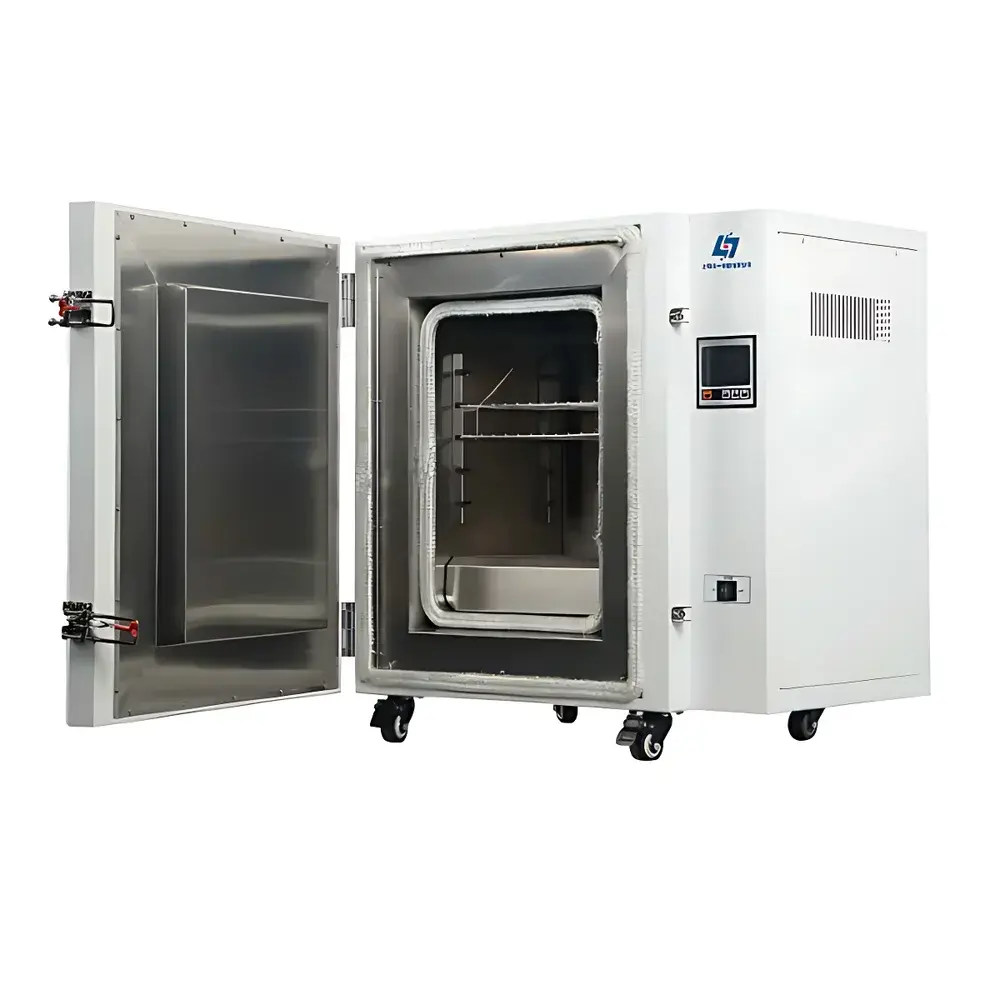
Yoyilab DHG-9249A High-Temperature Forced-Air Drying Oven (500 °C Max)
| Brand | Yoyilab |
|---|---|
| Origin | Shanghai, China |
| Manufacturer Type | Direct Manufacturer |
| Model | DHG-9249A |
| Temperature Range | RT+20 °C to 500 °C |
| Temperature Uniformity | ±2.5% at 100 °C |
| Temperature Fluctuation | ±2 °C |
| Temperature Resolution | ±1 °C |
| External Dimensions (W×D×H) | 870×780×1100 mm |
| Internal Chamber Dimensions (W×D×H) | 500×600×750 mm |
| Chamber Volume | 225 L |
| Chamber Material | Mirror-Finish Stainless Steel (SUS304) |
| Heating Method | Forced-Air Convection with Multi-Blade Centrifugal Fan |
| Insulation | High-Density Glass Fiber Blanket |
| Door Seal | Dual-Layer Ceramic Rope Gasket |
| Power Supply | AC 380 V, 50 Hz |
| Input Power | 5.5 kW |
| Standard Accessories | 2 Adjustable Stainless Steel Shelves, 4.3″ TFT LCD Controller with PID Algorithm, Auto-Restart after Power Failure, Parameter Memory Backup |
Overview
The Yoyilab DHG-9249A is a high-temperature forced-air drying oven engineered for precision thermal processing in industrial quality control laboratories, materials research facilities, and production R&D environments. Designed to operate continuously at temperatures up to 500 °C, it employs a robust convection heating architecture based on ISO 188–2011 and ASTM D573–20 standard methodologies for thermal aging and drying validation. The unit integrates a preheated air mixing chamber upstream of the working chamber, ensuring rapid thermal ramping and minimizing cold-spot formation during extended high-temperature holds. Its structural design complies with IEC 61010-1:2010 safety requirements for laboratory electrical equipment, with dual thermal protection layers—primary PID-controlled heating and an independent mechanical overtemperature cutoff (optional)—to meet GLP-compliant operational safeguards.
Key Features
- Microprocessor-based PID temperature controller with 4.3-inch TFT LCD interface, supporting setpoint programming, real-time monitoring, timer function (1–9999 minutes), and auto-tuning capability
- Forced-air circulation system utilizing a multi-blade centrifugal fan and internal baffle-guided airflow path, achieving ≤±2.5% temperature uniformity across the chamber at 100 °C per ASTM E145–21 Annex A3
- Chamber constructed from mirror-finish SUS304 stainless steel with seamless welded corners; interior surface passivated for oxidation resistance under sustained 500 °C exposure
- High-efficiency thermal insulation comprising ≥100 mm thick glass fiber blanket between double-walled chamber and outer cold-rolled steel housing (electrostatically coated)
- Dual-layer ceramic rope door gasket rated for continuous operation at 550 °C, ensuring long-term sealing integrity and minimal heat leakage
- Preheat cavity design enables rapid air reheating and homogeneous distribution before entering the main chamber—reducing stabilization time by up to 35% compared to conventional ducted ovens
- Power-failure recovery mode retains all programmed parameters and resumes operation upon grid restoration, maintaining data continuity in regulated environments
Sample Compatibility & Compliance
The DHG-9249A accommodates a broad range of sample formats including metal coupons, polymer specimens, ceramic substrates, catalyst pellets, and coated components. Its chamber dimensions (500 × 600 × 750 mm) support standard ASTM G151–21 exposure trays and ISO 3270–2017 test panels. The oven meets functional requirements for thermal aging per ISO 188:2011, vulcanization testing per ASTM D573–20, and moisture removal validation per USP . Optional accessories—including RS485 Modbus RTU interface and embedded thermal printer—enable integration into 21 CFR Part 11–compliant data acquisition workflows when paired with validated third-party software.
Software & Data Management
While the base unit operates via standalone microcontroller firmware, optional RS485 communication enables bidirectional data exchange with external SCADA or LIMS platforms. The included protocol supports real-time temperature logging, alarm event reporting (e.g., overtemp, door open), and remote setpoint adjustment. When configured with the optional embedded thermal printer, the system generates timestamped hardcopy records compliant with ALCOA+ principles—ensuring attributable, legible, contemporaneous, original, accurate, complete, consistent, enduring, and available documentation. Audit trail functionality is available through compatible supervisory software deployed on Windows-based host systems.
Applications
- Thermal aging of elastomers, composites, and aerospace-grade adhesives per MIL-STD-810H Method 506.6
- Drying of high-purity ceramic powders and battery cathode precursors prior to sintering
- Stress-relief annealing of machined aluminum and stainless steel components
- Moisture content verification in pharmaceutical excipients and active ingredients (ICH Q5C)
- Curing of high-temperature epoxies and polyimide coatings used in PCB manufacturing
- Accelerated life testing of electronic encapsulants and conformal coatings
- Pre-conditioning of reference standards for thermogravimetric analysis (TGA) and differential scanning calorimetry (DSC)
FAQ
What is the maximum continuous operating temperature of the DHG-9249A?
The chamber is rated for continuous operation at 500 °C, verified per manufacturer thermal mapping reports conducted at three load conditions (empty, half-load, full-load) using NIST-traceable Class A PT100 sensors.
Does the oven support programmable ramp-soak profiles?
The standard controller supports single-stage timing; however, the optional intelligent program controller (part #IPC-DHG) enables up to 30 segment ramp-hold sequences with adjustable rate limits and loop logic.
Is the unit suitable for inert atmosphere applications?
No. The DHG-9249A is not gas-tight and lacks purge ports or pressure regulation. For nitrogen or argon environments, consider Yoyilab’s specialized inert-gas-compatible series (e.g., NGF-9249A).
Can I validate temperature uniformity per ISO/IEC 17025 requirements?
Yes. The chamber geometry, sensor mounting provisions (via optional 25 mm or 50 mm test ports), and documented uncertainty budget (<±0.8 °C k=2 at 300 °C) support formal validation per ILAC-G8:2021 guidelines.
What maintenance intervals are recommended for long-term 500 °C operation?
Fan bearings and door gaskets should be inspected every 500 operating hours; ceramic rope seals typically last ≥6,000 hours at 450 °C but require replacement after 3,000 hours at peak 500 °C duty cycles.



