
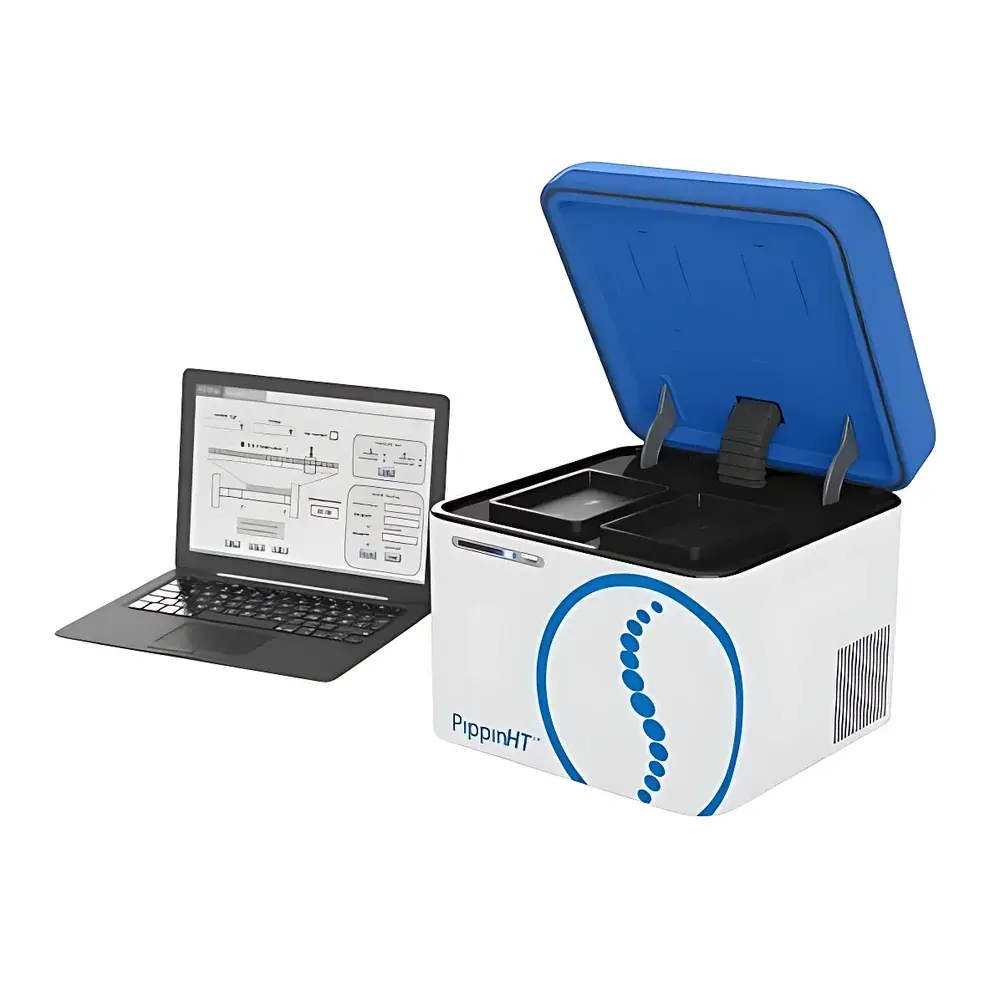
Pippin HT High-Throughput Automated DNA Fragment Recovery System
| Brand | Sage Science |
|---|---|
| Origin | USA |
| Manufacturer Type | Authorized Distributor |
| Instrument Type | Magnetic Bead-Based Purification |
| Automation Level | Dedicated Fully Automatic |
| Throughput | 24 Samples per Run |
| Sample Volume Range | 20–100 µL |
| Processing Time | ~30 Minutes per Run |
| Compliance | Designed for ISO 13485–aligned workflows and compatible with GLP/GMP documentation requirements |
Overview
The Pippin HT High-Throughput Automated DNA Fragment Recovery System is a dedicated, fully automated nucleic acid purification platform engineered for precision size selection and recovery of DNA fragments in next-generation sequencing (NGS) library preparation workflows. Leveraging proprietary magnetic bead-based chemistry and integrated electrophoretic fractionation, the system performs automated binding, washing, elution, and size-based recovery—all within a single, unattended run. Unlike conventional gel-based or manual column-based methods, the Pippin HT eliminates human variability and inter-run inconsistency by standardizing fragment excision thresholds, buffer exchange kinetics, and magnetic separation dynamics. Its architecture is optimized for reproducible recovery of DNA fragments ranging from 100 bp to 10 kb, with minimal bias across GC-rich or AT-rich regions—critical for uniform library complexity and reduced duplication rates in Illumina, PacBio, and Oxford Nanopore applications.
Key Features
- Dedicated fully automatic operation: No manual pipetting, gel excision, or column handling required—entire workflow initiated with one touchscreen command.
- 24-sample parallel processing: Simultaneous recovery across two 12-lane cassette modules, enabling batch scalability without compromising resolution or yield.
- Electrophoretically guided size selection: Real-time current monitoring and voltage-controlled migration ensure sub-50 bp resolution and consistent fragment cutoffs (e.g., 300 ± 15 bp, 550 ± 20 bp).
- Integrated magnetic bead handling: On-instrument bead resuspension, binding, wash cycles (3×), and low-volume elution (15–30 µL) minimize carryover and maximize recovery efficiency (>85% for 300–700 bp fragments).
- Pre-validated, lot-tested reagent kits: Sage Science’s Pippin HT Buffer Kits and Bead Slurries are manufactured under controlled conditions and certified for lot-to-lot consistency, supporting audit-ready documentation.
- Compact benchtop footprint (46 × 51 × 43 cm): Designed for integration into core genomics facilities without requiring dedicated cleanroom space or external ventilation.
Sample Compatibility & Compliance
The Pippin HT accepts input DNA from enzymatic fragmentation (e.g., tagmentation, sonication, enzymatic shearing), PCR-amplified libraries, and adapter-ligated products. It supports double-stranded DNA only; RNA, ssDNA, or modified nucleotides (e.g., biotinylated, phosphorylated) require protocol validation prior to routine use. All consumables—including cassettes, buffers, and beads—are supplied as sterile, nuclease-free components compliant with ISO 11137 (radiation sterilization) and ISO 13485 (medical device quality management). The system’s electronic logbook records timestamped run parameters, operator ID, reagent lot numbers, and thermal/electrical diagnostics—enabling traceability aligned with FDA 21 CFR Part 11 and EU Annex 11 expectations for regulated environments.
Software & Data Management
Controlled via the Pippin HT Software Suite (v4.2+), the system provides role-based user access, audit-trail-enabled method editing, and encrypted local data storage. Each run generates a standardized .csv report containing fragment size distribution histograms, recovered mass (ng), CV% of band intensity across lanes, and QC flags for voltage drift or bead aggregation. Raw electropherogram data (.pht files) are exportable for third-party analysis or LIMS integration (HL7 v2.5 and ASTM E1384-compliant metadata tagging). Software updates are delivered through secure, signed firmware packages with SHA-256 verification—no internet connectivity required during operation.
Applications
- NGS library size selection for whole-genome sequencing, exome capture, ChIP-seq, and RNA-seq.
- Removal of primer dimers and adapter artifacts post-ligation or PCR cleanup.
- Targeted enrichment workflows requiring narrow size windows (e.g., 150–250 bp for single-cell ATAC-seq).
- Quality control of fragmented genomic DNA prior to library construction.
- High-fidelity recovery of long-read sequencing templates (e.g., >5 kb fragments for PacBio HiFi or ONT ultra-long reads).
FAQ
What input DNA concentration range is recommended for optimal recovery?
For consistent size selection and high yield, input should be 10–100 ng total DNA per lane (20–100 µL volume), with fragment distribution verified by Bioanalyzer or TapeStation prior to loading.
Can the Pippin HT process samples prepared with non-Sage Science enzymes or adapters?
Yes—provided the sample contains no residual EDTA (>0.1 mM), high salt (>50 mM NaCl), or glycerol (>5%), all of which interfere with magnetic bead binding kinetics.
Is method validation required for GLP-compliant studies?
Yes—users must perform in-house system suitability testing (SST) per SOP, including recovery linearity (50–500 ng), repeatability (n=6 replicates), and size accuracy against NIST-traceable DNA ladders.
How often does the instrument require maintenance calibration?
No routine calibration is needed; however, quarterly performance verification using the Sage Science QC Cassette Kit is recommended to confirm voltage stability, temperature uniformity, and bead dispersion fidelity.



