
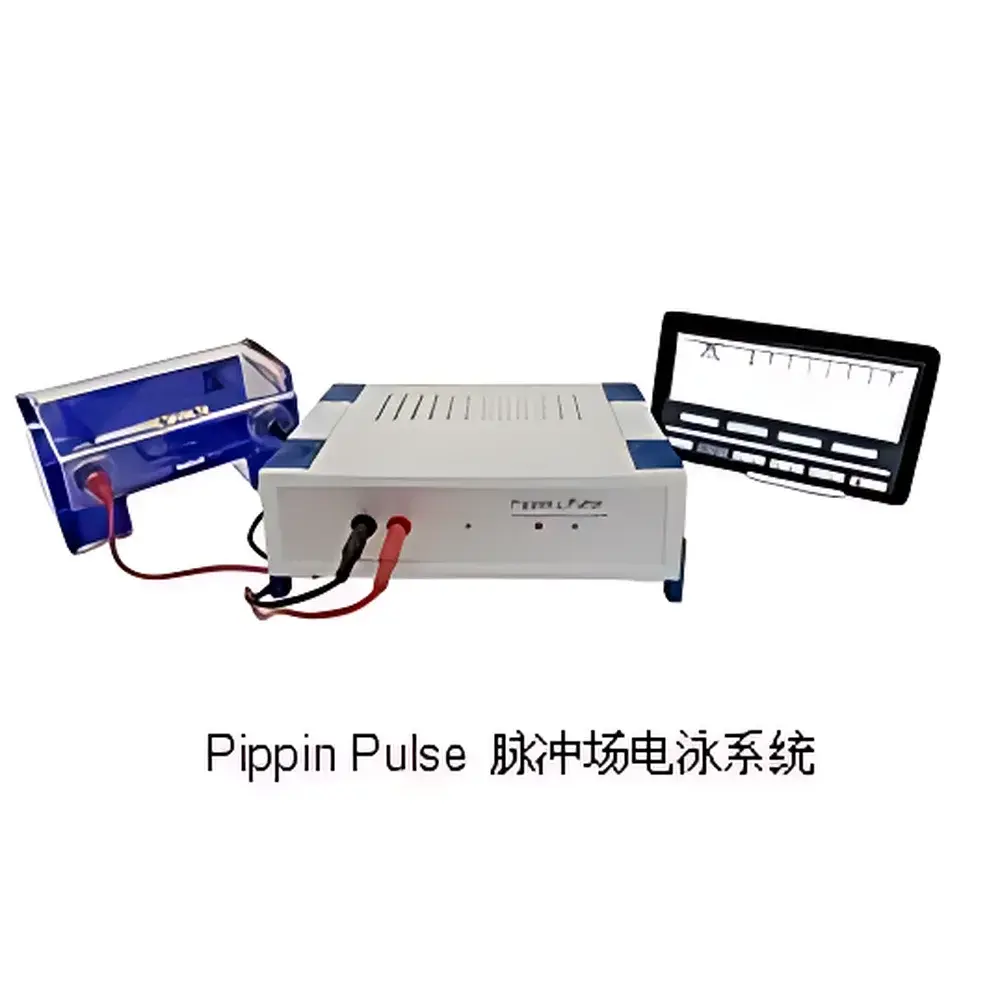
Pippin Pulse Pulsed-Field Electrophoresis System
| Brand | Sage Science |
|---|---|
| Origin | USA |
| Model | Pippin Pulse |
| Instrument Type | Nucleic Acid Pulsed-Field Electrophoresis System |
| Voltage Range | 25–150 V |
| Max Current | 120 mA |
| Software | Preconfigured & User-Editable Field Inversion Protocols |
Overview
The Pippin Pulse Pulsed-Field Electrophoresis System is an engineered platform for high-resolution separation of large DNA fragments ranging from >100 bp up to several hundred kilobases. Unlike conventional slab-gel electrophoresis, which relies on constant-field migration and exhibits limited resolution above ~20 kb, the Pippin Pulse implements controlled alternating electric fields—typically via orthogonal or rotating field configurations—to enable reorientation-based mobility differentiation among megabase-sized DNA molecules. This principle, grounded in the principles of contour-length-dependent reorientation kinetics and time-dependent field inversion, allows precise sizing and recovery of intact genomic DNA, restriction-digested chromosomes, CRISPR-edited large inserts, and synthetic long-read library fragments. Designed for reproducible, hands-off operation in core genomics and sequencing preparation labs, the system integrates a compact, temperature-stabilized electrophoresis chamber with real-time voltage monitoring and programmable pulse timing logic.
Key Features
- Programmable pulsed-field electrophoresis engine supporting both CHEF (Contour-Clamped Homogeneous Electric Fields) and FIGE (Field-Inversion Gel Electrophoresis) modalities through software-defined electrode switching sequences.
- Adjustable voltage output from 25 V to 150 V DC, with precision regulation and active current limiting up to 120 mA to prevent gel overheating or buffer depletion during extended runs.
- Dedicated electrophoresis chamber with integrated cooling plate and buffer recirculation path to maintain thermal uniformity across the gel matrix (±0.5 °C over 18-h run).
- Three factory-validated, application-optimized protocols preloaded in firmware: (1) High-resolution 1–70 kb fragment separation, (2) Megabase-range chromosome banding (50–1,000 kb), and (3) Targeted size-selection for PacBio SMRTbell or Oxford Nanopore ultra-long library prep.
- Modular gel tray design compatible with standard 14 × 14 cm agarose gels (0.5–1.2% w/v), including low-melt and pulsed-field–optimized matrices; accommodates both ethidium bromide and SYBR Gold-compatible staining workflows.
Sample Compatibility & Compliance
The Pippin Pulse supports native, nicked, linearized, and supercoiled double-stranded DNA templates without requiring enzymatic dephosphorylation or denaturation. It is routinely employed in applications compliant with ISO/IEC 17025-accredited laboratory practices for nucleic acid integrity assessment, as well as in GLP-regulated environments where traceable electrophoretic documentation is required. While the instrument itself does not include built-in imaging, its output gels are fully compatible with downstream UV transillumination, CCD-based gel documentation systems, and digital densitometry per ASTM D7689-22 (Standard Guide for Quantitative Analysis of Nucleic Acids by Gel Electrophoresis). All electrical components conform to UL 61010-1 and IEC 61010-1 safety standards for laboratory equipment.
Software & Data Management
Control and protocol management are handled via the proprietary Pippin Pulse Control Suite (v3.x), a Windows-based application that provides audit-trail logging compliant with FDA 21 CFR Part 11 requirements—including user authentication, electronic signatures, and immutable run history export (CSV/XML). The software enables full customization of pulse duration (1–999 sec), forward/reverse field ratio (1:1 to 5:1), switch angle (0°–180°), and ramping profiles. Each run generates a timestamped metadata file containing voltage waveform logs, current draw curves, and thermal sensor readings—facilitating root-cause analysis during method validation or troubleshooting. Exported data integrates natively with LabVantage LIMS and Benchling ELN platforms via RESTful API endpoints.
Applications
- Size selection of long-read sequencing libraries (e.g., >20 kb fragments for PacBio HiFi or ONT ultra-long reads)
- Verification of CRISPR/Cas9-mediated large genomic deletions or insertions (>5 kb)
- Quality control of BAC/YAC/PAC clones and synthetic genome constructs
- Analysis of chromosomal rearrangements in cancer cytogenetics (e.g., detection of translocations, inversions, and aneuploidy)
- Recovery of intact mitochondrial or chloroplast DNA from plant and animal tissues
- Preparative isolation of restriction fragments for Southern blotting or next-generation mapping assays
FAQ
What buffer systems are recommended for use with the Pippin Pulse?
Tris-Acetate-EDTA (TAE) and Tris-Borate-EDTA (TBE) are both validated; TAE is preferred for downstream enzymatic processing due to lower borate interference.
Can the Pippin Pulse be used for RNA separation?
No—it is optimized exclusively for double-stranded DNA; RNA requires denaturing conditions and specialized buffers incompatible with the system’s thermal and field parameters.
Is gradient gel capability supported?
The hardware supports uniform agarose concentration only; gradient gels require manual casting and are not automated or validated by Sage Science.
Does the system support remote monitoring or networked operation?
Yes—via Ethernet-connected host PC with static IP assignment; real-time status polling and emergency shutdown are accessible through the Control Suite’s web service interface.
What maintenance is required between runs?
Routine cleaning of electrode contacts and chamber seals with deionized water; annual calibration of voltage/current sensors is recommended per ISO/IEC 17025 internal quality procedures.




