
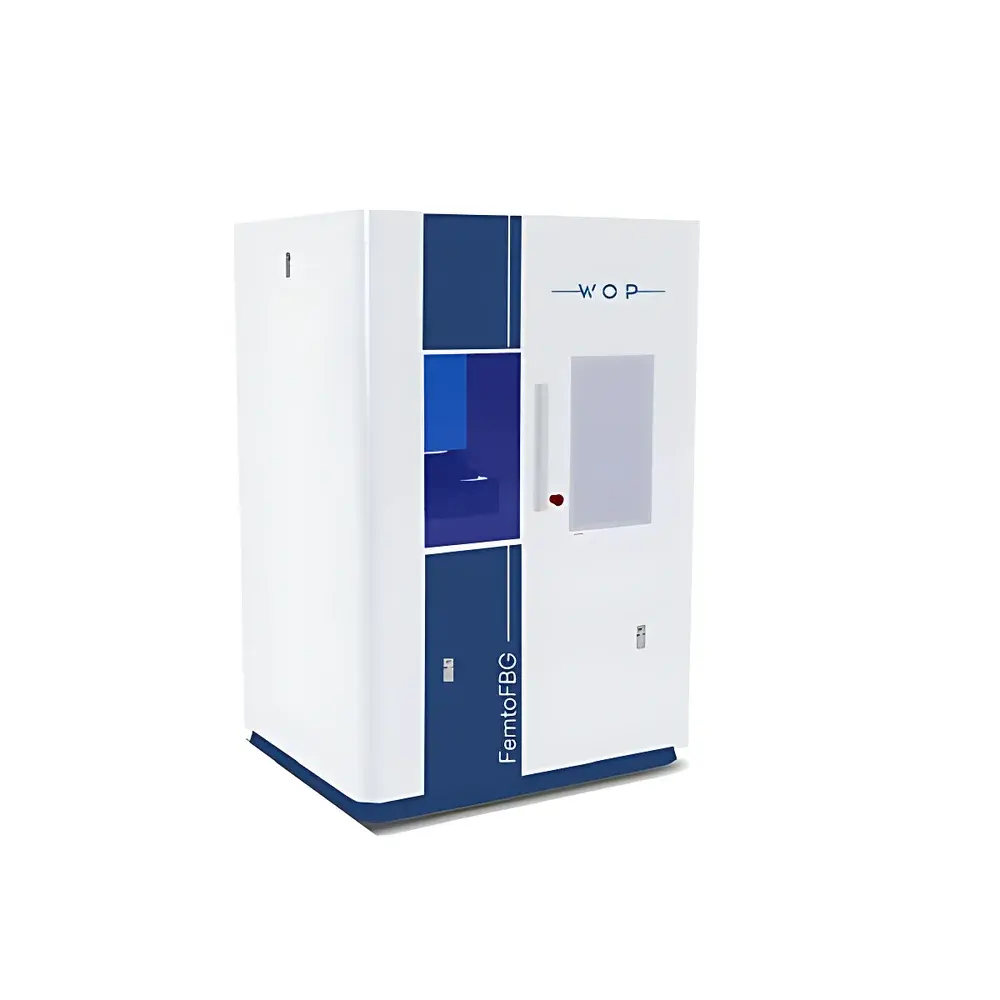
Workshop of Photonics FemtoFBG Femtosecond Fiber Bragg Grating Writing System
| Brand | Workshop of Photonics (WOP) |
|---|---|
| Origin | Lithuania |
| Model | FemtoFBG |
| Laser Type | Solid-State Femtosecond Oscillator + Amplifier |
| Writing Methods | Point-by-Point (PbP), Line-by-Line (LbL), Plane-by-Plane |
| Minimum Grating Pitch | ~1 µm |
| Phase-Mask-Free Operation | Yes |
| Compatible Fibers | Single-Mode, Dual-Clad, Multi-Core, Photonic Crystal, and Specialty Fibers |
| Max Fiber Diameter | 1 mm |
| Integrated Autofocus (FCA) | Standard |
| Polarization Control | Standard |
| Precision Positioning & Scanning Stage | Standard |
| Optional Configuration | Dual-Wavelength Laser, Phase-Mask-Assisted Writing, Apodization Engine |
Overview
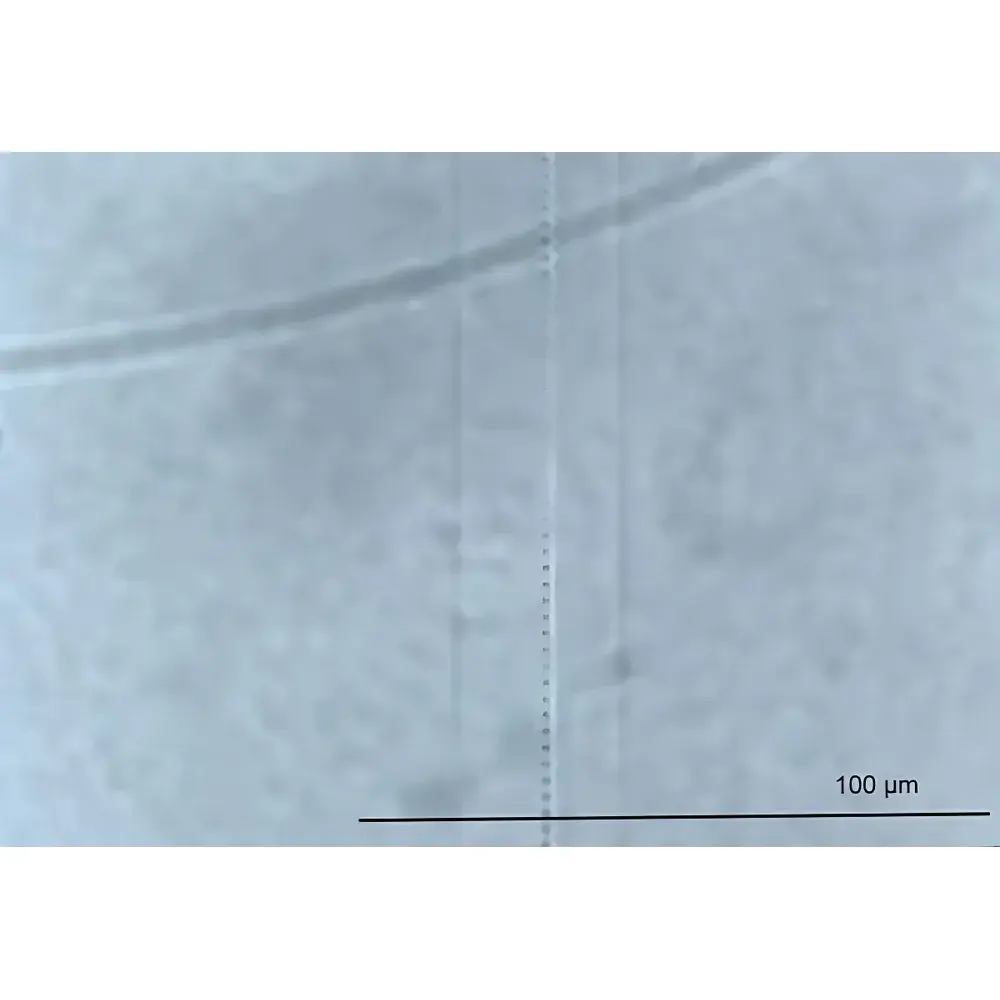
The Workshop of Photonics FemtoFBG is a turnkey femtosecond laser microfabrication workstation engineered specifically for high-precision, maskless inscription of Fiber Bragg Gratings (FBGs) in diverse optical fiber platforms. Unlike excimer-laser-based systems that rely on periodic phase masks and suffer from UV-induced degradation and alignment sensitivity, the FemtoFBG leverages near-infrared (NIR) ultrafast laser pulses to induce localized nonlinear refractive index modifications inside the fiber core via multiphoton absorption and plasma formation. This non-thermal, diffraction-limited process enables sub-micrometer spatial resolution (~1 µm pitch), exceptional grating uniformity, and intrinsic compatibility with photosensitive and non-photosensitive fibers—including single-mode (SMF), dual-clad, multi-core, and photonic crystal fibers—without requiring oil immersion or hydrogen loading. The system operates on the principle of direct laser writing (DLW), supporting three fundamental inscription modalities: point-by-point (PbP), line-by-line (LbL), and plane-by-plane (PbP), each selectable based on spectral target, length scalability, and apodization requirements.
Key Features
- Femtosecond solid-state laser source with tunable repetition rate and pulse energy control, optimized for stable, long-term index modification in silica and specialty glasses.
- Integrated high-resolution 3-axis motorized translation stage with nanometer-level closed-loop feedback, enabling precise grating period definition and axial positioning repeatability better than ±50 nm.
- Real-time beam delivery path stabilization using active interferometric monitoring, ensuring consistent focus geometry across extended write lengths (>10 m).
- Automated fiber centering and autofocus (FCA) module with vision-based alignment, eliminating manual calibration and reducing setup time per sample by >70%.
- Onboard polarization control unit with motorized half-wave plates and polarimeters, allowing deterministic birefringence engineering and polarization-dependent grating design.
- Modular architecture supporting field-upgradable configurations: dual-wavelength operation (e.g., 1030 nm + 515 nm), phase-mask-assisted writing for high-throughput standard FBGs, and custom apodization algorithms for sidelobe suppression.
Sample Compatibility & Compliance
The FemtoFBG supports a broad spectrum of optical fiber geometries and material systems. It has been validated for FBG inscription in standard SMF-28, erbium-doped dual-clad fibers (e.g., Nufern EDF-16/13/0.2), 7- and 19-core multicore fibers (MCFs), hollow-core photonic bandgap fibers, and fluoride-based mid-IR fibers. All mechanical handling modules comply with ISO 14644-1 Class 5 cleanroom integration standards. The system’s motion control firmware adheres to IEC 61508 SIL2 functional safety requirements for industrial laser equipment. While not certified as a medical device, its output parameters and process logs are structured to support GLP-compliant documentation workflows required in regulated R&D environments (e.g., photonics component qualification per Telcordia GR-1221-CORE).
Software & Data Management
Control is executed through WOP’s proprietary FemtoWrite Suite—a Windows-based application built on Qt and Python 3.9, featuring a modular GUI with dedicated tabs for laser parameter configuration, scan trajectory programming, real-time power/position logging, and post-write spectral simulation. All acquisition data—including pulse energy per spot, stage coordinates, polarization state, and ambient temperature/humidity—are timestamped and stored in HDF5 format with embedded metadata compliant with FAIR (Findable, Accessible, Interoperable, Reusable) principles. Audit trails record user actions, parameter changes, and system errors with SHA-256 hashing for integrity verification—fully compatible with FDA 21 CFR Part 11 electronic signature and record retention requirements when deployed in GxP-aligned laboratories.
Applications
- Development of ultra-stable, narrow-linewidth FBGs for distributed acoustic sensing (DAS) and seismic monitoring arrays.
- Multi-parameter sensing gratings in dual-clad fibers for simultaneous temperature/strain/pressure discrimination in downhole oil & gas instrumentation.
- Complex apodized and chirped FBGs used as dispersion compensation elements in coherent optical communications (C-band & L-band).
- Grating arrays in multi-core fibers enabling spatial division multiplexing (SDM) and mode-selective coupling in next-generation optical interconnects.
- Integrated photonic waveguide fabrication in fused silica substrates for cold-atom trapping and quantum optics experiments.
- Research-grade FBG fabrication for biomedical applications including minimally invasive thermal dosimetry during laser ablation therapy.
FAQ
Does the FemtoFBG require hydrogen loading or fiber photosensitization before writing?
No. The femtosecond NIR inscription mechanism induces permanent refractive index changes intrinsically in standard telecom-grade silica fibers without chemical sensitization.
Can the system write gratings longer than 10 cm with uniform reflectivity?
Yes. Using LbL or PbP scanning with active focus tracking, users routinely fabricate FBGs up to 50 cm in length while maintaining reflectivity variation below ±0.8 dB across the full spectrum.
Is phase-mask-assisted writing supported, and how does it differ from direct-write modes?
Yes—optional phase-mask integration enables high-throughput production of standard uniform FBGs at speeds exceeding 10 mm/s, whereas direct-write modes prioritize design flexibility, apodization, and non-periodic structures.
What level of spectral resolution can be achieved in post-write characterization?
When paired with a calibrated optical vector analyzer (e.g., Luna OVA5000), spectral features down to 0.05 pm (≈6 MHz) linewidth are resolvable, sufficient for cavity-length metrology and narrowband filter validation.
Does WOP provide application support for custom grating designs such as tilted or blazed FBGs?
Yes. WOP’s Application Engineering team offers joint development contracts—including simulation (using MODE Solutions or Lumerical), prototype writing, and spectral validation—under NDA for academic and industrial partners.




