
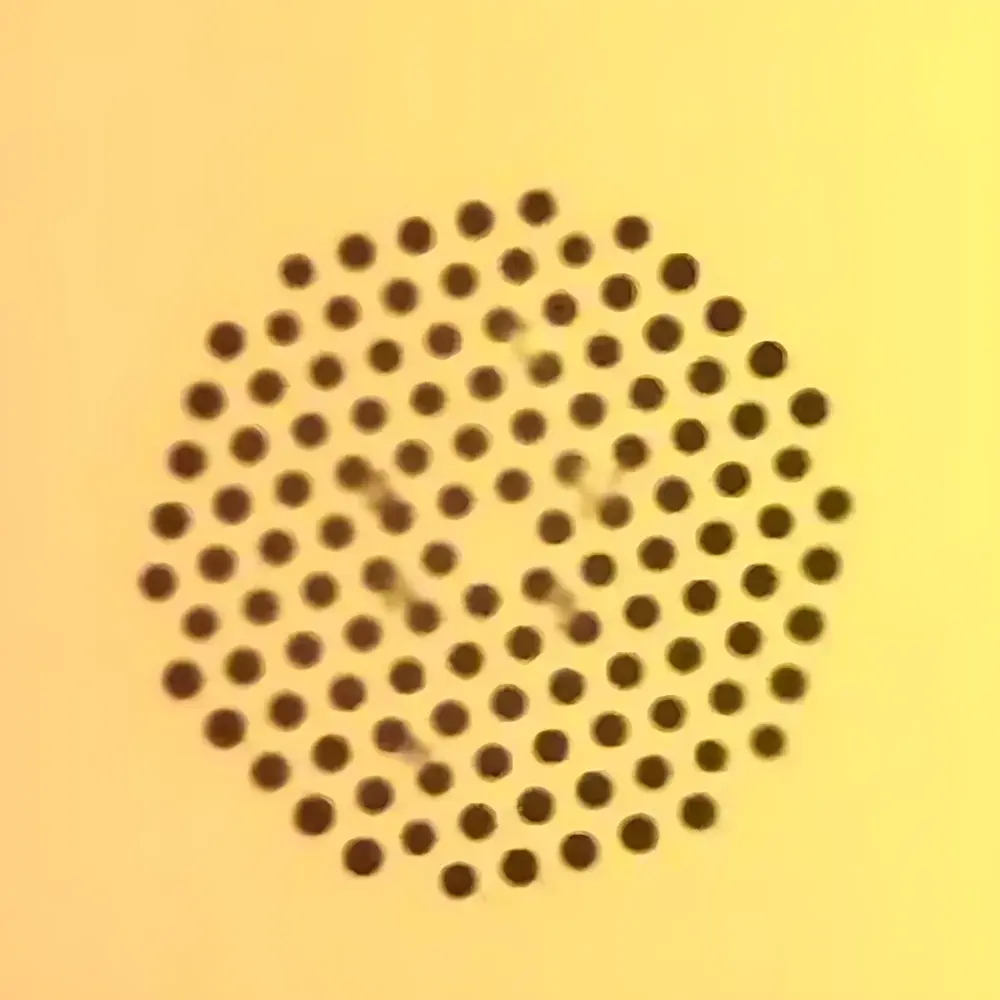
Oetech HC-PCF Hollow-Core Photonic Crystal Fiber
| Brand | Oetech |
|---|---|
| Origin | Beijing, China |
| Manufacturer Type | Authorized Distributor |
| Country of Origin | China |
| Model | HC-PCF |
| Price Range | USD 280 – 700 (FOB) |
| Core Material | Synthetic Fused Silica |
| Cladding Structure | Hexagonal Air-Hole Lattice |
| Coating | Single Acrylate |
| Core Diameter | ~4.8 µm |
| Cladding Diameter (bare fiber) | ~157 µm |
| Transmission Bandwidth | 450–1700 nm+ |
| Attenuation | <0.05 dB/m (typ.), 0.025 dB/m @ 1500 nm, 0.04 dB/m @ 1064 nm |
| Guidance Mechanism | Photonic Bandgap (PBG) or Inhibited Coupling (IC) |
| Operating Mode | Effectively Single-Mode (ESM), Cutoff-Free |
Overview
Oetech HC-PCF is a hollow-core photonic crystal fiber engineered for high-fidelity light guidance in the visible to near-infrared spectrum (450–1700 nm+). Unlike conventional solid-core fibers, this HC-PCF guides light primarily within a central air-filled core—surrounded by a microstructured cladding composed of a periodic hexagonal lattice of air holes in pure fused silica. This architecture enables guidance via photonic bandgap (PBG) or inhibited coupling (IC) mechanisms, depending on the specific design iteration and operational wavelength. The absence of glass in the light path drastically reduces nonlinear effects, material dispersion, and absorption losses—making it uniquely suited for ultrafast pulse delivery, low-latency signal transmission, and high-power laser beam transport where nonlinear distortion and thermal damage thresholds are critical constraints.
Key Features
- Cutoff-Free Single-Mode Operation: Engineered with a robust mode-area-to-wavelength ratio, enabling effectively single-mode (ESM) guidance across its full bandwidth without modal cutoff—eliminating the need for careful launch alignment or mode filtering in broadband applications.
- Ultra-Low Propagation Loss: Achieves attenuation as low as 0.025 dB/m at 1500 nm and 0.04 dB/m at 1064 nm, with typical values remaining below 0.05 dB/m over the entire operating range—comparable to high-grade telecom fibers but with fundamentally different dispersion and nonlinearity profiles.
- Tailorable Dispersion Profile: The geometric parameters of the air-hole lattice (pitch, hole size, and arrangement symmetry) allow precise engineering of group velocity dispersion (GVD), enabling zero-dispersion wavelengths to be placed at user-specified positions—critical for supercontinuum generation and dispersion compensation.
- Suppressed Nonlinear Interaction: With >99% of optical power confined in air, the effective nonlinear coefficient (γ) is reduced by two orders of magnitude versus standard SMF-28—enabling high-peak-power pulse transmission with minimal self-phase modulation or stimulated Raman scattering.
- High Damage Threshold & Thermal Stability: Pure fused silica construction and air-core guidance yield exceptional resistance to laser-induced damage (LIDT > 10 GW/cm² for ns pulses at 1064 nm) and negligible thermal lensing—ideal for high-repetition-rate ultrafast amplifiers and industrial laser systems.
Sample Compatibility & Compliance
The HC-PCF is supplied as a bare fiber with 157 µm outer diameter and single acrylate coating, compatible with standard fiber cleaving, splicing (fusion or mechanical), and connectorization (FC/PC, FC/APC, or custom ferrules). All fibers undergo rigorous inspection per IEC 60793-2-50 (Category A1a for multimode PCFs; adapted criteria for hollow-core variants) and meet ISO 9022-2 for environmental robustness under controlled lab conditions. While not certified to ITU-T G.652.D or G.657.A1 due to structural divergence, performance data—including cut-off wavelength, mode field diameter (MFD), and polarization extinction ratio (PER > 20 dB over 1 m)—are provided in individual test reports traceable to NIM (National Institute of Metrology, China). The fiber complies with RoHS Directive 2011/65/EU and REACH Annex XVII restrictions on hazardous substances.
Software & Data Management
As a passive optical component, the HC-PCF does not integrate embedded firmware or digital interfaces. However, Oetech provides a comprehensive characterization dataset for each batch—including spectral attenuation maps (450–1700 nm), dispersion curves (measured via white-light interferometry), and mode-field imaging (via near-field scanning). These datasets are delivered in standardized ASCII (.txt) and MATLAB (.mat) formats, fully compatible with common optical simulation platforms (e.g., Lumerical MODE, COMSOL Multiphysics Wave Optics Module, RP Fiber Power). For GLP/GMP-regulated environments, raw measurement logs include timestamps, operator IDs, instrument calibration certificates (NIST-traceable power meters and tunable lasers), and audit trails compliant with FDA 21 CFR Part 11 requirements when hosted on validated networked storage systems.
Applications
- Supercontinuum Generation: Enables octave-spanning spectra from femtosecond Yb or Er fiber lasers with improved coherence and reduced noise floor due to suppressed soliton fission dynamics.
- Fiber Optic Gyroscopes (FOGs): Reduces Shupe effect and Kerr-induced bias drift by minimizing thermo-optic and nonlinear phase errors—enhancing long-term stability in navigation-grade inertial sensors.
- Gas & Chemical Sensing: The hollow core serves as a natural interaction chamber; analyte gases introduced via side-diffusion or end-capillary filling yield strong evanescent-field-enhanced absorption signatures, supporting ppb-level detection in mid-IR quantum cascade laser spectroscopy.
- High-Power Laser Delivery: Used in industrial cutting/welding systems and medical laser scalpels to transmit kW-level CW or pulsed beams with minimal thermal load and no photodarkening degradation.
- Quantum Photonics Interfacing: Supports low-loss, low-decoherence coupling between atomic vapors, trapped ions, and integrated photonic circuits—facilitating quantum memory and entanglement distribution experiments.
FAQ
What distinguishes HC-PCF from conventional solid-core photonic crystal fiber (SC-PCF)?
HC-PCF guides light predominantly in air, resulting in lower nonlinearity, reduced dispersion slope, and higher damage threshold—whereas SC-PCF retains a solid glass core and exhibits enhanced nonlinearity and adjustable dispersion but remains subject to material absorption and thermal limitations.
Can HC-PCF be fusion-spliced to standard SMF-28?
Yes—with optimized arc parameters (reduced current, extended pre-fuse time) and core-alignment active splicing, splice losses of <0.3 dB are routinely achieved; mechanical splices with index-matching gel yield <0.5 dB loss.
Is the HC-PCF suitable for UV transmission below 400 nm?
Not recommended: Standard fused silica HC-PCF exhibits increased Rayleigh scattering and OH-related absorption below 450 nm; UV-grade synthetic silica variants are available upon request with modified fabrication protocols.
Does Oetech provide custom lengths or connectorized assemblies?
Yes—standard lengths range from 0.5 m to 50 m; FC/APC, SMA905, or custom ceramic ferrule terminations are offered with full IL/RL testing reports and 100% inspection under 40× dark-field microscopy.
How is bend sensitivity characterized for this HC-PCF?
Minimum bend radius is specified at 30 mm for <0.1 dB additional loss at 1550 nm; performance degrades gradually beyond this point due to bandgap distortion—not catastrophic mode leakage—enabling compact coiling in portable instrumentation.






