
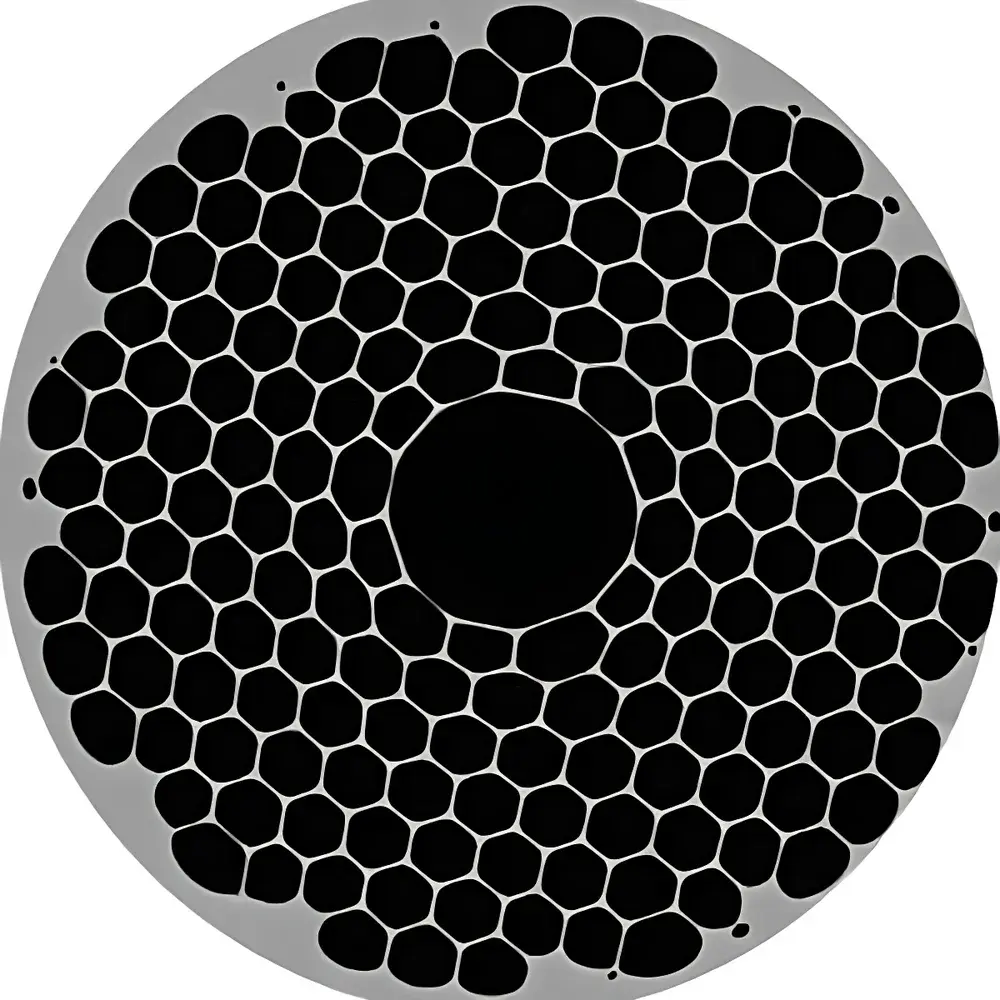
OETECH SMPBG-19-6-2 Hollow-Core Photonic Bandgap Fiber
| Brand | OETECH |
|---|---|
| Origin | Beijing, China |
| Manufacturer Type | Authorized Distributor |
| Country of Origin | China |
| Model | SMPBG-19-6-2 |
| Price Range | USD 280 – 700 |
| Core Diameter | ~14 µm |
| Cladding Diameter (Bare Fiber) | ~145 µm |
| Coated Diameter | ~360 µm |
| Transmission Band | 1450–1610 nm |
| Attenuation | <0.03 dB/m |
| Minimum Attenuation | ~0.011 dB/m @ ~1570 nm |
| Attenuation @ 1550 nm | ~0.012 dB/m |
| Material | Pure Silica |
| Coating | Single Acrylate |
Overview
The OETECH SMPBG-19-6-2 Hollow-Core Photonic Bandgap Fiber (HC-PBGF) is a microstructured optical fiber engineered to guide light within a central air-filled core via the photonic bandgap effect—distinct from total internal reflection used in conventional solid-core fibers. This fundamental operating principle enables exceptional suppression of nonlinear optical effects, reduced latency, and immunity to material-related absorption and dispersion limitations inherent to silica glass. Designed for high-fidelity signal propagation in demanding photonic systems, the SMPBG-19-6-2 delivers sub-0.012 dB/m attenuation at 1550 nm and maintains stable guidance across a broad 1450–1610 nm transmission window. Its pure-silica construction and single-acrylate coating ensure mechanical robustness while preserving low-stress optical performance under controlled handling and splicing conditions.
Key Features
- Hollow-Core Guidance Mechanism: Light confinement occurs predominantly in air (refractive index ≈ 1.0), minimizing interaction with glass matrix—resulting in ultra-low nonlinearity, reduced thermal sensitivity, and intrinsic immunity to radiation-induced darkening.
- Ultra-Low Propagation Loss: Achieves ≤0.012 dB/m at 1550 nm and <0.03 dB/m across the full C+L telecom band, enabling extended passive transmission lengths without active amplification.
- Broadband Compatibility: Supports continuous guidance from visible-edge (≈1450 nm) through the entire C-band and into the L-band (up to 1610 nm), facilitating multi-wavelength instrumentation and wavelength-division multiplexing (WDM) compatibility.
- Engineered Bend Resilience: Optimized photonic crystal cladding geometry reduces macrobend-induced loss—critical for compact coil integration in fiber optic gyroscopes (FOGs) and space-constrained photonic assemblies.
- Quasi-Single-Mode Operation: Fundamental mode (LP₀₁) dominance ensures high spatial coherence and polarization-maintaining potential when combined with asymmetric core designs or stress-applying elements in custom configurations.
Sample Compatibility & Compliance
The SMPBG-19-6-2 is compatible with standard fusion splicers equipped with hollow-core fiber alignment modules and optimized arc discharge profiles. It meets mechanical handling requirements defined in IEC 60793-2-50 (category A1a) for bend-insensitive specialty fibers. While not certified to ITU-T G.652.D or G.657.A1 as a telecommunications cable, its optical performance aligns with laboratory-grade specifications referenced in IEEE Std 1476™ (Fiber Optic Gyroscope Standards) and supports GLP-compliant calibration traceability when integrated into metrology-grade FOG or interferometric test benches. No hazardous substances are employed in manufacturing; RoHS 2011/65/EU compliance is maintained per material declaration.
Software & Data Management
As a passive optical component, the SMPBG-19-6-2 does not incorporate embedded electronics or firmware. However, it interfaces seamlessly with industry-standard optical test platforms—including EXFO FTB-400, VIAVI ONT-800, and Keysight N77xx series optical loss analyzers—enabling automated insertion loss mapping, spectral attenuation profiling, and polarization-dependent loss (PDL) characterization. When deployed in closed-loop FOG systems, its performance metrics integrate directly into host system data logs compliant with ISO/IEC 17025:2017 documentation frameworks. Traceable calibration reports (including spectral loss curves and mode field diameter measurements) are provided upon request for audit readiness under FDA 21 CFR Part 11–aligned quality management systems.
Applications
- Fiber Optic Gyroscopes (FOGs): Low nonlinearity and near-zero Kerr coefficient minimize bias drift and scale factor errors; low attenuation enables longer coil lengths (>5 km) without compromising bandwidth or bias stability—meeting MIL-STD-883H Class B environmental screening thresholds.
- High-Power Laser Delivery: Air-core guidance eliminates thermal lensing and catastrophic damage thresholds associated with fused silica, supporting peak power transmission >1 MW/cm² in pulsed nanosecond regimes (e.g., 1550 nm Er:fiber amplifiers).
- Low-Latency Data Links: Group velocity in air (~c) yields ≈31% lower latency vs. standard SMF-28, advantageous in HFT infrastructure and quantum key distribution (QKD) backbones requiring precise timing synchronization.
- Spectroscopic Gas Sensing: Extended interaction length within the hollow core enhances evanescent-field absorption sensitivity for trace gas detection (e.g., CH₄, CO₂) using tunable diode laser absorption spectroscopy (TDLAS) in the 1550–1600 nm window.
FAQ
Is this fiber compatible with standard SMF-28 pigtailing and connectorization?
Yes—when using mode-field adapters or tapered fusion splices, the SMPBG-19-6-2 achieves <0.3 dB splice loss to SMF-28 with proper alignment and discharge optimization.
What is the maximum recommended bending radius during installation?
For sustained operation without measurable loss increase, maintain a minimum bend radius of ≥30 mm; short-term handling down to 15 mm is permissible under controlled tension.
Can this fiber be used in vacuum or high-humidity environments?
The acrylate coating provides adequate moisture resistance for ambient lab use; for vacuum applications, hermetic metal-cabled variants (e.g., stainless steel jacketed) are available under custom order.
Does OETECH provide spectral attenuation data beyond the 1450–1610 nm range?
Yes—extended characterization from 1300 nm to 1700 nm is available upon request, including water-peak region analysis and higher-order mode cutoff verification.
Are there polarization-maintaining (PM) versions of this hollow-core design?
Currently, the SMPBG-19-6-2 is non-PM; however, OETECH offers custom PM-HC-PBGF development with elliptical air-hole lattices under NDA-supported engineering programs.





