
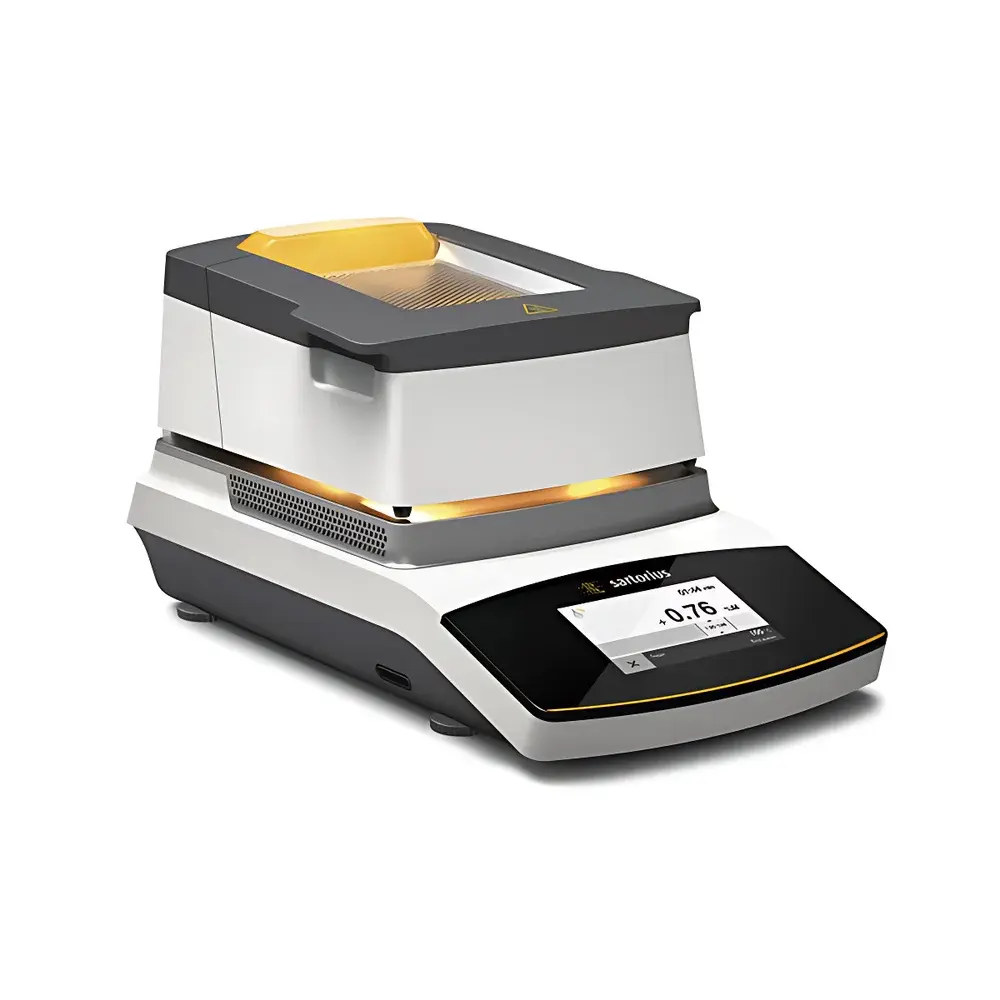
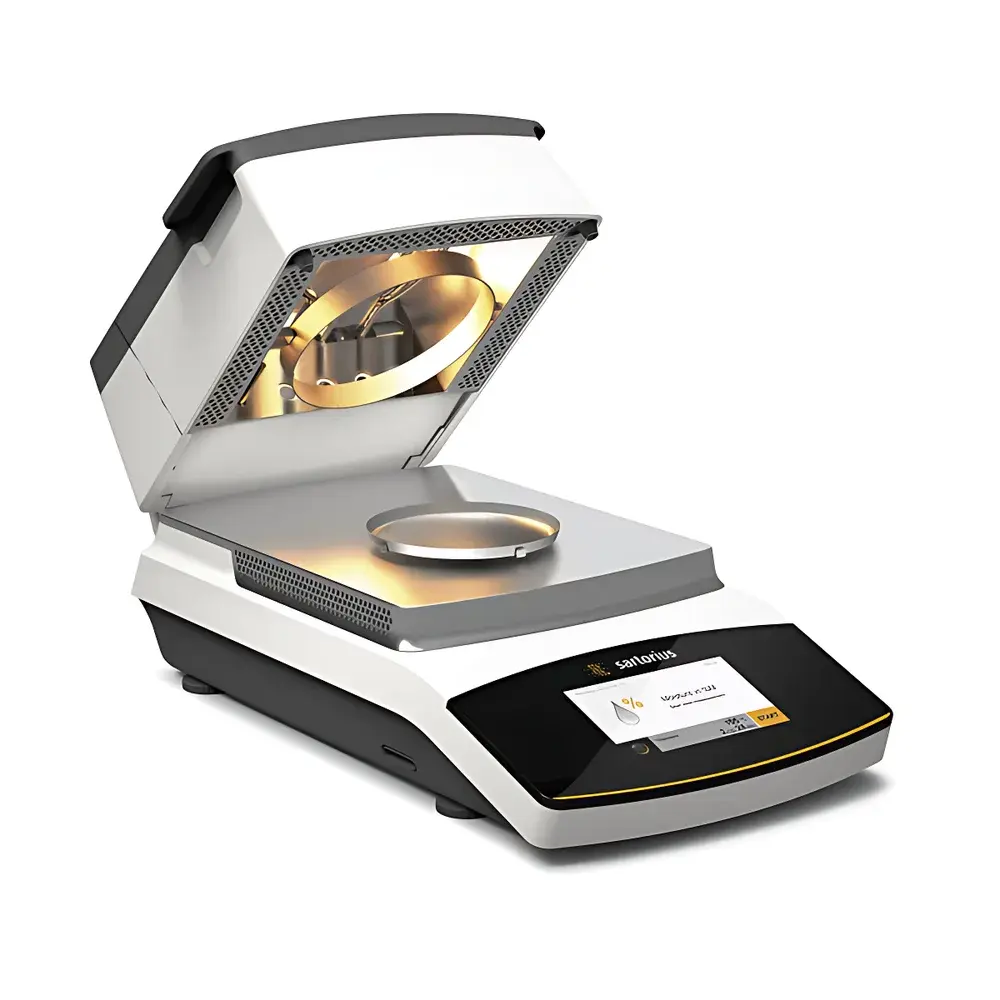
Sartorius MA160-1CN Infrared Moisture Analyzer
| Brand | Sartorius |
|---|---|
| Origin | Beijing, China |
| Manufacturer Type | Authorized Distributor |
| Country of Origin | China |
| Model | MA160-1CN |
| Heating Method | Infrared (AURI Alloy Heating Element) |
| Weighing Range | 200 g |
| Readability | 1 mg |
| Repeatability | ±0.2% (for sample mass ≥1 g) |
| Temperature Range | 40–160 °C (adjustable in 1 °C increments) |
| Heating Power | 640 VA |
| Display | Full-color capacitive touchscreen |
| Data Storage | 32 GB (SD/SDHC) |
| Endpoint Detection | Fully automatic, semi-automatic (mg or %), timed, and manual modes |
| Compliance | FDA 21 CFR Part 11-ready (with optional printer YDP30/YDP40), HACCP, GLP-supportive reporting |
| Interface | Mini-USB (direct export to Microsoft Word/Excel) |
Overview
The Sartorius MA160-1CN Infrared Moisture Analyzer is a high-performance, thermogravimetric instrument engineered for rapid, precise, and reproducible moisture content determination in solid, semi-solid, and paste-like samples. It operates on the principle of infrared-assisted thermal gravimetry (TGA): sample mass loss upon controlled heating is measured in real time using a high-resolution analytical balance integrated into the instrument architecture. The proprietary AURI alloy infrared heating element delivers uniform, directional radiant energy—minimizing thermal gradients and surface charring while ensuring consistent drying kinetics across heterogeneous matrices. Unlike conventional halogen-based systems, this design enables stable temperature control from 40 °C to 160 °C in 1 °C increments, supporting both standard drying protocols and thermally sensitive applications (e.g., pharmaceutical actives, dairy powders, or enzyme formulations). Its compact benchtop footprint (215 × 210.5 × 401 mm) and low ambient operating range (10–30 °C) make it suitable for QC labs, production floors, and field-deployed quality assurance units.
Key Features
- High-power AURI infrared heating system (640 VA) delivering up to 2× faster drying versus prior-generation models—reducing typical analysis time by 30–50% without compromising endpoint accuracy.
- Capacitive full-color touchscreen interface with intuitive, gesture-driven navigation—designed for zero-training operation; no manual required for routine method execution or parameter adjustment.
- Automated endpoint detection with four configurable modes: fully automatic (mass-change threshold), semi-automatic (% or mg loss), timed drying (0.1–99.9 min), and manual termination—ensuring adaptability across ISO 5350, AOAC 952.08, and USP <731> compliant workflows.
- Modular sample pan configuration: interchangeable glass or FDA-compliant anodized aluminum inserts—validated for food, pharma, and nutraceutical applications under HACCP and GMP-aligned environments.
- Integrated performance verification suite including built-in calibration diagnostics, temperature validation tools (YTM03MA-compatible), and daily system suitability checks—supporting audit readiness per GLP and ISO/IEC 17025 requirements.
- Ergonomic flip-lid heating chamber with tool-free access, smooth-surface stainless steel interior, and removable drip tray—facilitating rapid cleaning and cross-contamination prevention between high-throughput batches.
Sample Compatibility & Compliance
The MA160-1CN accommodates sample masses from 0.100 g to 200 g, with optimal repeatability achieved at ≥1 g (±0.2%) and enhanced precision at ≥5 g (±0.05%). It supports diverse material classes—including hygroscopic polymers, granulated APIs, herbal extracts, baked goods, and industrial catalysts—without requiring pre-grinding or homogenization in most cases. The instrument’s firmware embeds method templates aligned with ASTM D4442 (wood moisture), ISO 712 (cereals), and EN ISO 1445 (milk powder), and allows user-defined protocol storage (up to 100 methods). All data output—including raw mass/time curves, final % moisture, % dry matter, ATRO ratios, and g-based results—can be exported via Mini-USB directly into Excel or Word without third-party software. When paired with Sartorius YDP30/YDP40 printers, reports include operator ID, timestamp, method name, calibration status, and digital signature fields—meeting documentation rigor for FDA 21 CFR Part 11 Subpart B (electronic records and signatures).
Software & Data Management
Data integrity is maintained through embedded 32 GB SD/SDHC storage, enabling secure retention of measurement logs, method versions, calibration histories, and system event timestamps. The onboard file manager supports hierarchical folder organization, method duplication, and version-controlled editing—critical for change management in regulated environments. The “Method Development Assistant” guides users stepwise through drying profile optimization (temperature ramping, hold times, endpoint sensitivity), automatically generating comparative drying curves for parameter refinement. Audit trails are permanently recorded and non-erasable; all modifications to methods or instrument settings are time-stamped and attributed to logged-in users. Export functionality includes CSV, PDF, and native .sma formats—compatible with LIMS integration via standardized USB mass storage protocols.
Applications
This analyzer serves as a primary moisture verification tool in pharmaceutical manufacturing (raw material release, blend uniformity, tablet coating validation), food safety laboratories (moisture specification compliance per Codex Alimentarius), chemical R&D (polymer hydration state monitoring), and agricultural QA (grain moisture certification). Its gentle yet efficient infrared heating makes it especially valuable for heat-labile compounds where oven-drying induces decomposition—such as vitamins, probiotics, or amorphous dispersions. Field deployment is supported by stable power draw (<640 VA), minimal warm-up time (<60 s), and resistance to ambient humidity fluctuations—enabling real-time moisture trending during incoming inspection or line clearance verification.
FAQ
Does the MA160-1CN comply with FDA 21 CFR Part 11?
Yes—when used with enabled user authentication, electronic signatures, and audit-trail logging (all firmware-native), and when paired with YDP30/YDP40 printers for GLP-compliant reporting.
Can I validate temperature accuracy independently?
Yes—the instrument supports external temperature probe calibration using the YTM03MA reference sensor, with traceable adjustments stored in the calibration log.
What is the minimum detectable moisture change?
At 100 g sample mass, resolution is 0.01% moisture; detection limit depends on initial mass and repeatability—typically ≤0.05% RSD for well-homogenized samples ≥5 g.
Is method transfer possible between different MA-series units?
Yes—methods are stored in portable .sma files and can be loaded across MA160, MA150, and MA100 platforms with identical hardware configurations.
How often does the balance require recalibration?
External calibration with 100 g E2 class weights is recommended before each shift or after transport; internal drift compensation runs automatically during idle periods.





