
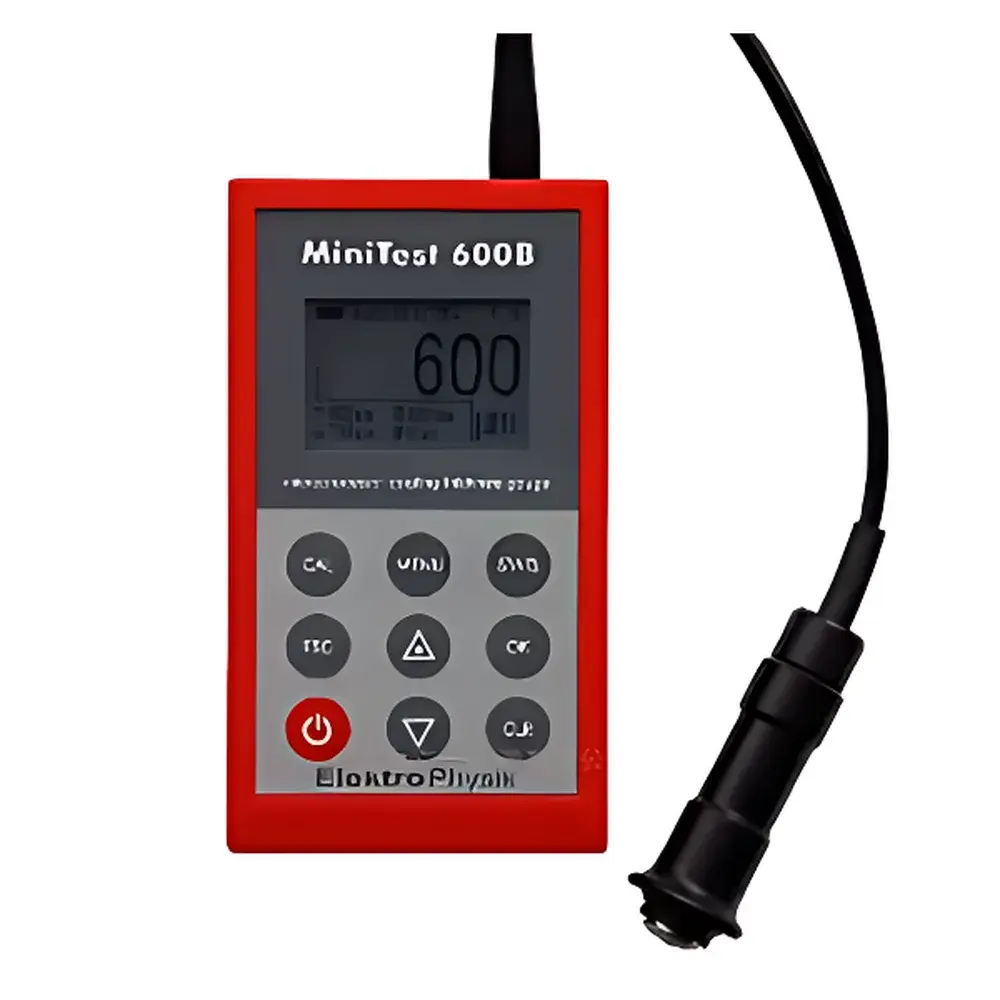
EPK MiniTest 600 BFN Dual-Mode Coating Thickness Gauge
| Brand | EPK |
|---|---|
| Origin | Germany |
| Model | MiniTest 600 BFN |
| Measurement Principle | Magnetic Induction (F-mode) & Eddy Current (N-mode) |
| Range (F) | 0–3000 µm |
| Range (N/FN) | 0–2000 µm |
| Accuracy | ±(2% of reading + 2 µm) |
| Minimum Substrate Thickness | 0.5 mm (ferrous), 50 µm (non-ferrous) |
| Minimum Curvature Radius | 5 mm (convex), 25 mm (concave) |
| Minimum Measuring Area | Ø20 mm |
| Display | 128×64 backlit LCD |
| Data Storage | Up to 10,000 readings (10 groups × 1,000 values) |
| Interface | USB |
| Power | 2×AA batteries |
| Operating Temperature | 0–50 °C (instrument), –10–70 °C (probe) |
| Compliance | ISO 2178, ISO 2360, DIN 50981, ASTM B499, ASTM D7091, BS 3900-E7 |
Overview
The EPK MiniTest 600 BFN is a handheld, dual-mode non-destructive coating thickness gauge engineered for precision and field reliability in industrial quality control environments. It operates on two complementary physical principles: magnetic induction for ferrous substrates (e.g., steel, iron) and high-frequency eddy current for non-ferrous conductive substrates (e.g., aluminum, copper, brass, austenitic stainless steel). This dual-sensor architecture eliminates manual mode selection—its integrated FN probe automatically detects substrate conductivity and magnetic permeability, switching measurement algorithms in real time to ensure correct calibration path and optimal signal-to-noise ratio. Designed for rigorous use in automotive OEM facilities, shipyards, bridge maintenance crews, architectural metal fabricators, and corrosion protection contractors, the MiniTest 600 BFN delivers traceable, repeatable thickness data without surface preparation or sample destruction. Its compact form factor (64 × 115 × 25 mm, 270 g), rugged probe housing with wear-resistant ceramic-tipped sensing face, and extended operating temperature range support continuous operation under ambient conditions typical of outdoor infrastructure inspection or production-line floor deployment.
Key Features
- Dual-mode FN probe with automatic substrate recognition—no manual F/N mode switching required
- High-resolution 128×64 backlit LCD display with configurable metric/imperial units and real-time clock stamping
- Onboard statistical engine: calculates mean, min/max, standard deviation, and count per group; supports up to 10 user-defined data groups (1,000 readings each)
- Three-point calibration capability (zero, one-point, two-point) with traceable reference standards included
- USB interface enables direct connection to Windows-based PCs for data export, report generation, and firmware updates via EPK’s official WinCoat software
- Low-power design powered by two standard AA alkaline cells (typical battery life > 30 hours of continuous use)
- Robust mechanical architecture: probe tip engineered from sapphire-reinforced ceramic for abrasion resistance during repeated contact on rough or coated surfaces
- Compliant with international metrological standards including ISO 2178 (magnetic method), ISO 2360 (eddy current), ASTM B499 (metallic coatings on steel), and ASTM D7091 (non-conductive coatings on non-ferrous metals)
Sample Compatibility & Compliance
The MiniTest 600 BFN measures non-magnetic coatings on ferrous substrates—including paint, enamel, plastic, zinc, chromium, and epoxy—and insulating layers on non-ferrous conductive substrates such as anodized oxide films, lacquers, powder coatings, and ceramic finishes. It requires minimum substrate thicknesses of 0.5 mm for steel and 50 µm for aluminum or copper to avoid backside interference. Minimum measurable area is Ø20 mm; curvature limits are 5 mm (convex) and 25 mm (concave) to maintain probe lift-off consistency. All measurements adhere to GLP-aligned documentation practices: timestamped readings, audit-ready group metadata, and full traceability to certified calibration foils (supplied with unit). The instrument satisfies requirements for ISO/IEC 17025-accredited laboratories when used with documented calibration procedures and controlled environmental conditions.
Software & Data Management
WinCoat software (included) provides full bidirectional communication via USB. Users can download stored datasets, generate customizable PDF reports with statistical summaries, apply batch corrections, and export CSV files for integration into LIMS or ERP systems. The software supports FDA 21 CFR Part 11-compliant electronic signatures when deployed in regulated manufacturing environments. Audit trails record all configuration changes, calibration events, and data transfers. Firmware updates preserve backward compatibility with legacy data structures and extend instrument lifecycle beyond typical field service intervals.
Applications
This gauge is routinely deployed across sectors where coating integrity directly impacts service life and regulatory compliance: verifying primer thickness in automotive body shops per OEM specifications (e.g., VW TL-226); validating galvanizing layer uniformity on structural steel per ASTM A123; monitoring anodize thickness on aerospace extrusions per AMS-A-8625; ensuring compliant dry-film thickness (DFT) on marine hulls per SSPC-PA2; and auditing decorative PVD coatings on architectural aluminum façades. Its portability and rapid single-button measurement make it ideal for incoming material inspection, in-process verification, and final QA sign-off.
FAQ
Does the MiniTest 600 BFN require separate calibration for ferrous and non-ferrous modes?
No—the FN probe performs automatic substrate identification and selects the appropriate algorithm internally; only one unified calibration routine is needed.
Can it measure coatings on stainless steel?
Yes, but only on non-magnetic (austenitic) grades such as 304 or 316; ferritic or martensitic stainless steels will trigger the F-mode algorithm.
Is the USB interface compatible with modern Windows OS versions?
Yes—WinCoat v4.2+ supports Windows 10 and Windows 11 (64-bit) with signed drivers.
What is the recommended recalibration interval?
Annual verification against certified standards is advised; more frequent checks are required if used in high-vibration or extreme-temperature environments.
Does it support statistical process control (SPC) output?
Yes—real-time sigma, Cp/Cpk, and X-bar/R chart parameters are exportable via WinCoat for integration into SPC platforms.



