
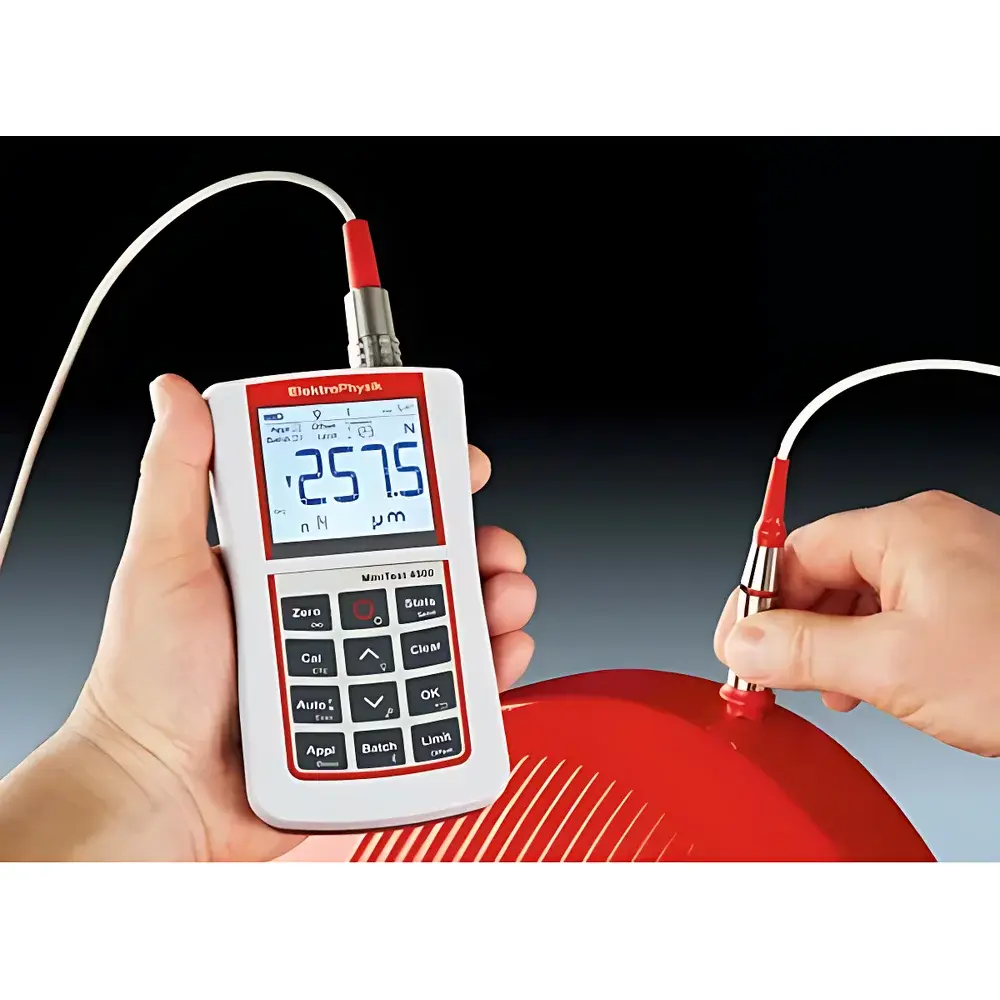
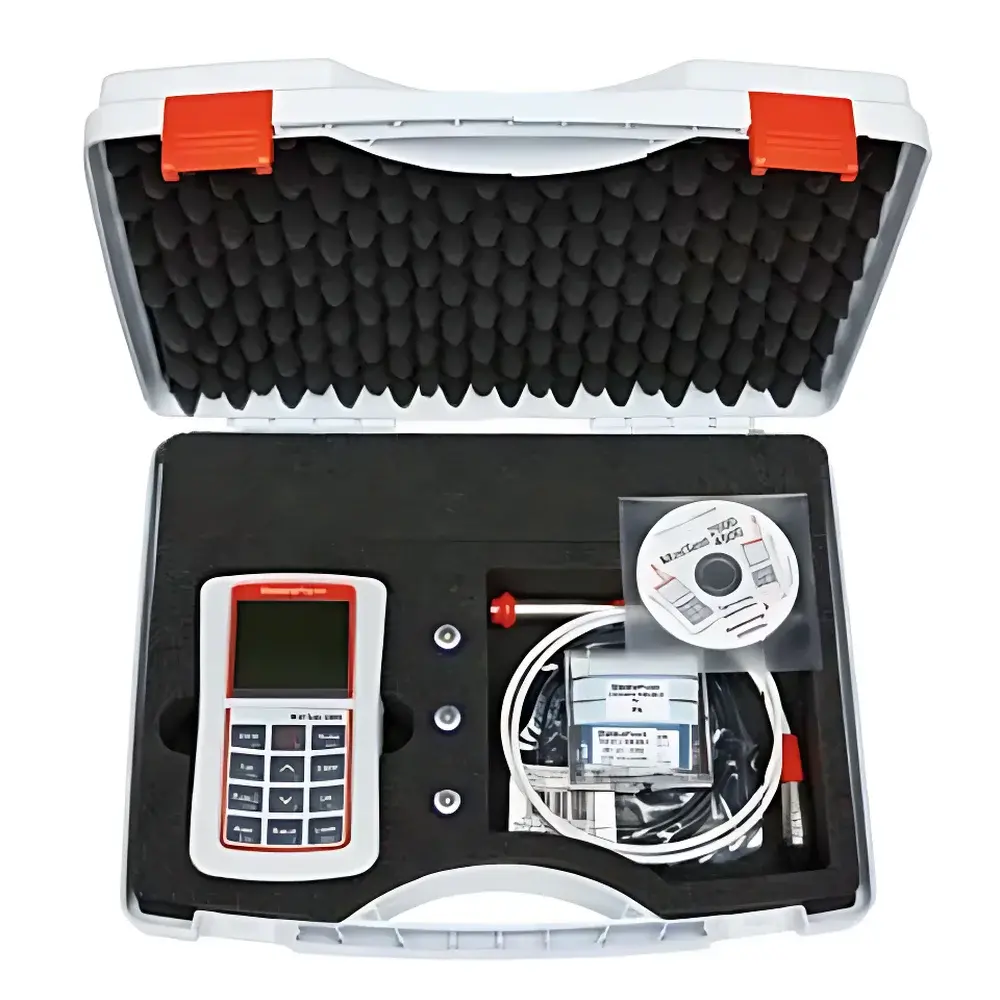
EPK MiniTest 2500 Electromagnetic Eddy Current & Magnetic Induction Coating Thickness Gauge
| Brand | EPK |
|---|---|
| Origin | Germany |
| Model | MiniTest 2500 |
| Measurement Principle | Dual-mode (magnetic induction for non-ferrous coatings on ferrous substrates |
| Data Storage Capacity | 2,000,000 readings |
| Max. Batch Groups | 1 |
| Calibration Points | Up to 4 user-defined points + factory calibration + CTC (Coating-on-Non-Metal) mode |
| Statistical Functions per Batch | kvar, n, max., min. |
| Units | mm, µm, mils, inch, cm |
| Interface | USB |
| Compliance | DIN EN ISO 1461, 2178, 2360, 2808, 3882 |
| Display | 53 × 46 mm backlit LCD |
| Operating Temp. | –10 °C to +60 °C |
| Storage Temp. | –20 °C to +70 °C |
| Dimensions | 153 × 89 × 36 mm |
| Weight | 320 g (incl. batteries) |
| Power | 3 × AA (LR06), ~150 h runtime (backlight off) |
Overview
The EPK MiniTest 2500 is a handheld, dual-principle coating thickness gauge engineered for high-precision, non-destructive measurement of non-magnetic coatings on ferrous substrates and non-conductive coatings on non-ferrous metal substrates. It operates simultaneously via magnetic induction (per DIN EN ISO 2178 and ASTM B499) and electromagnetic eddy current (per DIN EN ISO 2360 and ASTM E376), enabling reliable quantification across diverse industrial surface systems—including paint, enamel, plastic, zinc, chrome, and anodized layers—without substrate damage or sample preparation. Designed and manufactured in Germany, the instrument complies with international metrological standards for repeatability, linearity, and thermal stability. Its compact, ergonomic housing integrates robust mechanical protection (IP65 ingress rating) and extended field usability—making it suitable for quality control in automotive OEM finishing lines, aerospace component inspection, galvanizing plant audits, and third-party coating certification laboratories.
Key Features
- Dual-sensor architecture supporting automatic mode selection based on substrate conductivity and coating type—eliminating manual sensor swaps during multi-material inspections.
- Factory-calibrated transducer with optional user-defined calibration at up to four reference points, plus Coating-on-Non-Metal (CTC) functionality for measurements on plastic, ceramic, or composite substrates using certified foil standards.
- High-resolution backlit LCD (53 × 46 mm) optimized for readability under variable ambient lighting, including direct sunlight and low-illumination workshop environments.
- Integrated statistical engine calculating per-batch parameters: standard deviation (kvar), count (n), maximum/minimum values—supporting real-time SPC (Statistical Process Control) implementation without external software.
- USB interface enabling firmware updates, data export in CSV format, and direct integration into enterprise LIMS or MES platforms compliant with ISO/IEC 17025 and FDA 21 CFR Part 11 requirements for audit-trail integrity.
- Ruggedized design featuring shock-absorbing rubber overmold, IP65-rated enclosure, and operational reliability across –10 °C to +60 °C—validated per IEC 60068-2 environmental test protocols.
Sample Compatibility & Compliance
The MiniTest 2500 supports measurement on flat, curved, and slightly irregular surfaces with radii ≥5 mm. Substrate requirements include minimum thickness (≥1 mm for steel; ≥0.5 mm for aluminum) and surface roughness (Ra < 10 µm recommended). It meets the technical scope of DIN EN ISO 1461 (zinc coatings on iron/steel), ISO 19840 (protective coating systems for offshore structures), and ASTM D7091 (non-destructive measurement of dry film thickness of non-magnetic coatings on non-ferrous metals). All calibrations adhere to traceable NIST- or DAkkS-accredited reference standards. The device is CE-marked and conforms to EMC Directive 2014/30/EU and RoHS 2011/65/EU.
Software & Data Management
Data acquisition and reporting are managed via EPK’s proprietary WinFTM software (Windows-based), which enables batch configuration, calibration certificate generation, trend analysis, and PDF report export with embedded metadata (operator ID, timestamp, GPS coordinates if connected via Bluetooth-enabled host). Raw datasets retain full audit trail information—including calibration history, measurement sequence, and environmental logging—ensuring compliance with GLP and GMP documentation requirements. USB connectivity supports direct drag-and-drop transfer without proprietary drivers. No cloud dependency or subscription model is required for core functionality.
Applications
- Automotive: Verification of e-coat, primer, basecoat, and clearcoat thickness on stamped steel and aluminum body panels.
- Energy Infrastructure: Inspection of fusion-bonded epoxy (FBE) and polyethylene coatings on pipeline joints per ISO 21809-2.
- Aerospace: Thickness validation of anodized Al 2024-T3 and chromate conversion coatings per AMS 2470/AMS 2471.
- Electronics: Measurement of solder mask and conformal coating thickness on PCB substrates.
- Marine & Offshore: In-service assessment of antifouling and corrosion-resistant polymer coatings on hulls and ballast tanks.
FAQ
Does the MiniTest 2500 require annual recalibration?
Yes—recommended recalibration interval is 12 months or after 10,000 measurements, whichever occurs first, using traceable certified standards per ISO/IEC 17025 accredited service providers.
Can it measure coatings on stainless steel?
Yes, provided the stainless steel grade is ferritic or martensitic (magnetically permeable); austenitic grades (e.g., 304, 316) require eddy current mode only and may exhibit reduced accuracy below 25 µm.
Is Bluetooth connectivity supported on the MiniTest 2500?
No—Bluetooth 4.0 is available exclusively on the MiniTest 4500 model. The MiniTest 2500 features USB 2.0 only.
What is the minimum substrate thickness for valid measurement?
For ferrous substrates: ≥1.0 mm; for non-ferrous substrates (e.g., Al, Cu): ≥0.5 mm. Thinner substrates induce lift-off error and require specialized probe geometry not included with this model.
How is measurement uncertainty determined?
Uncertainty is calculated per GUM (JCGM 100:2008) using Type A (statistical dispersion of repeated readings) and Type B (calibration certificate tolerance, temperature coefficient, probe wear) components—typically ±(1 µm + 1.5% of reading) for coatings <50 µm on calibrated steel.



