
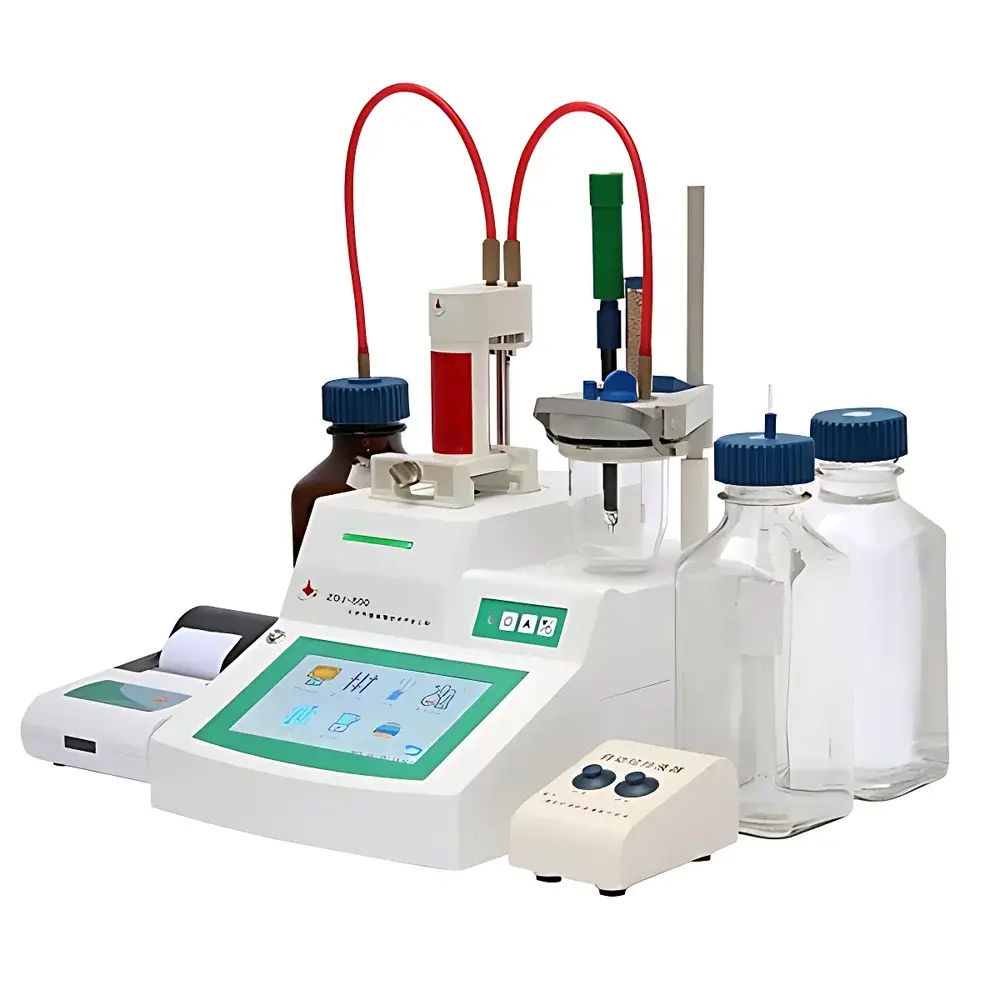
Forerunner ZDJ-600S Karl Fischer Coulometric Moisture Analyzer
| Brand | Forerunner |
|---|---|
| Origin | Beijing, China |
| Manufacturer Type | Authorized Distributor |
| Product Category | Domestic |
| Model | ZDJ-600S |
| Titration Method | Fully Automated Volumetric Titration |
| Instrument Type | Volumetric Karl Fischer Moisture Analyzer |
| Current Resolution | 0.01 µA |
| Moisture Range | 10 ppm to 100% w/w |
| Measurement Accuracy | ≤0.2% RSD |
| Minimum Dispensing Volume | 5 µL |
| Burette Precision | 1/20,000 |
| Burette Capacity | 10 mL (standard) |
| Burette Accuracy | ±10 µL @ 10 mL |
| Polarization Current Range | 0–200 µA |
| Polarization Voltage Range | 0–2550 mV |
| Polarization Voltage Step | 10 mV |
| Effective Current Accuracy | Better than ±0.1 µA |
| Repeatability (Pure Water) | <1% RSD |
| Standardization Repeatability | ±0.5% of mean across three consecutive runs |
Overview
The Forerunner ZDJ-600S is a fully automated volumetric Karl Fischer (KF) moisture analyzer engineered for precision quantification of water content in solid, liquid, and gaseous samples across pharmaceutical, chemical, petrochemical, polymer, and battery material laboratories. It operates on the principle of iodometric redox titration, where water reacts stoichiometrically with iodine generated electrochemically or delivered via standardized KF reagent. The ZDJ-600S implements the official volumetric KF method (ASTM E203, ISO 760, USP <921>, EP 2.5.12), delivering trace-level detection down to 10 ppm while maintaining full compliance with regulatory requirements for data integrity and process validation.
Key Features
- Fully automated volumetric titration with real-time endpoint detection using dual-platinum digital electrodes and adaptive current-sensing circuitry
- High-precision 10 mL borosilicate glass burette with thermal-stable construction and 1/20,000 volumetric resolution—exceeding JJG 814 and ISO 8655-2 accuracy specifications
- Digital signal acquisition based on ceramic-substrate measurement electronics, supporting 0.01 µA current resolution and high-fidelity endpoint discrimination
- Advanced endpoint control algorithms—including PID regulation and neural network-based feed-forward logic—to minimize overshoot and ensure reproducible equivalence point determination
- Tool-free burette exchange mechanism enabling rapid reagent changeover without mechanical recalibration
- Embedded Windows CE operating system with 7-inch capacitive color touchscreen interface, supporting multi-language operation (English, Chinese, Spanish, German)
- Comprehensive peripheral integration: USB host/device, RJ45 Ethernet, RS232/RS485 serial, WLAN, BNC, banana jacks, and aviation connectors for seamless interfacing with balances, barcode scanners, printers, and LIMS
Sample Compatibility & Compliance
The ZDJ-600S accommodates diverse sample matrices—including hygroscopic solids (e.g., APIs, excipients), viscous liquids (e.g., silicone oils, resins), and volatile solvents—via programmable sample volume injection, solvent selection, and pre-titration drying options. It supports both open-cell and closed-cell titration cells and is compatible with standard KF reagents (single-component and two-component systems). All operational logs—including user identity, timestamp, parameter settings, electrode status, reagent consumption, and raw current/voltage traces—are stored locally with immutable timestamps. Audit trail functionality meets FDA 21 CFR Part 11, EU Annex 11, and WHO TRS 996 requirements for electronic records and signatures when configured with password policy enforcement, role-based access control (RBAC), and tamper-evident logging.
Software & Data Management
Data acquisition, processing, and reporting are handled natively within the embedded platform—no external PC required for routine operation. Statistical analysis tools compute mean, SD, RSD, confidence intervals, and trend charts per batch or method. Reports export in PDF, TXT, DOCX, XLSX, and WPS formats and can be saved to USB drives, network shares, or printed directly. Full audit trail entries record every action—including method edits, result approvals, and manual overrides—with hierarchical visibility (operator, supervisor, QA reviewer). Raw sensor data and intermediate calculation steps remain accessible for root cause analysis and method verification.
Applications
- Pharmaceutical quality control: water content verification in active pharmaceutical ingredients (APIs), lyophilized powders, and packaging materials per ICH Q5C and USP <921>
- Battery electrolyte and cathode/anode material testing—critical for Li-ion cell stability and cycle life prediction
- Polymer manufacturing: monitoring residual monomer hydration in polyamide, polyester, and polyurethane synthesis
- Petrochemical QC: determining trace water in fuels, lubricants, and solvents per ASTM D6304 and IP 386
- Food and feed analysis: quantifying moisture in low-water activity products such as spices, dried fruits, and powdered dairy
- Research labs requiring validated, GxP-aligned moisture data for method development and stability studies
FAQ
Is the ZDJ-600S compliant with 21 CFR Part 11 out-of-the-box?
Yes—when audit trail, electronic signature, and user authentication modules are enabled, the system satisfies core technical controls for electronic records and signatures, including secure login, session timeout, and immutable log storage.
Can it be integrated into an existing LIMS or MES environment?
Yes—via TCP/IP, Modbus TCP, or HL7-compatible protocols over Ethernet or RS485; custom API integration is supported through documented COM/ActiveX interfaces.
What validation support is provided?
Forerunner supplies IQ/OQ documentation templates, installation checklists, performance qualification protocols, and on-site IQ/OQ execution services aligned with ASTM E2500 and ISO/IEC 17025.
Does it support coulometric KF titration?
No—the ZDJ-600S is a volumetric KF analyzer; coulometric capability requires separate instrumentation (e.g., ZDJ-600C variant).
How is electrode calibration verified?
Dual-platinum electrode integrity is assessed automatically during each titration via open-circuit potential monitoring and dynamic impedance profiling; optional certified water standards (e.g., 1.00 mg H₂O/ampoule) enable periodic system suitability testing.




