
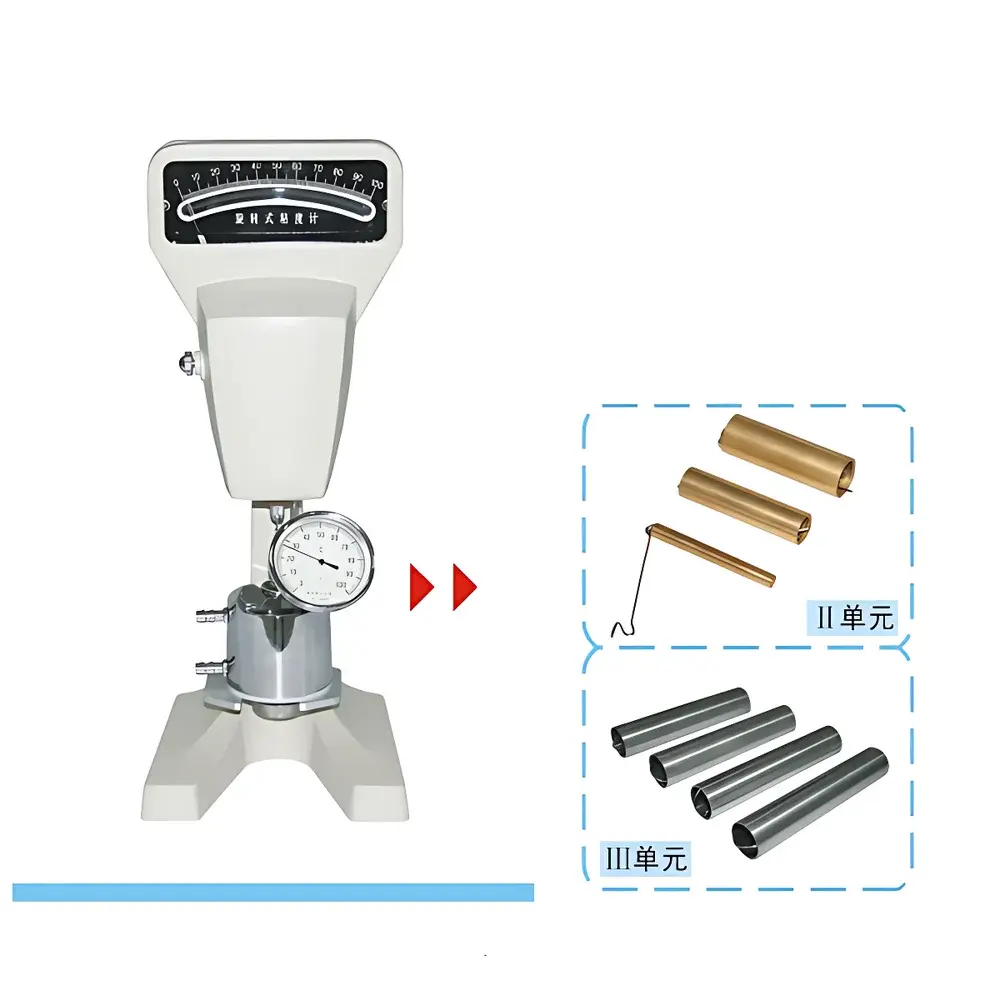
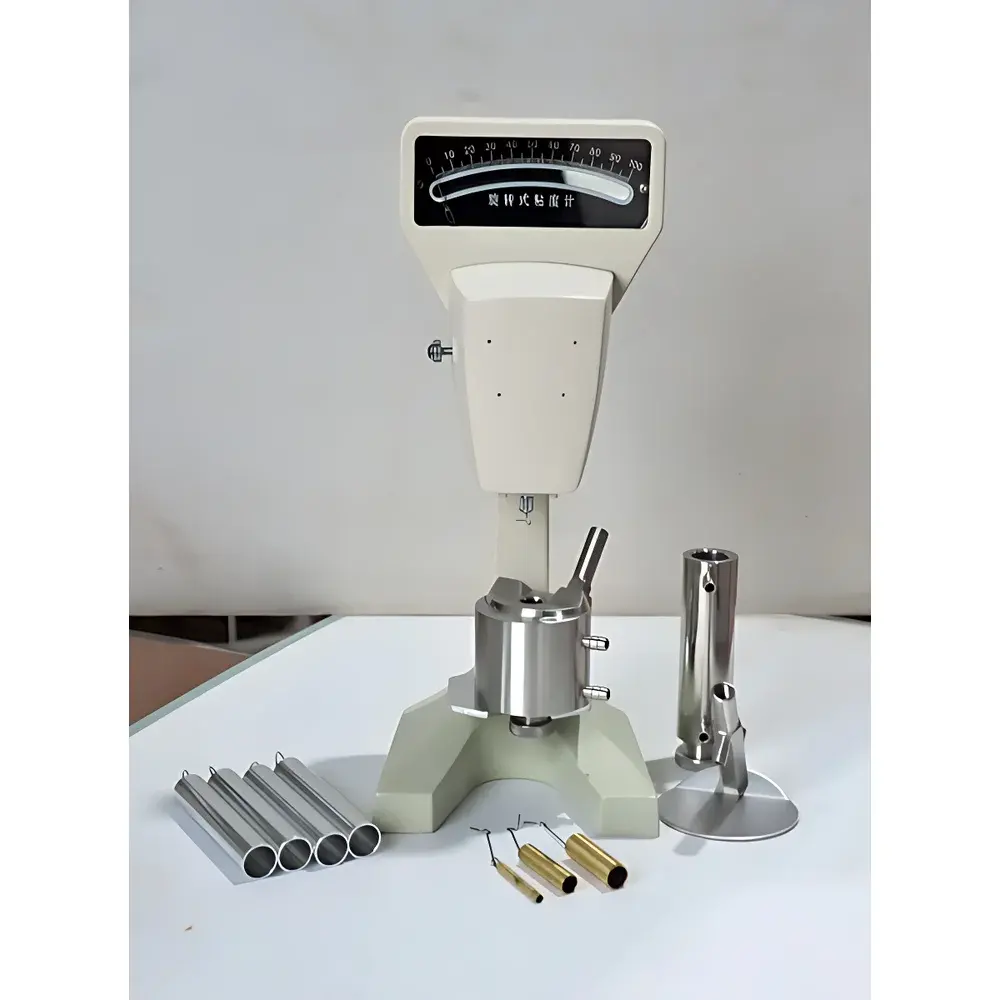
Yoyi NDJ-79 Advanced Rotational Viscometer with Dual-Speed Motor and Dual Rotor Modules (II & III)
| Brand | Yoyi |
|---|---|
| Model | NDJ-79 |
| Type | Analog Mechanical Rotational Viscometer |
| Drive | Synchronous Motor (750/75/7.5 rpm) |
| Viscosity Range | 1–1×10⁶ mPa·s |
| Accuracy | ±5% (for Newtonian fluids) |
| Rotor Configuration | Modular Units II & III |
| Power Supply | AC 220 V, 50 Hz |
| Operating Temperature | 5–35 °C |
| Relative Humidity | ≤80% |
| Dimensions | 170 × 140 × 440 mm |
| Weight | 15 kg |
| Compliance | Designed per GB/T 2794–2013 (Chinese National Standard for Viscometer Performance Testing) |
| Application Scope | Laboratory QC, R&D, and routine viscosity assessment in industrial and academic settings |
Overview
The Yoyi NDJ-79 is a precision analog mechanical rotational viscometer engineered for reliable measurement of dynamic viscosity in Newtonian liquids and apparent viscosity in non-Newtonian fluids. It operates on the principle of torsional equilibrium—utilizing a constant-speed synchronous motor to rotate a cylindrical spindle (rotor) immersed in the test fluid. The viscous drag torque acting on the rotor induces a proportional angular deflection in the motor housing, which is restrained by dual counter-wound phosphor-bronze helical springs. This mechanical displacement rotates a pointer across a calibrated dial, where the reading—when multiplied by the rotor-specific calibration factor—yields dynamic viscosity in millipascal-seconds (mPa·s). Unlike digital or microprocessor-based instruments, the NDJ-79 relies on passive mechanical feedback, eliminating dependency on software algorithms or electronic signal conditioning. Its design prioritizes long-term stability, minimal drift, and operational robustness under ambient laboratory conditions without requiring temperature-controlled enclosures or external calibration verification tools.
Key Features
- Triple-speed synchronous motor drive delivering precise rotational speeds of 750 rpm, 75 rpm, and 7.5 rpm—enabling broad shear rate coverage across low-, medium-, and high-viscosity regimes
- Dual modular rotor system (Units II and III), each comprising geometrically distinct spindles optimized for specific viscosity ranges and sample geometries
- Mechanical torsion-spring transduction mechanism ensures inherent linearity and immunity to electromagnetic interference or power supply fluctuations
- Calibrated analog dial display with direct-read scale; no battery or firmware required—ideal for environments with limited IT infrastructure or strict GLP documentation requirements
- Stable suspension mount for motor assembly minimizes vibration transmission and enhances measurement repeatability
- Compact benchtop footprint (170 × 140 × 440 mm) and self-contained 15 kg mass provide structural rigidity without need for anchoring or anti-vibration platforms
Sample Compatibility & Compliance
The NDJ-79 accommodates a wide range of industrial and research-grade fluids—including solvent-based coatings, polymer melts, edible oils, pharmaceutical suspensions, cosmetic emulsions, and latex dispersions—provided sample volume exceeds minimum immersion depth for selected rotors. It complies with fundamental metrological principles outlined in GB/T 2794–2013, China’s national standard for rotational viscometer performance evaluation. While not certified to ISO 2555 or ASTM D2196, its mechanical architecture aligns with core physical definitions of dynamic viscosity (η = τ/γ̇) and supports traceable calibration using NIST-traceable silicone oil standards. The instrument is suitable for use in environments meeting ISO/IEC 17025 preconditions, particularly where audit trails rely on manual logbook entries rather than electronic data capture.
Software & Data Management
The NDJ-79 operates entirely without embedded software, firmware, or digital interfaces. All measurements are recorded manually via operator transcription from the analog dial into laboratory notebooks or LIMS-compatible spreadsheets. This architecture inherently satisfies regulatory constraints associated with FDA 21 CFR Part 11 when electronic records are not generated—eliminating requirements for electronic signature validation, audit trail configuration, or cybersecurity controls. For laboratories implementing paper-based GLP workflows, the absence of software dependencies simplifies qualification (IQ/OQ/PQ) and reduces validation burden during internal audits or regulatory inspections.
Applications
This viscometer serves as a foundational tool in quality control laboratories across paint & coatings, food processing, personal care formulation, and polymer manufacturing sectors. It is routinely deployed for batch release testing of lubricants, consistency grading of edible fats, shelf-life monitoring of suspensions, and preliminary rheological screening prior to advanced rotational rheometry. In academic settings, it supports undergraduate physics and chemical engineering labs in teaching fundamental concepts of shear stress, shear rate, Newtonian behavior, and viscosity-temperature relationships. Its mechanical simplicity also makes it suitable for field-deployable units in remote production facilities lacking stable IT infrastructure.
FAQ
Is the NDJ-79 compliant with international standards such as ISO or ASTM?
It conforms to GB/T 2794–2013, China’s national standard for viscometer performance. While not formally certified to ISO 2555 or ASTM D2196, its measurement principle and calibration methodology are physically consistent with those standards.
Can this instrument measure yield stress or thixotropy?
No. As a single-point, constant-shear-rate device, it does not support controlled-stress ramping, time-dependent recovery tests, or oscillatory modes required for yield stress or thixotropic characterization.
What maintenance is required for long-term accuracy?
Annual mechanical inspection of spring tension, rotor thread integrity, and bearing smoothness is recommended. Calibration verification using reference oils at all three speeds should be performed quarterly in regulated environments.
Does the NDJ-79 require temperature control during operation?
No built-in temperature regulation is provided. Users must stabilize sample temperature externally (e.g., water bath) when reporting viscosity values referenced to standardized temperatures (e.g., 25 °C), per ASTM D445 guidelines.
How is traceability established for calibration?
Traceability is achieved through use of NIST-traceable calibration oils and documented comparison against master instruments maintained under ISO/IEC 17025-accredited calibration programs.



