
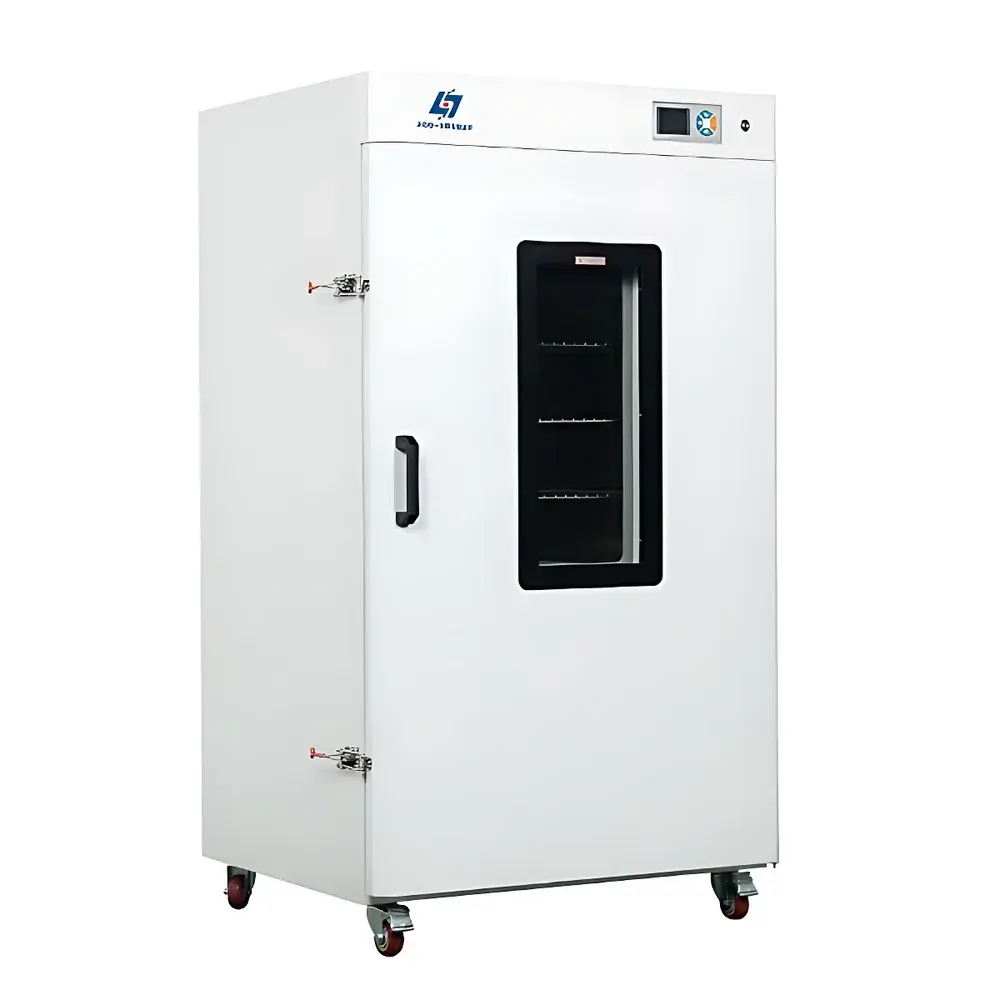
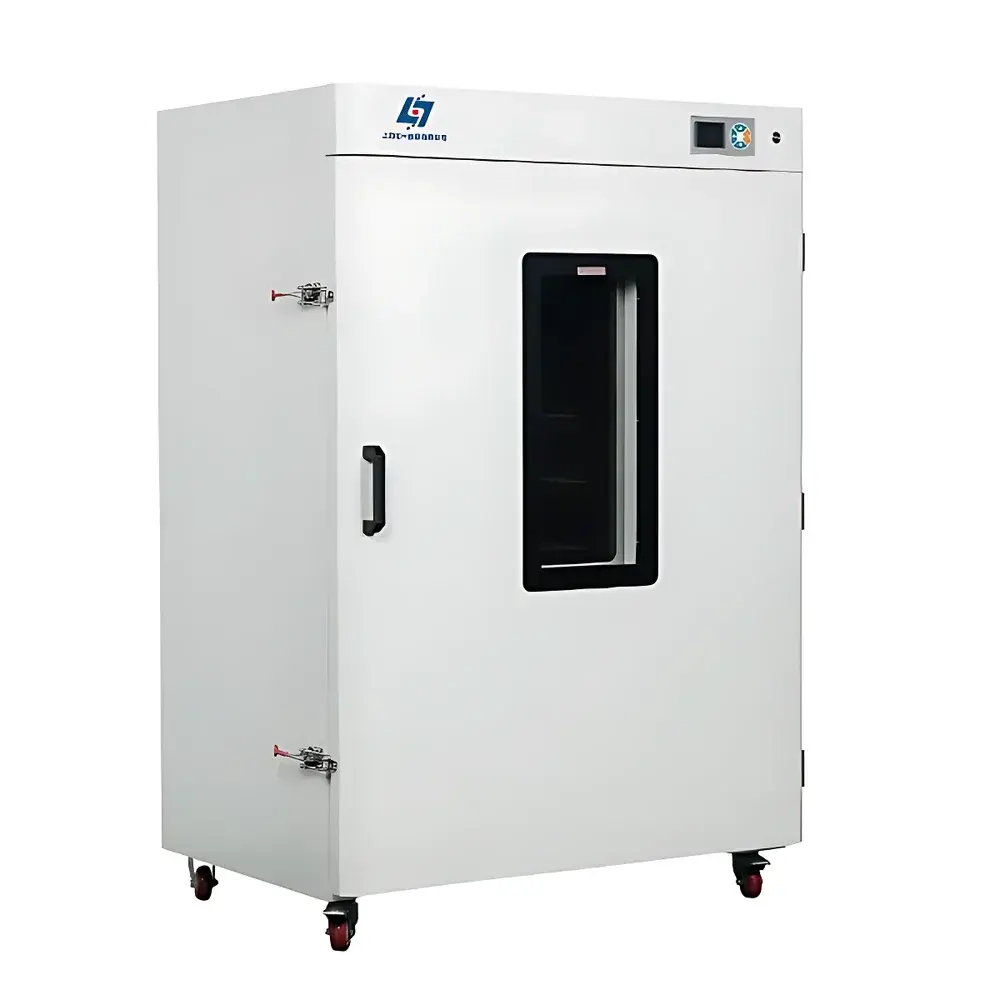
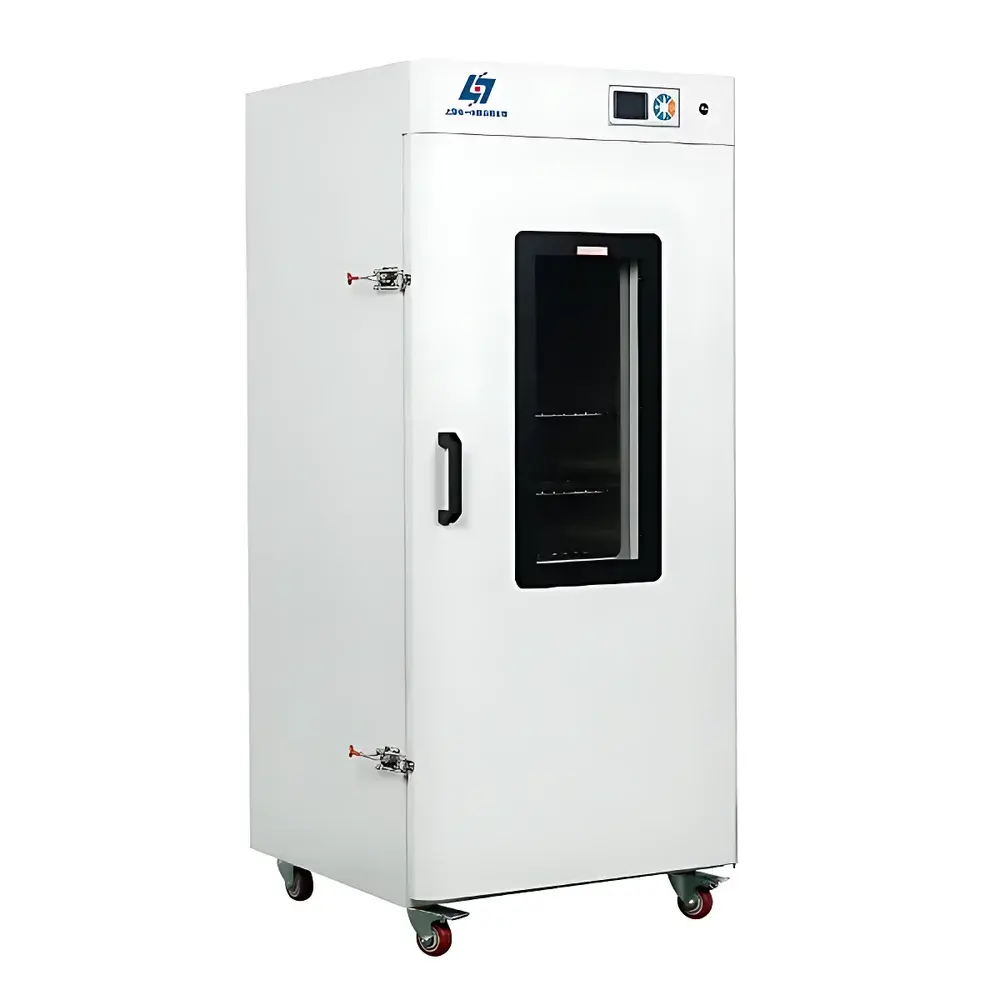
Yoyi DHG-9965C Nitrogen-Purged Forced-Air Drying Oven
| Brand | Yoyi |
|---|---|
| Origin | Shanghai, China |
| Manufacturer Type | Direct Manufacturer |
| Instrument Type | General-Purpose Drying Oven |
| Model | DHG-9965C |
| Temperature Stability | ±1 ℃ |
| External Dimensions | 1180 × 910 × 1750 mm |
| Temperature Range | RT+10 ℃ to 300 ℃ |
| Internal Chamber Dimensions | 1000 × 800 × 1300 mm |
| Temperature Resolution | 0.1 ℃ |
| Chamber Material | Mirror-Finish Stainless Steel (SUS304) |
| Heating Method | Electric Resistance Heating |
| Temperature Uniformity | ±2.5% (measured at 100 ℃, non-purged condition) |
| Inert Gas Inlet | Φ10 mm |
| Nitrogen Flow Control | 0–10 L/min (equipped with precision float flowmeter) |
Overview
The Yoyi DHG-9965C is a high-capacity, nitrogen-purged forced-air drying oven engineered for laboratories requiring inert-atmosphere thermal processing. Unlike standard convection ovens, the DHG-9965C integrates a dedicated nitrogen inlet system with calibrated mass flow control to actively displace ambient air—reducing oxygen concentration and minimizing oxidation, hydrolysis, or degradation of sensitive samples. Its thermally optimized wind tunnel architecture ensures uniform heat distribution across the 1000 L working chamber (1000 × 800 × 1300 mm), while the microprocessor-based PID temperature controller maintains setpoint stability within ±1 ℃ under steady-state conditions. Designed for continuous operation in GLP-compliant environments, the unit supports applications ranging from moisture-free polymer curing and pharmaceutical excipient drying to pre-sterilization conditioning of surgical instruments and controlled thermal aging of electronic components.
Key Features
- Stainless steel mirror-finish interior (SUS304) with seamless welded corners—resistant to corrosion, easy to clean, and compliant with ISO 14644-1 Class 8 cleanroom-compatible surface requirements.
- Dual-layer tempered glass observation window with silicone gasket seal—enables real-time visual monitoring without thermal interruption or pressure loss.
- Intelligent PID temperature control via 4.3-inch backlit LCD interface—supports multi-segment parameter display (setpoint, actual chamber temperature, elapsed/remaining time) and programmable ramp-soak profiles.
- Automatic ventilation management: rear-mounted motorized intake/exhaust ports synchronize with internal humidity sensors to purge condensate vapor—eliminating manual vent adjustment and preventing moisture reabsorption during cooldown.
- Integrated nitrogen delivery subsystem: standardized Φ10 mm quick-connect port paired with a calibrated glass-tube float flowmeter (0–10 L/min range) for repeatable gas substitution rate control.
- Robust structural design: cold-rolled steel outer casing with epoxy-polyester powder coating; reinforced door frame with high-temperature silicone sealing gasket (rated to 350 ℃); adjustable stainless steel shelving (3 removable trays included).
- Power-failure recovery logic: retains all active parameters—including temperature setpoint, timer status, and alarm thresholds—in non-volatile memory; resumes operation automatically upon power restoration.
Sample Compatibility & Compliance
The DHG-9965C accommodates diverse sample formats including Petri dishes, aluminum weighing pans, glass desiccators, stainless steel trays, and custom fixtures up to 800 mm depth. Its inert atmosphere capability makes it suitable for processing oxygen-sensitive materials such as lithium battery cathode precursors, organometallic catalysts, perovskite thin films, and lyophilized biologics intermediates. The oven meets mechanical safety requirements per IEC 61010-1:2010 and electromagnetic compatibility standards EN 61326-1:2013. While not certified for explosion-proof use, its nitrogen purging function aligns with OSHA 1910.1200 (HCS) hazard mitigation practices for thermally unstable compounds. Optional RS485 communication enables integration into centralized lab infrastructure for audit-ready data logging under FDA 21 CFR Part 11-compliant systems when paired with validated software.
Software & Data Management
The embedded controller records timestamped temperature readings at 10-second intervals and stores up to 10,000 data points internally. Optional RS485 serial interface (available as add-on) permits bidirectional communication with third-party SCADA platforms or LIMS using Modbus RTU protocol. When configured with the optional embedded printer module, hard-copy thermal validation reports—including start/end times, max/min deviations, and nitrogen flow verification stamps—can be generated on demand. All configuration changes are logged with user ID (if network-authenticated), timestamp, and parameter delta—supporting ALCOA+ data integrity principles for regulated QC/QA workflows.
Applications
- Drying of hygroscopic or oxidation-prone chemicals (e.g., sodium borohydride, titanium isopropoxide) under controlled N₂ blanket.
- Thermal stabilization of calibration standards prior to gravimetric analysis (ASTM E145-22 Annex A3).
- Pre-baking of PCB assemblies and semiconductor packaging substrates to eliminate residual moisture before encapsulation (IPC-CC-830B).
- Accelerated aging studies of elastomers and adhesives per ISO 188:2011 (hot-air oven method).
- Moisture removal from ceramic green bodies prior to sintering—without carbon contamination from ambient combustion byproducts.
- Heat treatment of reference materials used in differential scanning calorimetry (DSC) baseline calibration.
FAQ
What inert gases are compatible with the DHG-9965C?
Nitrogen (N₂) is the primary and validated gas; argon (Ar) may also be used if verified for material compatibility and flow calibration.
Is the temperature uniformity specification valid under nitrogen purge?
The stated ±2.5% uniformity is measured at 100 ℃ in non-purged air mode per IEC 60068-3-5. Under active N₂ flow, uniformity improves marginally due to enhanced convective mixing—but formal validation per ISO 17025 requires user-performed mapping with traceable probes.
Can the oven operate continuously at 300 ℃?
Yes—the heating elements, insulation, and chamber seals are rated for uninterrupted operation at maximum setpoint, provided ambient room temperature remains ≤40 ℃ and ventilation clearance ≥100 mm is maintained on all sides.
Does the unit include validation documentation?
Factory-assembled IQ/OQ documentation packages are available upon request; PQ execution must be performed on-site using user-defined protocols and NIST-traceable instrumentation.
What is the recommended maintenance interval?
Inspect door gasket integrity and clean air intake filters every 3 months; verify temperature sensor calibration annually using a Class A PT100 reference probe.



