
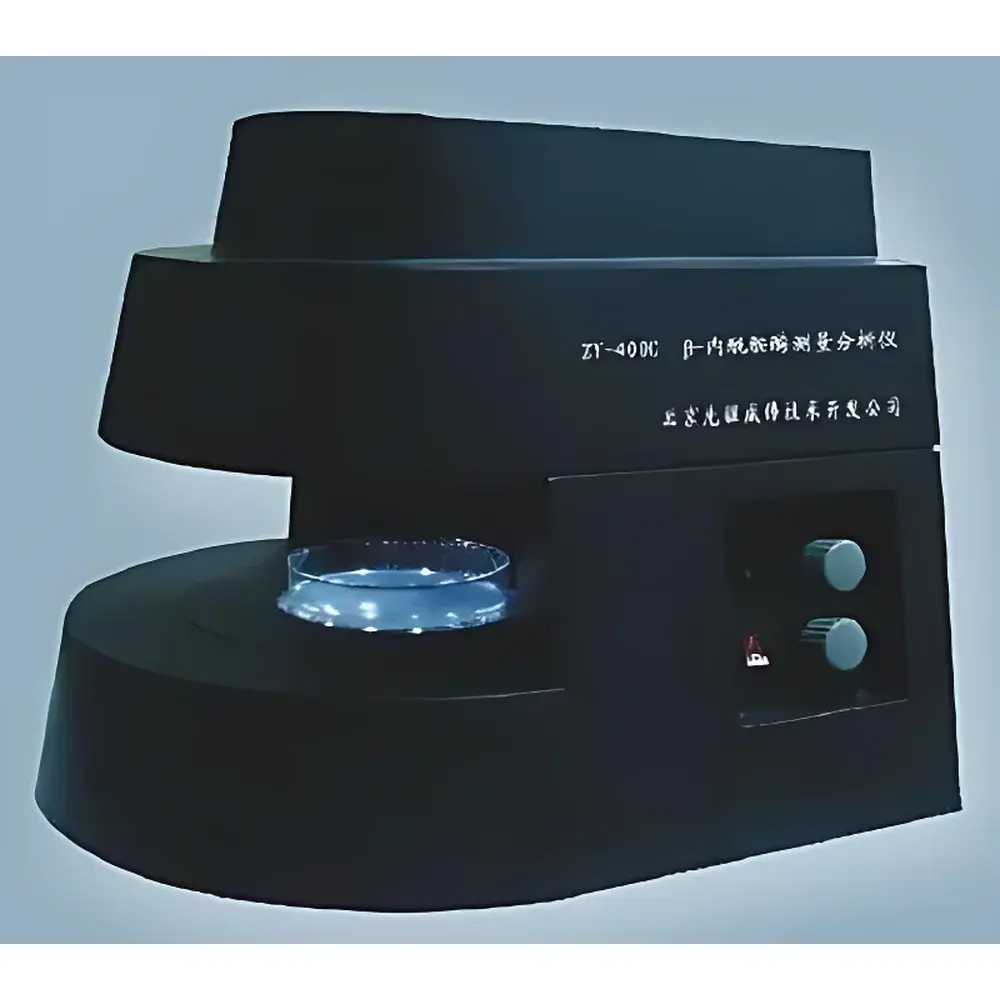
Forerunner ZY-400 Series β-Lactamase Analyzer for Dairy Applications
| Brand | Forerunner |
|---|---|
| Model | ZY-400 Series |
| Origin | Beijing, China |
| Instrument Type | Automated Microbiological Assay System for β-Lactamase Detection in Milk and Dairy Products |
| Measurement Principle | Turbidimetric/Zone-of-Inhibition-Based Enzymatic Activity Quantification |
| Resolution | 0.0105 mm |
| Repeatability Precision | ≤0.02 mm |
| Inter-instrument Variation | ≤0.5% |
| Potency Reproducibility | ≤0.5% |
| Compliance Framework | Aligned with Chinese National Standard for Detection of Susceptible β-Lactamases in Milk (e.g., GB/T 22338–2008 or equivalent) |
Overview
The Forerunner ZY-400 Series β-Lactamase Analyzer is a dedicated, automated microbiological assay platform engineered for the quantitative detection of sulbactam-sensitive β-lactamase activity—commonly referred to as “Jinyulan enzyme”—in raw milk, pasteurized milk, infant formula, whey-based products, and other dairy matrices. It operates on a validated turbidimetric and zone-of-inhibition principle: β-lactamase hydrolyzes β-lactam antibiotics (e.g., penicillin G) added to standardized test tubes; residual antibiotic activity is then assessed via growth inhibition of a susceptible indicator strain (typically Bacillus subtilis ATCC 6633 or equivalent). The instrument captures high-resolution digital images of agar diffusion plates or microtiter-based assay tubes using a calibrated CCD imaging system, measures inhibition zone diameters with sub-pixel accuracy, and computes enzymatic activity relative to reference standards and water controls. Designed specifically for regulatory and quality control laboratories in dairy processing, veterinary public health, and food safety inspection agencies, the ZY-400 series implements a protocol harmonized with national standard methodologies (e.g., GB/T 22338–2008), ensuring method traceability and technical alignment with official verification requirements.
Key Features
- High-precision CCD imaging module with auto-focus and uniform LED illumination, enabling consistent capture of inhibition zones across variable tube geometries and agar thicknesses.
- Automated recognition of tube positions (A, B, D controls) and simultaneous measurement of multiple inhibition zone diameters per sample—reducing manual interpretation bias and inter-operator variability.
- Optical character recognition (OCR) engine trained on standard antibiotic disk labels and assay tube markings, supporting automatic assignment of inhibition zones to corresponding reagents and controls.
- Algorithm-driven result validation logic: cross-references zone diameters from pure water controls (A, B, D tubes) against predefined acceptance criteria to flag assay validity before potency calculation.
- Binary classification engine that determines positive/negative status based on comparative zone diameter thresholds between sample tubes (A, B) and reference controls—fully compliant with decision rules defined in national dairy testing protocols.
- Integrated invalid-report detection: identifies outliers, saturation artifacts, poor contrast, or misaligned tubes and triggers real-time alerts prior to report generation.
- GLP/GMP-ready audit trail: timestamps all user actions, image acquisitions, parameter modifications, and final reports; supports electronic signatures and immutable data archiving.
- Native Windows-based application with intuitive workflow navigation, drag-and-drop file management, and version-controlled software updates backed by lifetime technical support.
Sample Compatibility & Compliance
The ZY-400 analyzer accommodates standard 13 × 100 mm glass test tubes, 16-mm culture tubes, and 96-well microplates configured for semi-automated broth microdilution formats. It accepts samples prepared according to standardized pre-treatment protocols—including fat removal, pH adjustment, and heat stabilization—as specified in GB/T 22338–2008 and related guidance documents. All measurement outputs adhere to metrological traceability principles outlined in ISO/IEC 17025:2017 for testing laboratories. While not FDA 21 CFR Part 11-certified out-of-the-box, the system’s data integrity architecture—including write-protected raw image storage, sequential audit logs, and exportable CSV/PDF reports—facilitates validation under GLP and GMP environments where local regulatory authorities accept locally harmonized methods.
Software & Data Management
The proprietary Forerunner AnalyzeSuite™ v4.x software provides full lifecycle data handling: from assay setup and calibration curve definition to statistical summary and regulatory reporting. Raw images are stored losslessly in TIFF format with embedded EXIF metadata (timestamp, operator ID, instrument serial number). Reports comply with GLP Annex 11-equivalent documentation standards—listing all raw measurements, intermediate calculations (e.g., log-linear interpolation of zone diameter vs. enzyme concentration), control pass/fail status, and final interpretive conclusions. Batch export functions support LIMS integration via ODBC-compliant database connectors. All user accounts enforce role-based access control (RBAC), and software updates are delivered through a secure, authenticated portal with versioned release notes and impact assessments.
Applications
- Routine screening of raw milk at dairy collection centers for illicit β-lactamase adulteration intended to mask antibiotic residues.
- Verification of thermal stability and inactivation kinetics of β-lactamase during pasteurization and UHT processing.
- Method validation and proficiency testing in national food safety laboratories conducting inter-laboratory comparisons under CNAS accreditation.
- Quality assurance audits in infant formula manufacturing facilities subject to GB 10765–2021 and related product standards.
- Research applications investigating enzyme kinetics, inhibitor interactions, and matrix interference effects in complex dairy emulsions.
FAQ
What regulatory standards does the ZY-400 Series comply with?
It implements methodology aligned with GB/T 22338–2008 (“Determination of Sulbactam-Sensitive β-Lactamase in Milk and Dairy Products”) and supports laboratory compliance with ISO/IEC 17025:2017 requirements for measurement uncertainty and traceability.
Can the system be validated for use in a GMP environment?
Yes—the software architecture includes audit trails, electronic signatures, and immutable data logging; however, site-specific IQ/OQ/PQ validation must be performed by the end-user laboratory per internal SOPs and local regulatory expectations.
Does the instrument require external calibration standards?
Yes—users must prepare and run reference β-lactamase standards (e.g., purified TEM-1 or commercial lyophilized controls) alongside each assay batch to establish the dose-response curve used for quantification.
Is remote maintenance or software update support available internationally?
Forerunner provides remote diagnostics and secure over-the-internet software updates for registered instruments; English-language technical documentation and training materials are included with all deployments.
What sample throughput can be achieved per hour?
Under standard operating conditions (48-tube configuration, 30-min incubation post-inoculation), the system processes up to 12 complete assay batches per 8-hour shift, assuming parallel plate preparation and automated image acquisition cycles.
Related Products





