
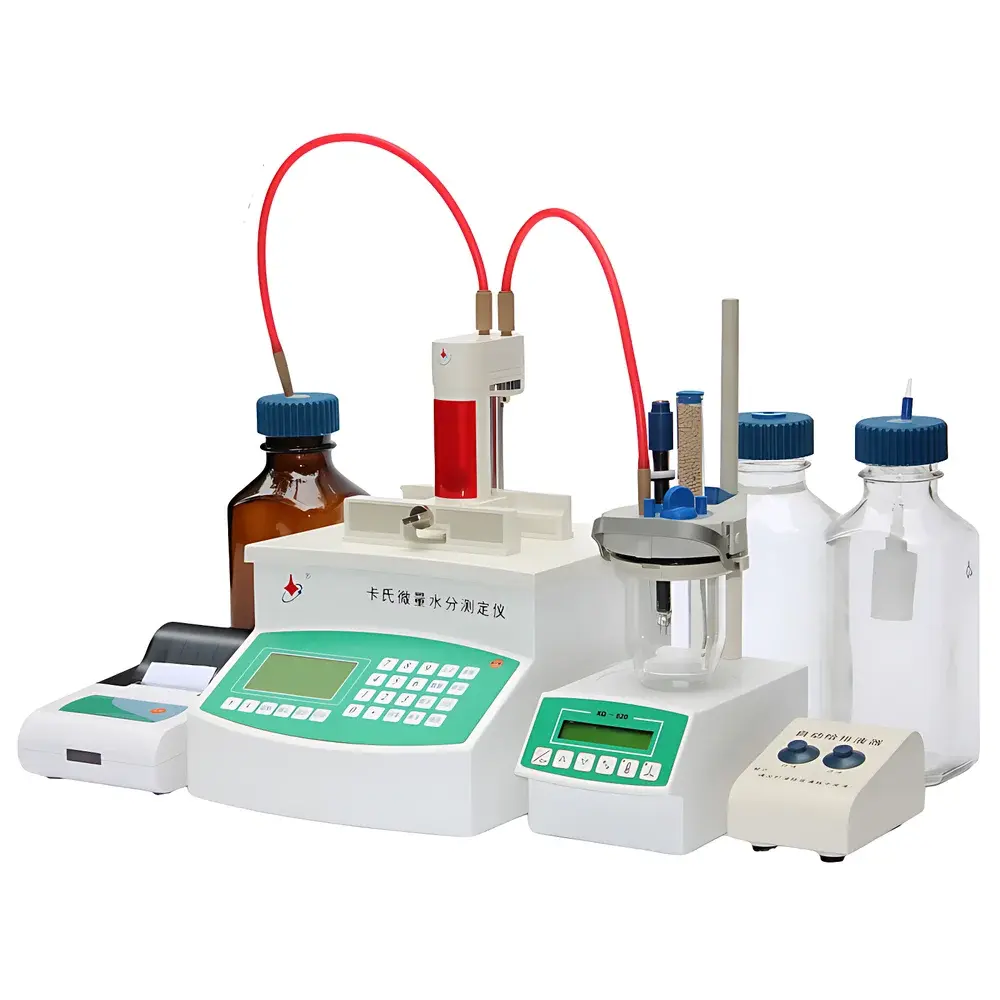
Forerunner ZDJ-3S Automated Karl Fischer Moisture Analyzer
| Brand | Forerunner |
|---|---|
| Origin | Beijing, China |
| Model | ZDJ-3S |
| Titration Mode | Fully Automatic |
| Method Principle | Volumetric & Coulometric Karl Fischer Titration |
| Current Resolution | 0.01 µA |
| Moisture Range | 10 ppm to 100% w/w |
| Measurement Accuracy | ±10 ppm |
| Minimum Dispensing Volume | 0.1 µL (1/20000 of burette volume) |
| Titration Control Precision | 0.1 µL |
| Polarization Voltage Output | 0–2550 mV (10 mV step, <±3% error) |
| Max Polarization Current | 5 mA |
| Current Range | 0–200 µA |
| Effective Current Accuracy | ±0.1 µA |
| Drift Compensation | Auto/manual background subtraction |
| Data Output Compliance | GLP/GMP-compliant reporting format |
| Interface | RS-232C (printer & PC connection) |
| Method Storage | 100 protocols |
| Optional | Dead-stop titration capability with accessory kit |
Overview
The Forerunner ZDJ-3S Automated Karl Fischer Moisture Analyzer is a dual-mode (volumetric and coulometric) electrochemical titration system engineered for precise, trace-level water quantification in diverse chemical, pharmaceutical, petrochemical, and polymer matrices. It operates on the fundamental stoichiometric reaction between iodine and water in the presence of sulfur dioxide, a base (e.g., imidazole), and methanol—governed by the Karl Fischer principle. The instrument employs bipotentiometric endpoint detection with dynamic polarization voltage control (0–2550 mV, adjustable in 10 mV increments), enabling high sensitivity across low-concentration regimes (down to 10 ppm). Its microprocessor-driven architecture integrates real-time current monitoring (0–200 µA range, 0.01 µA resolution), adaptive drift compensation algorithms, and closed-loop temperature regulation—ensuring thermally stable reaction kinetics and minimizing evaporation artifacts during titration.
Key Features
- Fully automated titration sequence—including solvent delivery, electrode conditioning, sample injection, endpoint detection, and waste evacuation—minimizing operator intervention and inter-laboratory variability.
- Hermetically sealed titration cell with inert gas purge capability, preventing ambient moisture ingress and ensuring measurement integrity in low-humidity environments.
- Precision piston-driven burette with push-in modular design and anti-diffusion titration tip, delivering volumetric accuracy of ±0.1 µL and repeatable dispensing at 1/20000 of full burette volume.
- Intelligent drift compensation logic supporting both automatic and user-defined baseline subtraction, critical for samples exhibiting slow background current drift (e.g., hygroscopic solids or viscous oils).
- Integrated thermal management system with PID-controlled heating/cooling interfaces—compatible with external Peltier coolers or heated sample chambers—to maintain optimal reaction temperature (typically 20–30°C) per ASTM E203 and ISO 760 compliance protocols.
- GLP/GMP-ready data handling: timestamped audit trails, electronic signatures, method versioning, and report generation conforming to FDA 21 CFR Part 11 requirements when paired with validated software configurations.
Sample Compatibility & Compliance
The ZDJ-3S accommodates solid, liquid, and gaseous samples via optional accessories—including oven couplers for volatile solids (per USP ), gas diffusion cells for dissolved water in gases, and homogenizer-integrated samplers for heterogeneous polymers. It meets core international standards for moisture analysis: ISO 760 (general KF methodology), ASTM E203 (water in organic liquids), ASTM D6304 (petroleum products), and pharmacopeial monographs (USP , EP 2.5.12, JP 2.05). All hardware components—including glassware, electrodes, and reagent lines—are chemically resistant to KF reagents (e.g., pyridine-free solvents), ensuring long-term stability and reproducibility.
Software & Data Management
The Windows-based monitoring software communicates via RS-232C interface, providing real-time visualization of titration curves (current vs. time), dynamic endpoint recognition, and post-run statistical evaluation (mean, RSD, confidence intervals). It supports method creation with multi-step parameter scripting (e.g., pre-titration drying, variable titrant addition rates, conditional endpoint termination). Data export is available in CSV, PDF, and XML formats; raw files retain full metadata (operator ID, environmental conditions, calibration logs). Firmware updates and method library synchronization are performed remotely through the same interface, reducing downtime and supporting continuous validation lifecycle management.
Applications
- Pharmaceutical QC: Residual moisture in lyophilized APIs, excipients, and blister-packaged tablets (critical for stability per ICH Q5C).
- Polymer manufacturing: Water content in polyamide, polyurethane, and silicone precursors—directly impacting polymerization kinetics and final molecular weight distribution.
- Electrolyte quality control: Trace water in lithium-ion battery electrolytes (LiPF6/carbonate blends), where >20 ppm H2O triggers HF formation and cell degradation.
- Fuel analysis: Water quantification in aviation turbine fuels (ASTM D6304) and biodiesel (EN 14103), where phase separation and microbial growth correlate strongly with ppm-level contamination.
- Food science: Moisture in low-water-activity matrices (e.g., powdered milk, spices), where accurate determination informs shelf-life modeling and regulatory labeling compliance (FDA 21 CFR 101.9).
FAQ
What KF titration methods does the ZDJ-3S support?
It natively supports both volumetric and coulometric Karl Fischer titration, with method selection configurable per sample type and concentration range.
Is the instrument compliant with 21 CFR Part 11 for electronic records?
Yes—when deployed with validated software configuration, role-based access controls, and enabled audit trail logging, it satisfies predicate rule requirements for regulated laboratories.
Can the ZDJ-3S analyze solid samples directly?
Solid samples require dissolution in compatible KF solvents or coupling with a heated oven adapter (optional); direct solid titration is not supported due to incomplete reagent contact.
What maintenance is required for long-term accuracy?
Daily electrode cleaning with dry methanol, quarterly burette calibration using certified standard water solutions (e.g., 1.00 mg H2O/mL), and annual verification of polarization circuit linearity per manufacturer’s service protocol.
Does the system support dead-stop (biamperometric) titration?
Yes—via optional dead-stop electrode kit and firmware-enabled method template, expanding applicability to non-aqueous redox systems beyond classical KF chemistry.
Related Products






