
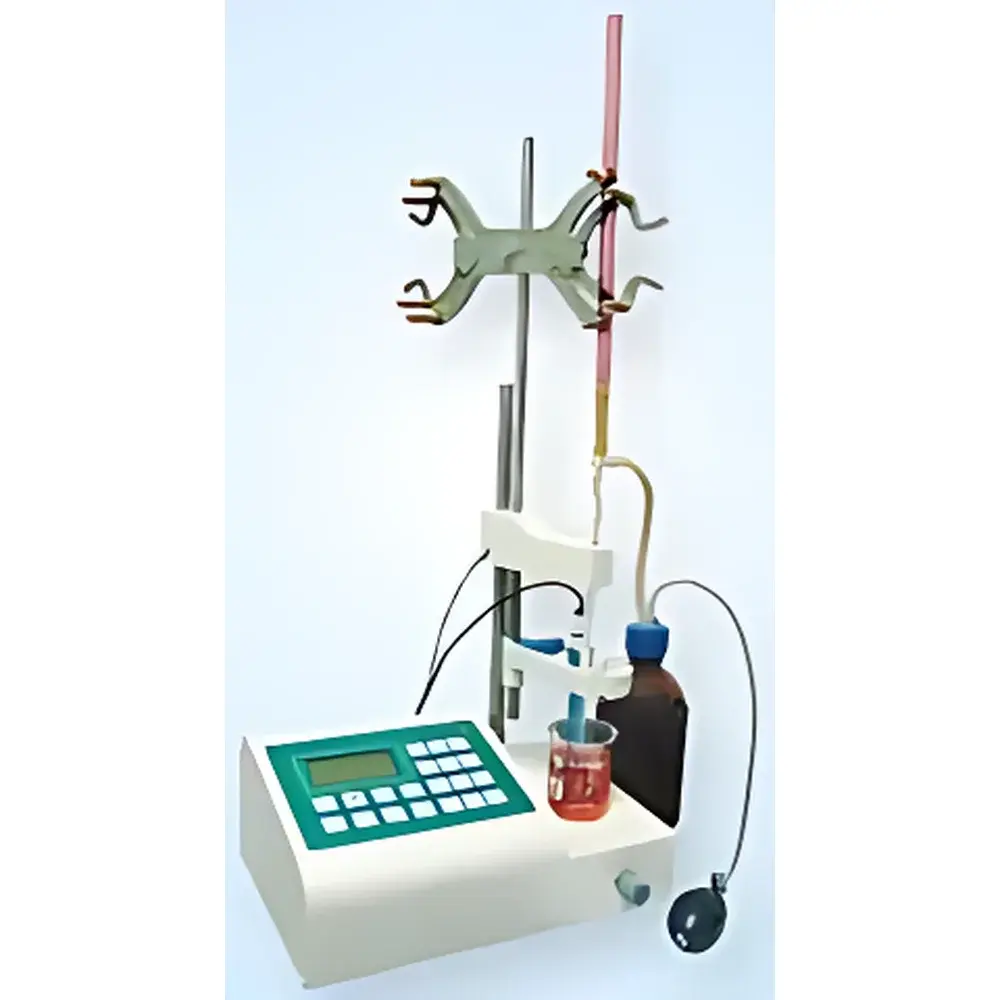
Forerunner ZDJ-100 Automatic Potentiometric Titrator
| Brand | Forerunner |
|---|---|
| Origin | Beijing, China |
| Model | ZDJ-100 |
| Instrument Type | General-purpose Automatic Potentiometric Titrator |
| Application Scope | General-purpose |
| Measurement Range | (-2000.0 to +2000.0) mV, (0.00 to 14.00) pH |
| Meter Accuracy | ±0.2% of full scale |
| Meter Resolution | 1 mV (mV mode), 0.01 pH (pH mode) |
| Titration Accuracy | (±0.3 mV ±1 digit) over 3 h |
| Input Impedance | ≥10¹⁵ Ω |
| Temperature Range (with optional thermostat) | -15 °C to +85 °C |
| Temperature Resolution | 0.1 °C |
| Temperature Accuracy (optional) | ±0.5 °C |
| Minimum Dispense Volume | 0.02 mL |
| Titration Control Precision | ±0.01 mL |
| Measurement Modes | Dynamic titration, Equivalence-point titration, Fixed-volume titration, Direct pH measurement |
| Interface Options | RS232C, Printer port (for optional thermal mini-printer) |
| Data Output | Real-time titration curve plotting, PC connectivity for process monitoring and post-analysis |
Overview
The Forerunner ZDJ-100 Automatic Potentiometric Titrator is a benchtop electrochemical analytical instrument engineered for precision, repeatability, and pedagogical clarity in academic and routine quality control laboratories. It operates on the fundamental principle of potentiometric titration—measuring the potential difference between a reference electrode and an indicator electrode as a function of titrant volume added—enabling accurate endpoint detection without reliance on visual indicators. Designed for teaching laboratories and entry-level QC environments, the ZDJ-100 supports classical volumetric analysis across acid-base, redox, complexometric, precipitation (e.g., argentometric), and ion-selective electrode (ISE) applications. Its architecture integrates a microprocessor-controlled burette drive, high-impedance electrometer circuitry (>10¹⁵ Ω input impedance), and real-time potential/pH acquisition at configurable sampling intervals. The system complies with foundational metrological requirements for educational instrumentation per ISO/IEC 17025:2017 Annex A.3 (equipment verification) and aligns with ASTM E2087–22 guidelines for potentiometric endpoint determination in aqueous systems.
Key Features
- High-stability electrometer with dual-range mV/pH measurement: ±2000.0 mV and 0.00–14.00 pH, resolved to 1 mV and 0.01 pH respectively
- Programmable titration modes: dynamic (inflection-based), equivalence-point (first-derivative), fixed-volume (stepwise addition), and direct pH measurement
- Motor-driven burette with ±0.01 mL volumetric control accuracy and minimum dispense volume of 0.02 mL
- Real-time graphical display of titration curves (E vs. V or dE/dV vs. V) directly on the built-in LCD interface
- Bilingual operation interface (Chinese/English) supporting both input and output—ideal for multilingual lab instruction
- RS232C serial interface for bidirectional communication with external PCs; compatible with Windows-based titration monitoring software
- Optional temperature control module (range: –15 °C to +85 °C) with ±0.5 °C stability for thermally sensitive titrations (e.g., weak acid–weak base)
- Integrated data logging and print-out capability via optional thermal mini-printer (IEEE 1284 compliant)
Sample Compatibility & Compliance
The ZDJ-100 accommodates standard glass-bodied combination electrodes (e.g., Ag/AgCl reference with pH-sensitive glass membrane) and interchangeable ISEs (e.g., fluoride, chloride, calcium). It supports aqueous and mixed-aqueous solvent systems typical in undergraduate chemistry curricula and industrial raw material testing. Electrode compatibility follows DIN 19262 and ASTM D1293–21 specifications for pH electrode calibration and maintenance. While not certified for GMP-regulated environments, its design enables traceable operation under GLP conditions: all titration events—including volume increments, potential readings, timestamps, and user IDs—are logged internally and exportable for audit review. Firmware supports version-controlled updates via PC link, ensuring alignment with evolving educational standards and method validation protocols.
Software & Data Management
The included Windows-compatible titration monitoring software provides live visualization of titration progress, overlay of multiple curves, and automated endpoint calculation using tangent, inflection, or Gran plot methods. Raw data exports to CSV or TXT formats for further statistical treatment in Excel or MATLAB. Audit trail functionality records operator login, method selection, calibration history, and result generation—supporting basic 21 CFR Part 11 compliance when paired with institutional electronic signature policies. Software updates are delivered digitally with SHA-256 checksum verification to ensure firmware integrity.
Applications
- Acid–base titrations: Determination of total acidity in vinegar, titratable alkalinity in water samples, or amine content in pharmaceutical intermediates
- Oxidation–reduction titrations: Quantification of iron(II) with ceric sulfate or ascorbic acid with iodine
- Complexometric titrations: EDTA-based determination of Ca²⁺/Mg²⁺ hardness in drinking water per ISO 6059
- Precipitation titrations: Chloride analysis via Mohr or Volhard methods using AgNO₃
- Direct ion concentration measurement: Using ISEs for F⁻ in toothpaste or NO₃⁻ in soil extracts
- Method development and validation exercises in analytical chemistry courses
FAQ
What electrode types are supported by the ZDJ-100?
Standard single-junction or double-junction pH electrodes, redox electrodes (Pt or Ag wire), and commercially available ion-selective electrodes (e.g., Orion, Thermo Fisher) with BNC or DIN connectors.
Can the instrument perform automatic calibration?
Yes—it supports two-point pH calibration (using NIST-traceable buffers) and mV offset verification against a known reference solution.
Is GLP-compliant data archiving possible?
Internal memory stores up to 100 complete titration reports with metadata; full export enables integration into institutional LIMS or electronic lab notebooks.
What safety certifications does the device hold?
Complies with GB 4793.1–2019 (equivalent to IEC 61010-1:2010) for electrical safety in laboratory equipment.
How is temperature compensation handled during pH measurement?
Manual temperature input is required for pH mode; optional PTC sensor integration enables automatic ATC (Automatic Temperature Compensation) per DIN 19266.





