
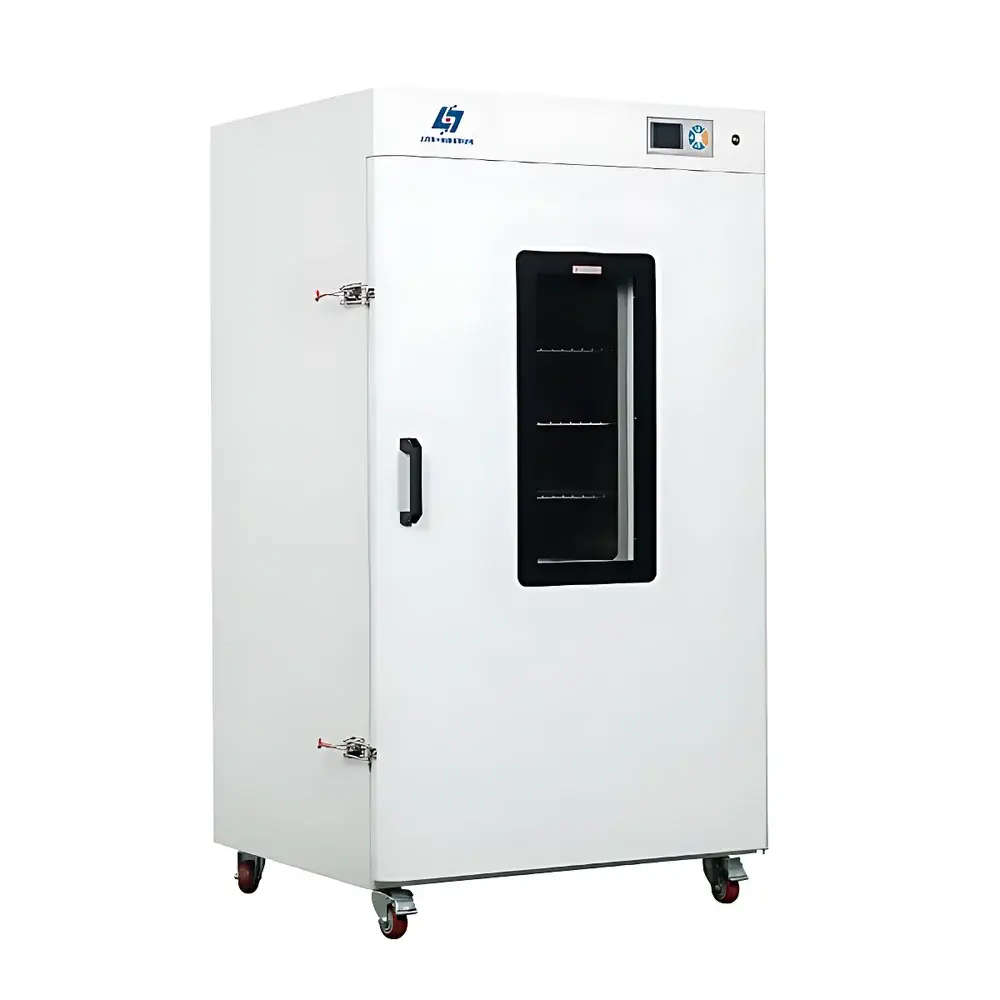
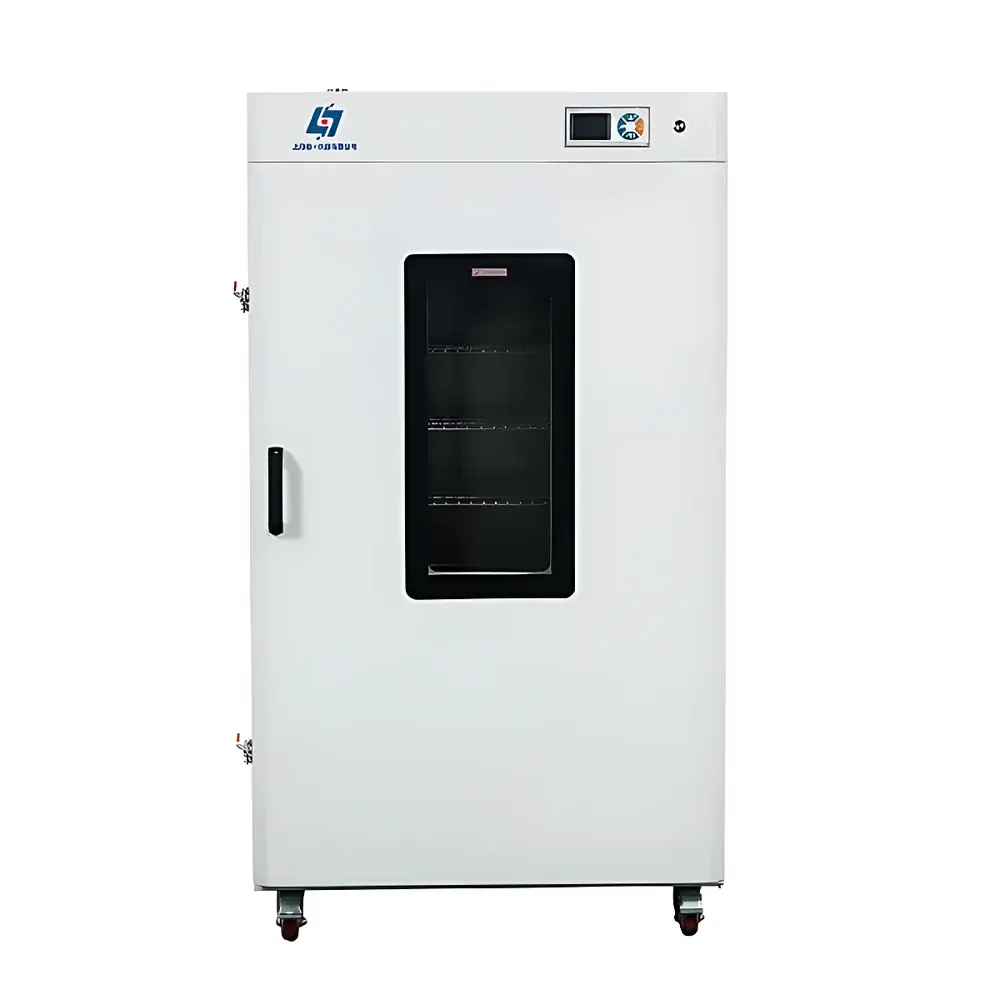
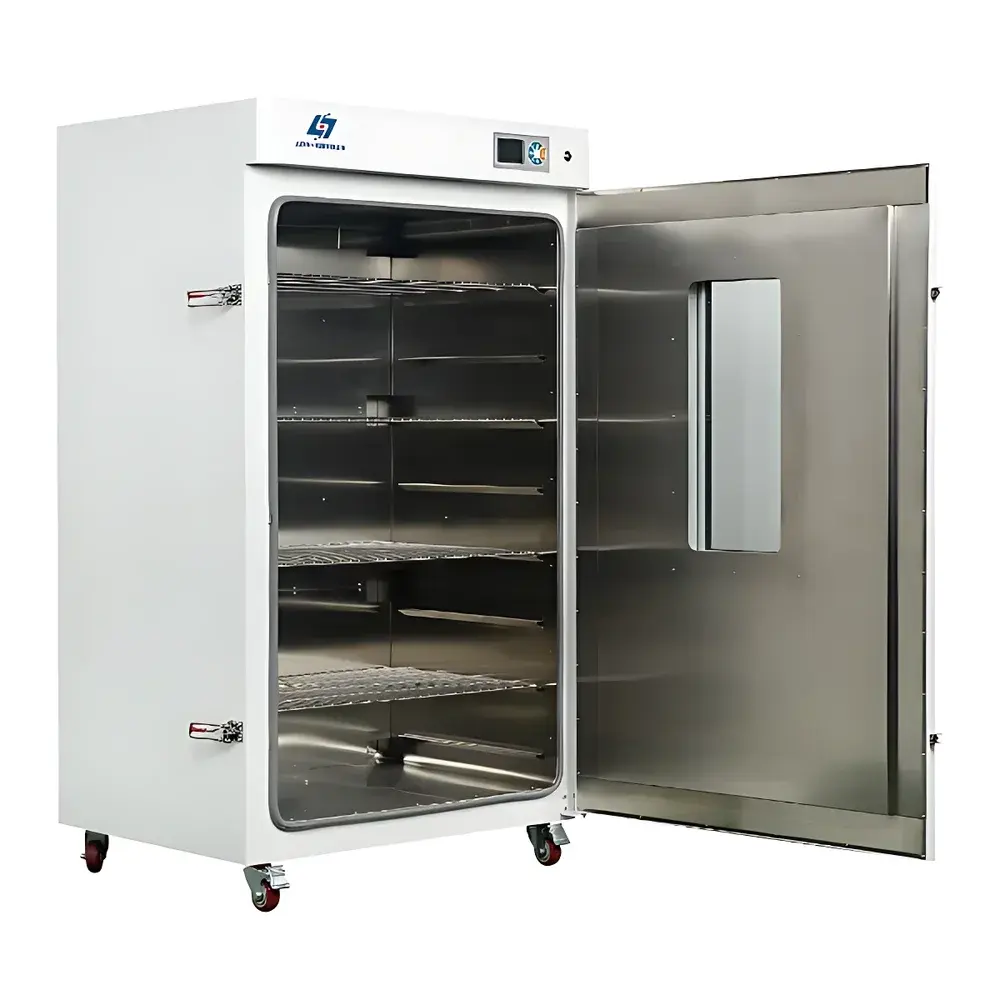
Yoyi DHG-9625C Vertical Nitrogen-Purged Forced-Air Drying Oven
| Brand | Yoyi |
|---|---|
| Origin | Shanghai, China |
| Manufacturer Type | Direct Manufacturer |
| Model | DHG-9625C |
| Temperature Fluctuation | ±1℃ |
| External Dimensions | 980×750×1750 mm |
| Temperature Control Range | RT+10 to 300℃ |
| Internal Chamber Dimensions | 800×640×1300 mm |
| Temperature Resolution | 0.1℃ |
| Interior Material | Mirror-Finish Stainless Steel (SUS304) |
| Heating Method | Electric Heaters with Balanced Air Distribution |
| Temperature Uniformity | ±2.5% (measured at 100℃, non-purged condition) |
| Inert Gas Inlet | Φ10 mm |
| Nitrogen Flow Rate Adjustment | 0–10 L/min (equipped with precision float flowmeter) |
| Control System | 4.3-inch LCD touchscreen with microcomputer-based PID algorithm |
| Power Supply | AC380V, 50 Hz |
| Rated Power | 4500 W |
| Working Environment | Ambient temperature RT+5 to 40℃, humidity ≤80% RH |
| Standard Load Capacity | 4 stainless steel adjustable shelves |
Overview
The Yoyi DHG-9625C is a vertically oriented, nitrogen-purged forced-air drying oven engineered for applications requiring controlled inert atmospheres and high thermal stability. It operates on the principle of convection-driven heat transfer, where a precisely regulated axial fan circulates preheated air through a multi-channel wind tunnel system—ensuring uniform thermal distribution across the large-volume chamber (620 L). Unlike standard drying ovens, the DHG-9625C integrates a dedicated inert gas management interface that enables continuous or intermittent nitrogen purging to displace ambient oxygen and moisture. This capability is critical for processing oxygen-sensitive materials—including thermally labile pharmaceutical intermediates, metal-organic precursors, lithium battery electrode coatings, and oxidation-prone polymer formulations—where even trace atmospheric exposure may compromise structural integrity, stoichiometry, or shelf life. The oven’s structural architecture complies with IEC 61010-1 safety standards for laboratory electrical equipment, and its thermal performance is validated under ISO 17025-accredited test conditions (empty chamber, no external vibration or electromagnetic interference, ambient 20℃/50% RH).
Key Features
- Vertical chamber design maximizes floor-space efficiency while accommodating tall or stacked samples—ideal for industrial R&D labs and QC environments with high throughput demands.
- Mirror-finish SUS304 stainless steel interior resists corrosion from acidic vapors, solvent residues, and repeated thermal cycling; seamless welds minimize particle entrapment.
- Microcomputer-controlled PID regulation with 0.1℃ resolution and ±1℃ temperature fluctuation ensures repeatability across extended dwell cycles (up to 9999 minutes).
- Dual-layer tempered glass observation window with silicone gasket seal maintains visual access without compromising thermal or inert gas integrity.
- Automated exhaust/intake duct system with rear-mounted ports actively removes condensate and volatile decomposition byproducts—eliminating manual venting and reducing operator intervention.
- Integrated Φ10 mm nitrogen inlet with calibrated float flowmeter (0–10 L/min range) allows precise, real-time adjustment of purge rate; compatible with standard CGA-580 or DIN 477 nitrogen supply manifolds.
- Robust cold-rolled steel outer casing with electrostatic epoxy coating provides mechanical durability and resistance to chemical splashes in shared lab environments.
- Power-fail recovery function retains all setpoints and elapsed time data during unexpected outages, resuming operation automatically upon power restoration.
Sample Compatibility & Compliance
The DHG-9625C supports diverse sample formats—from Petri dishes and crucibles to custom jigs and tray-stacked wafers—thanks to four independently adjustable stainless steel shelves (load capacity: 15 kg per shelf, uniformly distributed). Its inert atmosphere functionality aligns with ASTM E145-22 (Standard Specification for Gravity-Convection and Forced-Ventilation Ovens) and supports GLP-compliant workflows when paired with optional RS485 data logging (IEC 62591 WirelessHART or Modbus RTU protocol support available). For regulated industries, the oven’s temperature validation profile meets USP requirements for dry-heat sterilization process qualification when operated at ≥160℃ for ≥2 hours. Optional accessories—including independent overtemperature cut-off (UL-listed Class 3 thermal limiter), embedded thermal printer (for audit-ready hardcopy logs), and multi-segment programmable controller (up to 30 ramp/soak steps)—enable full 21 CFR Part 11 compliance when integrated with validated LIMS or ELN platforms.
Software & Data Management
The 4.3-inch capacitive touchscreen interface runs firmware v3.2.x with embedded event logging (timestamped start/stop, alarm triggers, door openings, nitrogen flow deviations). All operational parameters—including chamber temperature, setpoint, elapsed time, and real-time nitrogen flow rate—are stored internally for ≥10,000 cycles and exportable via USB 2.0 to CSV or PDF. Optional RS485 communication module enables bidirectional integration with LabVIEW, MATLAB, or enterprise MES systems using ASCII-based command sets. Audit trail functionality records user ID, action timestamp, and parameter change values—meeting ALCOA+ principles for data integrity in GMP environments. Firmware updates are performed via secure signed .bin files; no internet connectivity required during operation.
Applications
- Pharmaceutical: Residual solvent removal from active pharmaceutical ingredients (APIs) under inert conditions to prevent oxidative degradation prior to lyophilization or tablet compression.
- Materials Science: Pre-sintering of air-sensitive ceramic powders (e.g., TiN, SiC), annealing of perovskite thin films, and thermal stabilization of conductive polymer dispersions.
- Battery R&D: Drying of cathode/anode slurries on aluminum/copper foils without surface oxidation; post-coating moisture evacuation before calendaring.
- Food & Agriculture: Moisture content determination per AOAC 950.46 (with nitrogen blank correction), enzyme inactivation studies, and mycotoxin reference standard conditioning.
- Electronics: Outgassing of PCB substrates and conformal coatings prior to encapsulation; thermal aging of encapsulated sensors under controlled O2 partial pressure.
- Environmental Testing: Accelerated weathering simulation of polymer composites using sequential N2/humid air cycling protocols per ISO 4892-2.
FAQ
What inert gases are compatible with the DHG-9625C?
Nitrogen (N₂) is the primary recommended gas; argon (Ar) and helium (He) may also be used if purity ≥99.995% and dew point ≤−40℃. Compressed air or CO₂ are not supported due to reactivity or condensation risks.
Is calibration certificate included with shipment?
A factory-issued as-found/as-left calibration report (traceable to NIM China, uncertainty ±0.3℃ at 100℃) is provided. UKAS or DAkkS-accredited third-party certification is available upon request (lead time +7 business days).
Can the oven operate continuously at 300℃?
Yes—the heating elements, insulation, and sealing system are rated for uninterrupted operation at maximum setpoint. Chamber temperature uniformity remains within ±2.5% at 300℃ when nitrogen flow is maintained at ≥3 L/min.
How is temperature uniformity verified?
Per ISO 17025, uniformity is measured using nine calibrated PT100 probes arranged in a 3×3 vertical grid at center height; data collected over 30 minutes after thermal stabilization.
What maintenance intervals are recommended?
Fan motor lubrication every 12 months; silicone door gasket inspection quarterly; flowmeter recalibration annually or after 5000 operating hours—documented in the included Maintenance Logbook (EN 61000-6-2 compliant).



