
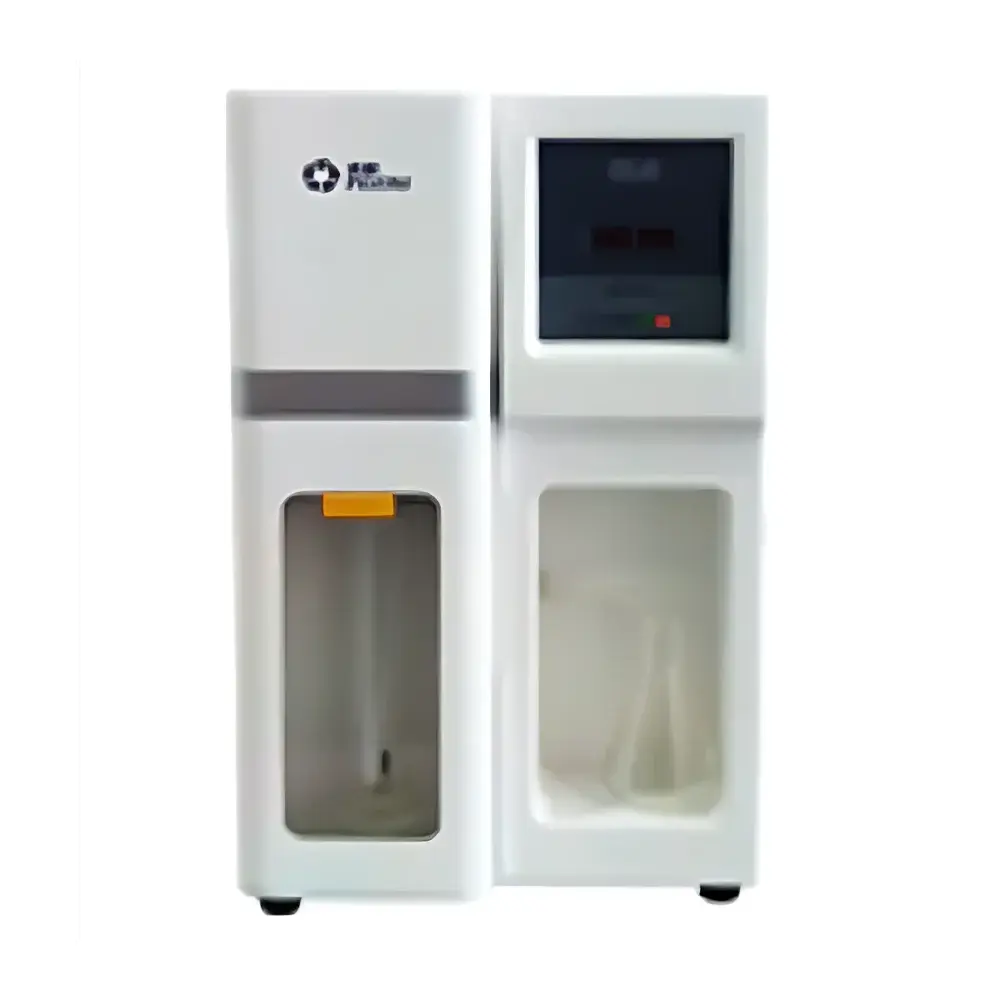
Peiou SKD-100 Automated Kjeldahl Nitrogen Determinator with Automatic Alkali Addition
| Brand | Peiou |
|---|---|
| Origin | Shanghai, China |
| Model | SKD-100 |
| Instrument Type | Kjeldahl Nitrogen Determinator |
| Automation Level | Semi-Automated |
| Nitrogen Determination Range | 0.1–240 mg N |
| Sample Weight Capacity | ≤5 g (solid) / ≤15 mL (liquid) per sample |
| Alkali/Acid Addition Time Control | 0–99 s (segmented) |
| Distillation Time Setting | 0–99 min |
| Distillation Rate | 14–28 mL/min |
| Power Adjustment Range | 750–1500 W |
| Recovery Rate | >99.5% |
| Repeatability | RSD ≤0.5% |
| Dimensions (L×W×H) | 370×300×680 mm |
| Net Weight | 15 kg |
| Display | LED digital |
| Data Storage | 10 programmable distillation/alkali addition methods |
| Safety Features | Real-time liquid level monitoring, overpressure protection, dry-run prevention, emergency stop |
| Housing Material | Molded ABS engineering plastic (acid/alkali resistant) |
| Tubing | PEIU proprietary corrosion-resistant high-temp tubing |
| Power Supply | AC 220 V ±10%, 50 Hz |
| Water Supply Requirement | ≥0.15 MPa pressure, ≤20 °C inlet temperature |
Overview
The Peiou SKD-100 Automated Kjeldahl Nitrogen Determinator is a semi-automated benchtop instrument engineered for precise and reproducible total nitrogen quantification via the classical Kjeldahl digestion–distillation–titration methodology. It implements standardized wet-chemical oxidation followed by alkaline distillation under controlled thermal and fluidic conditions to liberate ammonium ions as ammonia gas, which is subsequently trapped in boric acid and quantified via titration. Designed for routine QC laboratories in food, feed, agricultural, environmental, and pharmaceutical sectors, the SKD-100 delivers compliance-ready performance aligned with internationally recognized protocols including AOAC Official Method 984.13, ISO 5983-1:2009, and GB/T 6423–2022. Its robust architecture integrates corrosion-resistant materials and fail-safe hydraulic control logic to ensure long-term operational stability in high-acid/high-alkali environments typical of Kjeldahl workflows.
Key Features
- Corrosion-immune construction: Molded one-piece ABS housing rated for continuous exposure to concentrated H₂SO₄, NaOH, and H₃BO₃ — eliminating rust, leakage, and electrical hazards.
- Segmented alkali addition: Programmable 0–99 s timed dosing in discrete intervals enables precise stoichiometric control during distillation, critical for volatile nitrogen forms (e.g., TVB-N) and low-N matrices.
- Intelligent steam management: Integrated pressure-balanced steam generator with real-time overpressure cutoff prevents sample back-suction and ensures uniform distillate flow across variable load conditions.
- Dual safety monitoring: Simultaneous liquid-level sensing in the distillation flask and automatic dry-run shutdown prevent thermal damage and maintain method integrity.
- Modular fluid handling: PEIU-specific high-temperature, acid/alkali-resistant tubing (rated ≥120 °C, pH 0–14) certified for ≥3 years service life without replacement.
- Programmable operation: Stores up to 10 distinct distillation/alkali profiles — each configurable for time, power, volume, and sequence — supporting multi-matrix workflows without manual reconfiguration.
- Manual override capability: On-demand alkali injection during active distillation compensates for thermal lag in heterogeneous samples, improving recovery accuracy for complex biological matrices.
Sample Compatibility & Compliance
The SKD-100 accommodates solid samples up to 5 g and liquid samples up to 15 mL per run, making it suitable for diverse matrices including cereal grains, dairy powders, meat homogenates, soil extracts, wastewater digests, and botanical preparations. Its validated recovery rate (>99.5%) and repeatability (RSD ≤0.5%) meet the precision requirements of ISO 5725-2 for intermediate precision and AOAC 2012.01 for protein nitrogen in nutritional labeling. The system supports GLP-compliant documentation when paired with external titrators featuring audit-trail-enabled software (e.g., Metrohm Dosino or TitroLine 7800), though native data export is limited to LED-displayed endpoint values. No built-in CFR Part 11 compliance; however, its deterministic timing logic and non-volatile program storage provide traceable operational parameters for internal SOP enforcement.
Software & Data Management
The SKD-100 operates via an embedded microcontroller with no onboard OS or network interface. All method parameters — distillation duration (0–99 min), alkali addition timing (0–99 s segmented), steam power (750–1500 W), and distillate volume target (14–28 mL/min) — are configured and stored locally using front-panel keypad input. Ten user-defined programs may be saved and recalled instantly. Data output consists solely of LED-displayed numeric endpoints (e.g., mL titrant consumed); raw time-series sensor logs or CSV exports are not supported. Optional touchscreen upgrade (not standard on SKD-100) adds contextual help menus and remote firmware updates via USB — but does not introduce cloud connectivity or electronic signature functionality. For regulated environments, integration with LIMS requires external digitization of displayed results via serial RS-232 or analog voltage output (available upon request).
Applications
The SKD-100 is routinely deployed in accredited testing laboratories performing nitrogen analysis for regulatory reporting and quality certification. Primary use cases include crude protein estimation in animal feed (AOAC 984.13), total Kjeldahl nitrogen (TKN) in municipal wastewater (EPA 351.2), ammoniacal nitrogen in fertilizer formulations (ISO 5315), and volatile basic nitrogen (VBN) in seafood freshness assessment (AOAC 976.15). Its segmented alkali delivery and thermal compensation logic also support specialized applications such as determination of non-protein nitrogen (NPN) in milk powder and quantification of ammonium salts in pharmaceutical excipients. Educational institutions utilize the unit for undergraduate analytical chemistry instruction due to its transparent mechanical design and deterministic process sequencing.
FAQ
Does the SKD-100 support fully automated titration?
No. It performs only the distillation and alkali addition steps; titration must be conducted separately using a manual or automated burette.
Is the SKD-100 compliant with FDA 21 CFR Part 11?
No. It lacks electronic signatures, audit trails, and secure user authentication required for Part 11 compliance.
Can the SKD-100 digest samples?
No. Digestion is a prerequisite step performed externally using a separate Kjeldahl digester (e.g., SKD-200 series or third-party units).
What maintenance intervals are recommended for tubing and valves?
PEIU specifies ≥36 months for all internal tubing under normal operating conditions; acid/alkali solenoid valves require inspection every 12 months per preventive maintenance schedule.
Is distilled water mandatory for operation?
Yes. Tap water introduces scale and impurities that compromise steam purity and trigger false dry-run alarms; deionized or distilled water is required.




