
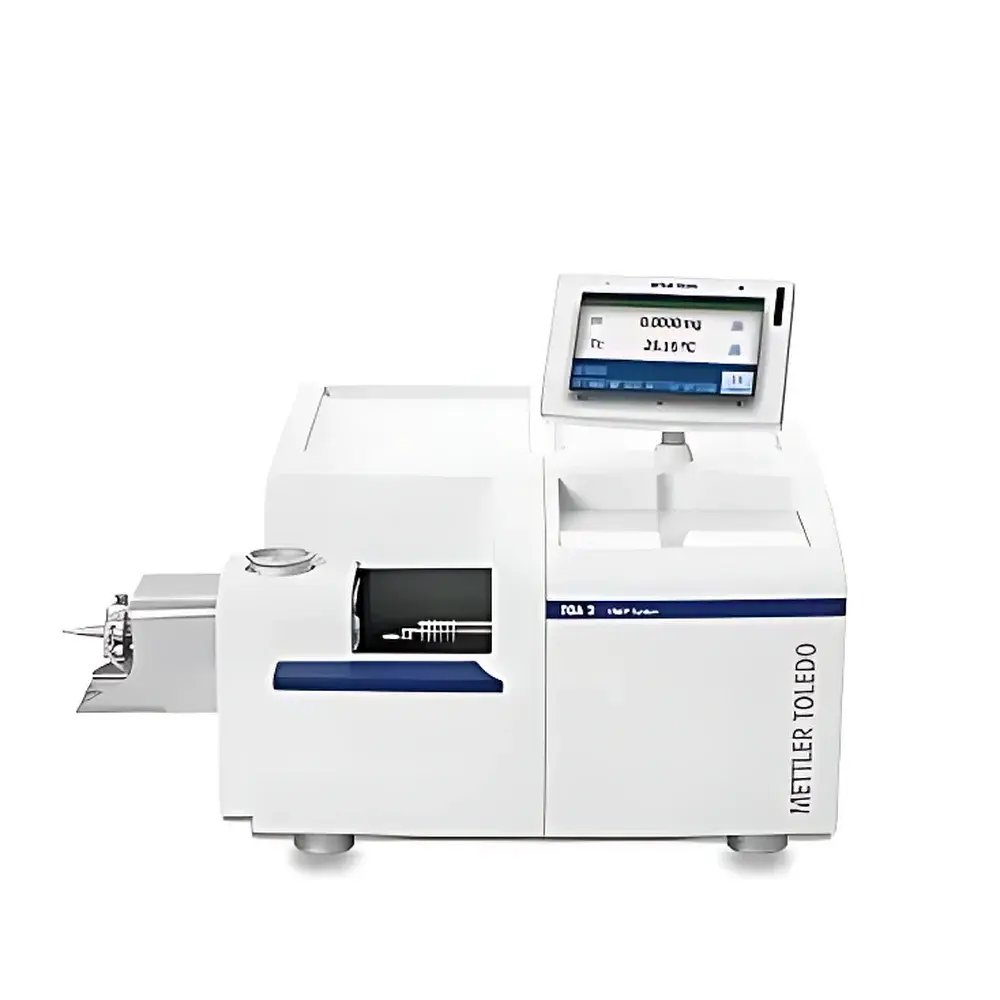
METTLER TOLEDO TGA2 LF/SF Thermogravimetric Analyzer
| Brand | METTLER TOLEDO |
|---|---|
| Origin | Switzerland |
| Model | TGA2 LF (Large Furnace) / TGA2 SF (Small Furnace) |
| Temperature Range | Up to 1100 °C (LF), Up to 600 °C (SF) |
| Temperature Accuracy | ±0.5 K |
| Balance Sensitivity | 0.1 µg |
| Heating/Cooling Rate | 0.001–100 K/min |
| Furnace Type | Dual-furnace modular architecture |
| Compliance | ASTM E1131, ISO 11358, USP <41>, FDA 21 CFR Part 11 ready |
Overview
The METTLER TOLEDO TGA2 is a high-precision thermogravimetric analyzer engineered for robust, reproducible mass-change measurements under controlled thermal conditions. Operating on the fundamental principle of dynamic thermogravimetry—monitoring sample mass as a function of temperature or time under defined gas atmospheres—the TGA2 delivers quantitative decomposition profiles, volatility assessments, compositional analysis (e.g., filler content, moisture, ash), and thermal stability evaluation. Its dual-furnace platform—comprising the TGA2 LF (Large Furnace) for extended high-temperature applications up to 1100 °C and the TGA2 SF (Small Furnace) optimized for rapid thermal cycling and routine analysis up to 600 °C—ensures method flexibility without hardware compromise. Both variants integrate METTLER TOLEDO’s proprietary micro- and ultra-micro balance technology, delivering sub-microgram resolution and exceptional long-term drift stability—critical for detecting subtle mass losses in polymers, pharmaceuticals, ceramics, and battery materials.
Key Features
- Modular furnace architecture enabling field-upgradable transition between LF and SF configurations without system replacement
- Hermetically sealed, gas-tight furnace chamber with programmable purge gas control (N₂, air, O₂, Ar, forming gas) and optional humidity generator integration
- Integrated automatic sample changer (ASC) supporting up to 48 positions, compatible with standard platinum, alumina, and ceramic crucibles (including hermetic and vented designs)
- Real-time buoyancy correction using built-in density calibration and furnace geometry modeling
- Thermal lag compensation algorithm minimizing apparent shift in onset temperatures across heating rates
- Robust mechanical design compliant with ISO 17025 environmental requirements for laboratory vibration and ambient temperature stability
Sample Compatibility & Compliance
The TGA2 accommodates solid powders, granules, films, fibers, and small metallic specimens (max. 1 g typical, up to 5 g in LF mode). Crucible options include open, pierced-lid, and hermetically sealed variants to support inert, oxidative, or reducing atmospheres per ASTM E1131 (standard test method for determination of composition by thermogravimetry) and ISO 11358 (plastics—thermogravimetry). Data integrity meets GLP/GMP requirements: audit trail logging, electronic signatures, and 21 CFR Part 11–compliant software architecture ensure traceability for regulated environments including pharmaceutical QC labs and materials R&D centers. Calibration protocols align with EURAMET cg-19 and NIST traceable reference standards.
Software & Data Management
STARe Software (v16.x or later) provides full instrument control, real-time visualization, and advanced data processing—including derivative thermogravimetry (DTG), multi-step kinetic modeling (e.g., Friedman, Ozawa-Flynn-Wall), and comparative overlay of up to 32 curves. Raw data is stored in vendor-neutral .TGA binary format with embedded metadata (operator ID, method file hash, calibration timestamp). Export options include ASCII, CSV, and PDF reports with customizable templates adhering to internal SOPs or external regulatory submission formats (e.g., ICH M4). Network deployment supports centralized method libraries, role-based access control, and automated backup to secure NAS or cloud storage via TLS 1.2–encrypted transfer.
Applications
- Quantification of organic/inorganic content in composites and nanocomposites
- Determination of residual solvents and moisture in active pharmaceutical ingredients (APIs) per USP and Ph. Eur. 2.2.34
- Thermal degradation kinetics of polymer blends and flame-retardant formulations
- Oxidative induction time (OIT) assessment for polyolefins per ASTM D3895
- Char yield and ash content analysis in coal, biomass, and catalyst supports
- Decomposition behavior of cathode/anode materials in lithium-ion battery development
FAQ
What is the maximum sample weight capacity for TGA2 LF and SF models?
The TGA2 LF supports up to 5 g in standard platinum crucibles; the TGA2 SF is optimized for 0.1–1 g samples to maximize sensitivity and thermal response.
Can the TGA2 be coupled with FTIR or MS for evolved gas analysis?
Yes—both LF and SF models feature standardized 6 mm O.D. capillary ports compatible with commercial GC-MS, FTIR, and QMS interfaces for real-time evolved gas analysis (EGA).
Is calibration traceable to national metrology institutes?
All temperature and mass calibrations are performed using NIST-traceable reference materials (e.g., Ni Curie point standard, certified CuO decomposition standard), documented in the instrument’s calibration certificate.
How does the TGA2 handle baseline drift during long-duration isothermal holds?
The system employs active buoyancy compensation and zero-drift correction algorithms, validated over 24-hour isotherms at 800 °C with drift ≤ ±2 µg.
Does STARe software support automated pass/fail criteria for release testing?
Yes—user-defined acceptance limits can be embedded in method files, triggering visual alerts and report flags when results exceed specified thresholds for mass loss onset, residue %, or decomposition enthalpy.



