
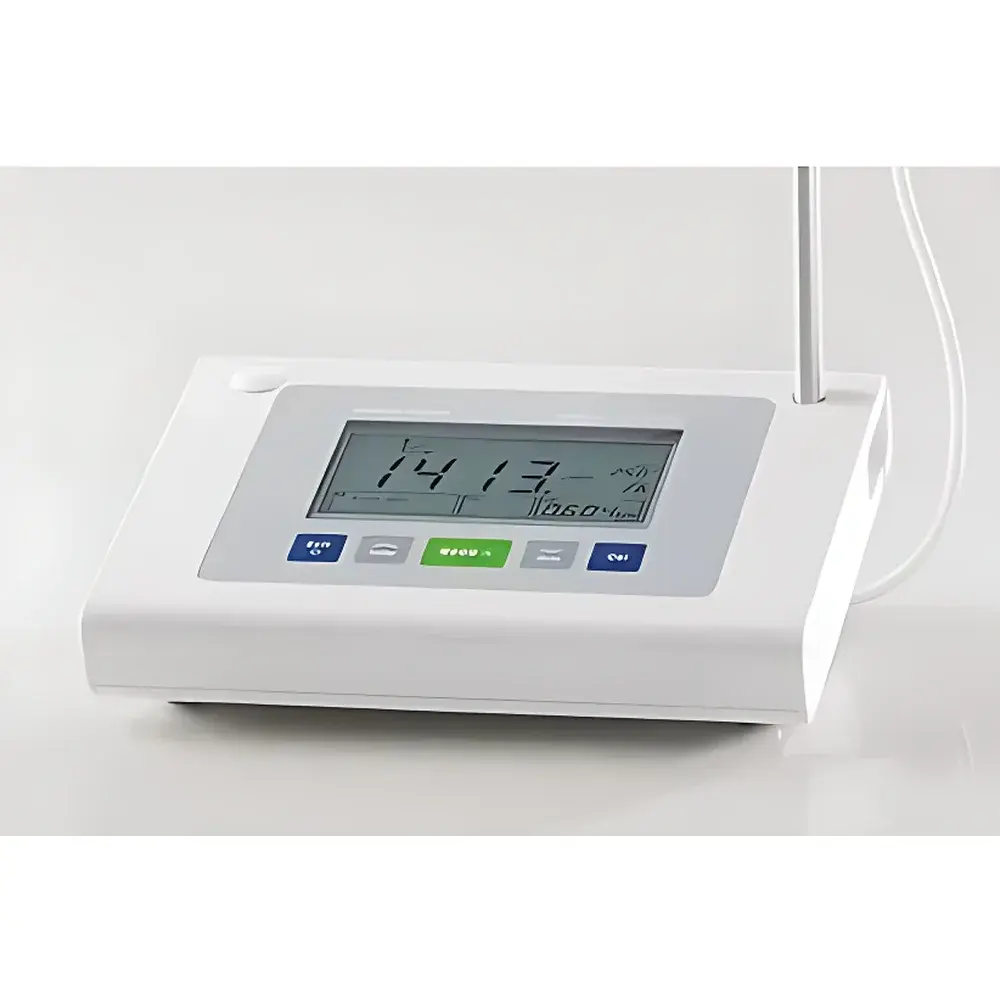
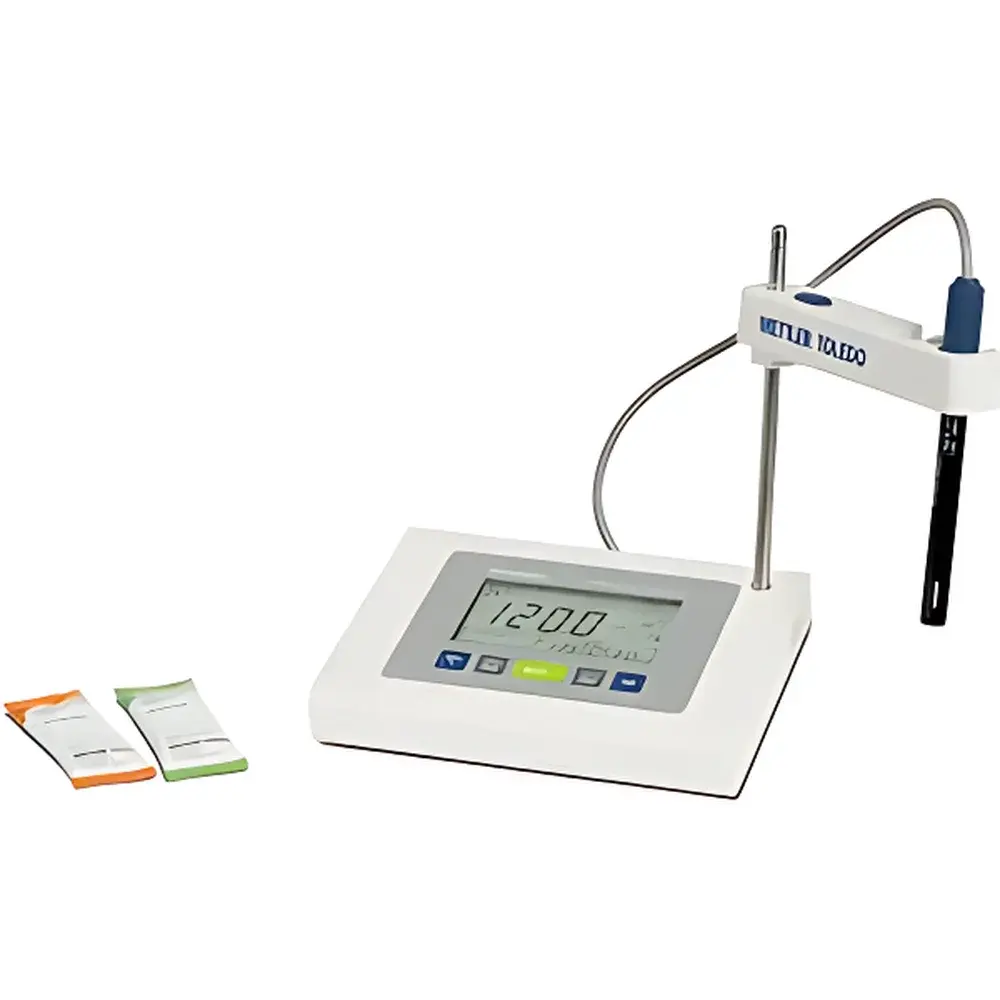
METTLER TOLEDO FE38 Standard Benchtop Conductivity Meter
| Brand | METTLER TOLEDO |
|---|---|
| Origin | Shanghai, China |
| Model | FE38 |
| Form Factor | Benchtop |
| Application Environment | Laboratory |
| Conductivity Range | 0.01 μS/cm – 500 mS/cm |
| TDS Range | 0.01 mg/L – 300 g/L |
| Resistivity Range | 1.99 Ω·cm – 100 MΩ·cm |
| Salinity Range | 0.00 – 42 psu |
| Temperature Range | −5 °C to 105 °C |
| Conductivity Accuracy | ±0.5% of reading |
| Minimum Conductivity Resolution | 0.01 μS/cm |
| Temperature Accuracy | ±0.3 °C |
| Temperature Resolution | 0.1 °C |
| Data Storage Capacity | 200 measurements |
| Interface | USB-B, RS232, mini-DIN |
| Display | 4.3-inch segmented LCD |
| Dimensions | 227 × 147 × 70 mm |
| Weight | 0.63 kg |
| Sensor Compatibility | LE703 (non-ISM) |
Overview
The METTLER TOLEDO FE38 Standard Benchtop Conductivity Meter is a rigorously engineered electrochemical instrument designed for routine conductivity, TDS, resistivity, and salinity measurements in regulated laboratory environments. Based on two-electrode AC conductometric principle with frequency-controlled excitation, the FE38 delivers stable, interference-resistant readings across five decades of conductivity (0.01 μS/cm to 500 mS/cm), supporting applications from ultrapure water monitoring to concentrated brine analysis. Its fixed single-channel architecture integrates a temperature-compensated measurement circuit with automatic linear or non-linear (NaCl or ISO 7888) compensation algorithms—ensuring traceable, repeatable results compliant with ISO 7888, ASTM D1125, and pharmacopeial guidelines for water quality testing. The instrument operates within a validated thermal envelope (−5 °C to 105 °C), enabling direct measurement of hot process streams or chilled buffers without external conditioning.
Key Features
- Benchtop form factor with space-optimized footprint (227 × 147 × 70 mm) and integrated electrode holder storage slot—minimizing bench clutter in high-density lab workflows.
- Segmented 4.3-inch LCD display with high-contrast segments and context-sensitive iconography for unambiguous parameter identification under variable lighting conditions.
- Intuitive push-button interface with dedicated function keys for calibration, measurement, and data recall—eliminating nested menu navigation and reducing operator training time.
- Dual-output connectivity via isolated RS232 and USB-B ports, enabling simultaneous real-time streaming to LIMS-compatible software and direct hardcopy output via ESC/P-compatible printers.
- 200-measurement internal memory with timestamping (date/time stamp enabled), supporting GLP-compliant audit trails when exported with metadata (sensor ID, calibration history, ambient temperature).
- Preconfigured support for LE703 cell constant (k = 0.1, 1.0, or 10 cm⁻¹) with manual cell constant entry—facilitating rapid sensor interchange without firmware reconfiguration.
Sample Compatibility & Compliance
The FE38 accommodates aqueous and mildly aggressive electrolyte solutions—including purified water (PW), water-for-injection (WFI), buffer preparations, fermentation broths, and saline-based cleaning agents—within its specified conductivity and temperature range. It meets mechanical and electrical safety requirements per IEC 61010-1:2010 (measurement category II, pollution degree 2). While not ISM-enabled, the FE38 supports manual sensor management protocols aligned with FDA 21 CFR Part 11 Annex 11 expectations for electronic record integrity: all stored measurements retain immutable timestamps, and calibration events are logged with date, solution used (e.g., KCl 0.01 mol/L), and applied cell constant. The instrument is routinely deployed in QC labs operating under ISO/IEC 17025, USP , and EP 2.2.38 frameworks.
Software & Data Management
Data export occurs via ASCII-formatted text files (.txt) compatible with Microsoft Excel, LabArchives, and ELN systems. Each exported record includes measurement value, unit, temperature at time of acquisition, sensor serial reference (manually entered), and calibration status flag. No proprietary drivers or cloud dependencies are required—USB connection enumerates as a standard CDC ACM device; RS232 operation uses standard null-modem wiring and 9600 baud, 8-N-1 configuration. For regulated environments, users may configure automated daily data dumps using Windows Task Scheduler and batch scripts—supporting ALCOA+ principles (Attributable, Legible, Contemporaneous, Original, Accurate, Complete, Consistent, Enduring, Available).
Applications
- Pharmaceutical water system validation (PW, WFI, pure steam condensate) per USP and EU GMP Annex 1.
- Electrolyte concentration verification in cell culture media and bioreactor feed solutions.
- Final rinse water quality assessment in medical device manufacturing cleanrooms.
- TDS estimation in environmental water samples (surface, groundwater, wastewater effluent) per EPA Method 120.1.
- Salinity calibration verification in marine biology and aquaculture laboratories.
- In-process control of acid/base titration endpoints where conductivity inflection is monitored.
FAQ
Does the FE38 support automatic temperature compensation (ATC)?
Yes—ATC is enabled by default using the integrated Pt1000 temperature sensor; users may select linear (2.0%/°C), NaCl, or ISO 7888 compensation curves.
Can the FE38 store calibration history separately from measurement data?
No—the instrument logs calibration events within the same 200-entry memory buffer; however, each calibration record is tagged with “CAL” prefix and includes solution conductivity and temperature.
Is the LE703 sensor autoclavable?
The LE703 glass-body sensor is rated for intermittent steam sterilization at 121 °C for ≤20 minutes; repeated autoclaving may degrade epoxy seals and requires post-sterilization recalibration.
What is the maximum allowable sample viscosity for accurate measurement?
Viscosity should remain below 100 mPa·s to prevent laminar flow distortion around the electrode surface; higher viscosities necessitate flow-through cell configurations not supported by the FE38 base platform.
Does the FE38 meet IP rating requirements for splash resistance?
It carries no formal IP rating; the enclosure is designed for dry, controlled laboratory use only—liquid ingress protection is not guaranteed.




