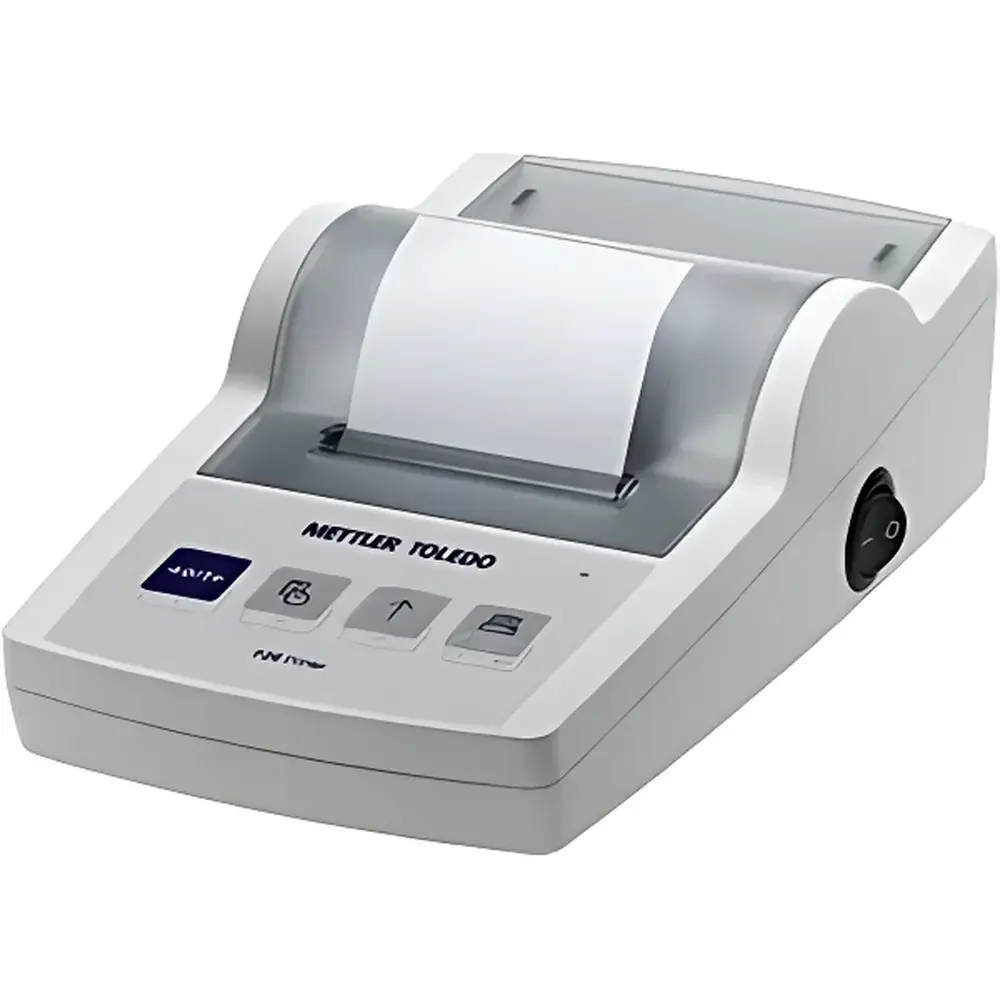
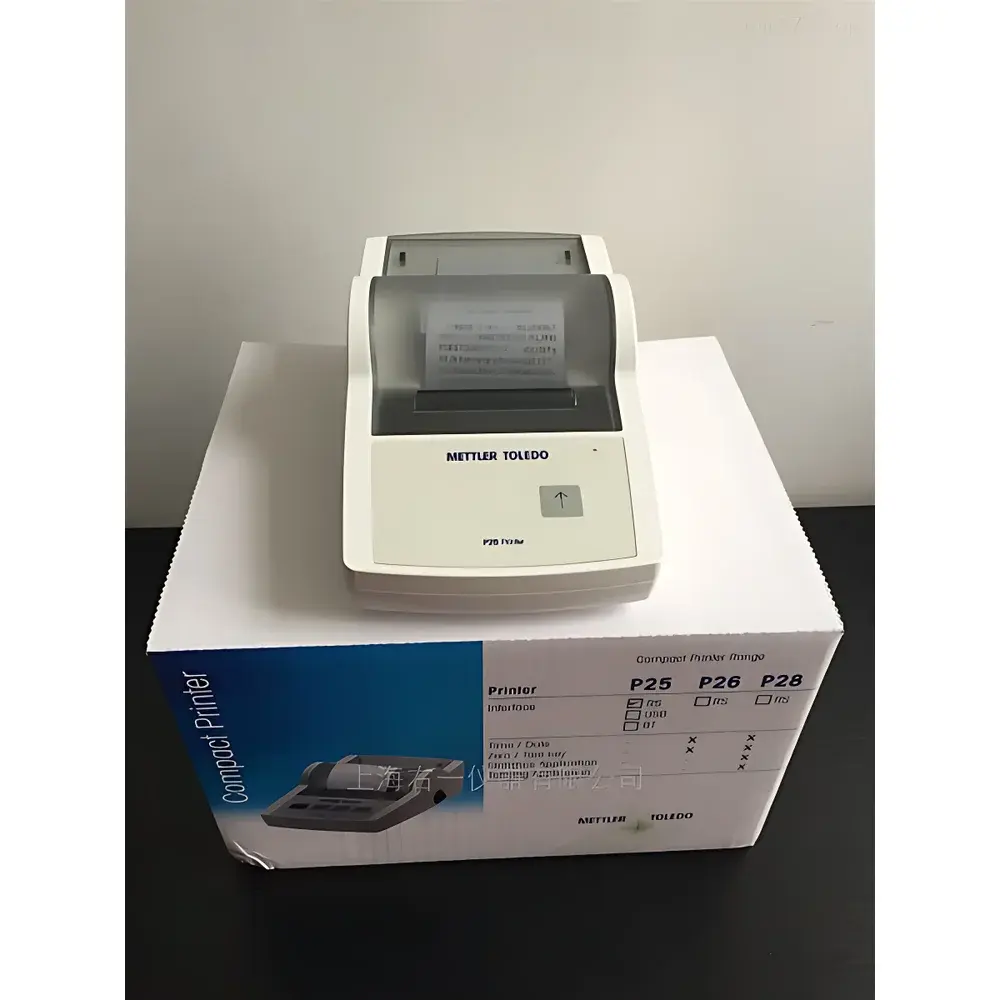
METTLER TOLEDO RS-P26/02 Dot Matrix Balance Data Printer
| Brand | METTLER TOLEDO |
|---|---|
| Origin | Shanghai, China |
| Model | RS-P26/02 |
| Printing Method | Impact Dot Matrix |
| Interface | RS-232 |
| Characters per Line | 24 |
| Print Speed | 2.3 lines/sec |
| Paper Size | 57.5 × Φ50 mm |
| Real-Time Clock | Integrated |
| Compliance | GxP-ready (audit trail support via timestamped output) |
| Application | Dedicated data logging for METTLER TOLEDO balances and analytical instruments |
Overview
The METTLER TOLEDO RS-P26/02 is a dedicated dot matrix balance data printer engineered for reliable, traceable, and regulatory-compliant documentation in GLP, GMP, and ISO 17025 environments. Designed exclusively for integration with METTLER TOLEDO weighing instruments—including analytical balances, precision balances, and moisture analyzers—the RS-P26/02 captures raw weight data, tare operations, timestamps, and user-defined annotations directly from the connected device via standard RS-232 serial communication. Its impact-based dot matrix printing mechanism ensures physical permanence of records—critical for audit readiness—without dependence on thermal sensitivity or ink stability. Unlike generic printers, the RS-P26/02 interprets native instrument protocols, preserving unit formatting (e.g., g, mg, %), decimal precision, and operator context (e.g., “TARE”, “ZERO”) without software abstraction layers. The built-in real-time clock (RTC) provides hardware-level time stamping synchronized to the host balance’s internal clock, enabling unambiguous chronological attribution of each printed line—a foundational requirement for FDA 21 CFR Part 11-aligned record integrity.
Key Features
- Dedicated RS-232 interface with auto-baud rate detection and protocol handshake compatibility across METTLER TOLEDO balance families (XSE, XS, ME, MS-TS, and AB series)
- 24-character-per-line dot matrix print head delivering high-contrast, smudge-resistant output on standard 57.5 mm wide paper rolls (Φ50 mm core)
- Integrated real-time clock with battery-backed memory ensuring continuous time/date accuracy across power cycles
- Hardware-level zero/tare key emulation: printer responds to balance-initiated tare/zero commands and prints corresponding status flags (“TARED”, “ZEROED”) alongside numeric values
- GxP-aligned output structure: each line includes timestamp (YYYY-MM-DD HH:MM:SS), instrument ID (if transmitted), net weight, unit, and operator action identifier
- No external driver or PC required—operates as a transparent peripheral in a point-to-point serial configuration
Sample Compatibility & Compliance
The RS-P26/02 supports all METTLER TOLEDO instruments equipped with RS-232C output and METTLER TOLEDO’s standard ASCII print protocol (e.g., XSE, XS, ME-T, and classic AE/AG balances). It accepts both fixed-format and variable-length data streams, automatically adapting line feed, character spacing, and carriage return behavior based on incoming control codes. For compliance, the printer enables full traceability: every printed record contains immutable temporal metadata and reflects the exact state of the balance at acquisition—supporting ALCOA+ principles (Attributable, Legible, Contemporaneous, Original, Accurate). While the printer itself does not store data, its deterministic, non-editable hardcopy output satisfies FDA 21 CFR Part 11 Subpart B requirements for signed electronic records when used within validated workflows. It is routinely deployed in pharmaceutical QC labs, contract testing organizations (CTOs), and academic core facilities where permanent, instrument-native documentation is mandated by SOPs referencing ISO/IEC 17025:2017 clause 7.8.2 (Reporting of results).
Software & Data Management
The RS-P26/02 operates independently of host software—it requires no installation, configuration utility, or operating system dependency. All formatting logic resides in firmware calibrated to METTLER TOLEDO’s proprietary data framing conventions. Time/date settings are configured directly via front-panel keys or remotely via balance-sent command sequences (e.g., “STIME” and “SDATE”). No local storage, network stack, or user-accessible memory exists; thus, no cybersecurity patching or firmware update management is required. Audit trails are maintained solely through printed output—eliminating risks associated with digital log file tampering or database corruption. When paired with METTLER TOLEDO LabX™ or STARe software, the RS-P26/02 serves as a fail-safe backup: if network or PC-based reporting fails, critical weighing events remain physically documented in real time.
Applications
- Regulatory-compliant batch release documentation in pharmaceutical manufacturing (e.g., raw material receipt, in-process checks, final product assay)
- GLP study reporting for preclinical toxicology and environmental testing laboratories
- Reference standard calibration logs requiring permanent, unalterable weight records
- Education labs where students must submit hardcopy evidence of experimental mass measurements
- Quality control workflows requiring dual-channel verification (digital export + signed hardcopy)
- Legacy system integration where USB or Ethernet connectivity is unavailable or prohibited
FAQ
Does the RS-P26/02 support custom header/footer templates?
No—output formatting is fixed and determined by the connected METTLER TOLEDO instrument. Headers such as lab name or sample ID must be entered via the balance’s keypad or sent programmatically from LabX.
Can it print barcodes or graphics?
No—this model supports only alphanumeric ASCII characters (standard 7-bit code page). Graphics or barcode generation require the RS-P28 variant.
Is the real-time clock battery-replaceable?
Yes—the internal lithium coin-cell battery (CR2032) is field-replaceable using standard service tools and maintains time for ≥3 years under normal conditions.
What paper types are certified for use?
Only METTLER TOLEDO-certified thermal-transfer ribbons and 57.5 mm plain paper rolls (order no. 116003883) ensure consistent print density, ribbon life, and archival stability per ISO 18902.
Does it meet electromagnetic compatibility (EMC) standards for laboratory use?
Yes—complies with EN 61326-1:2013 (Class B) and FCC Part 15 Subpart B for industrial scientific equipment.