
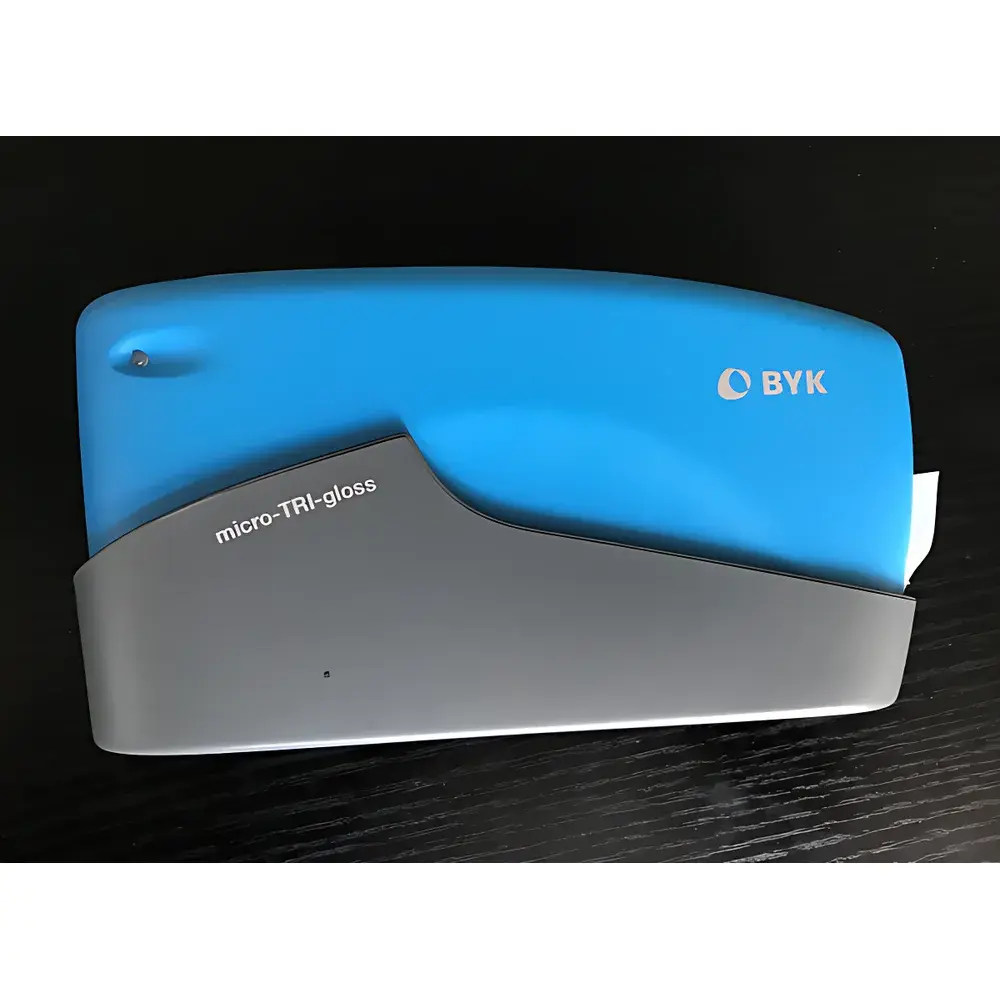
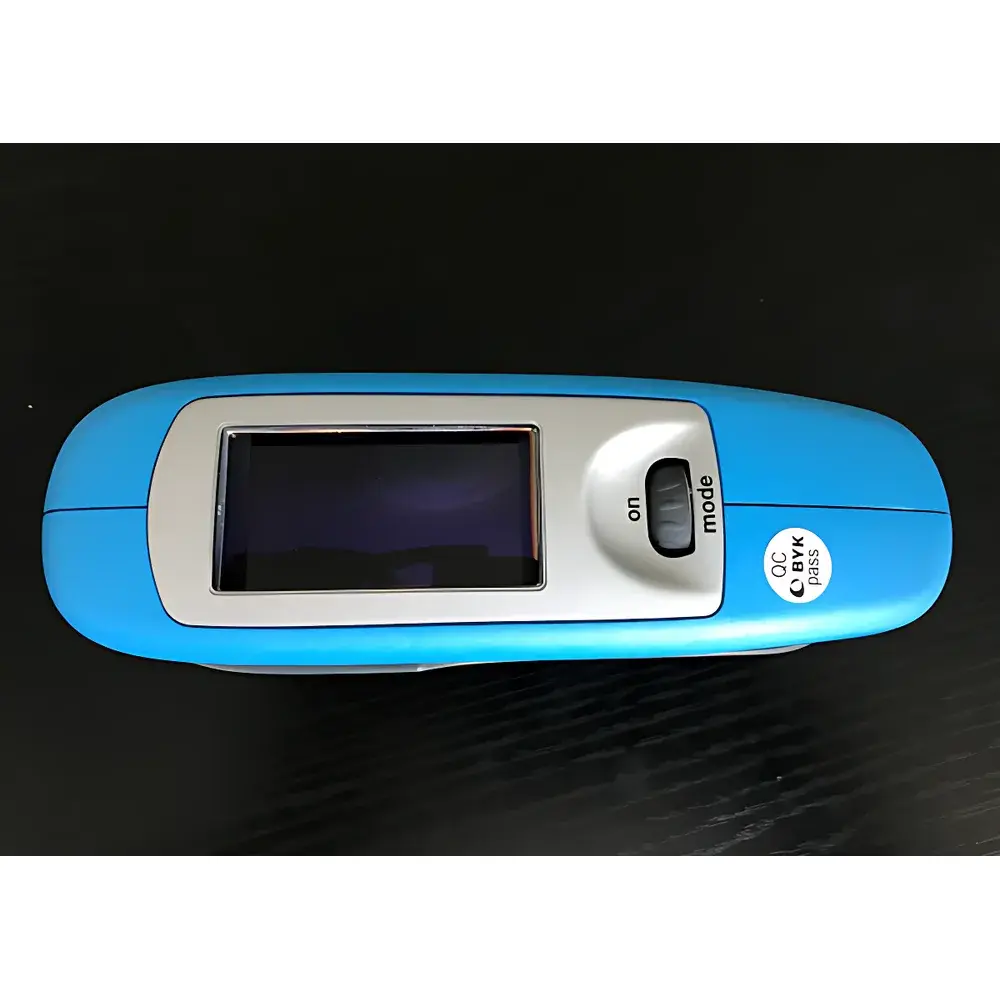
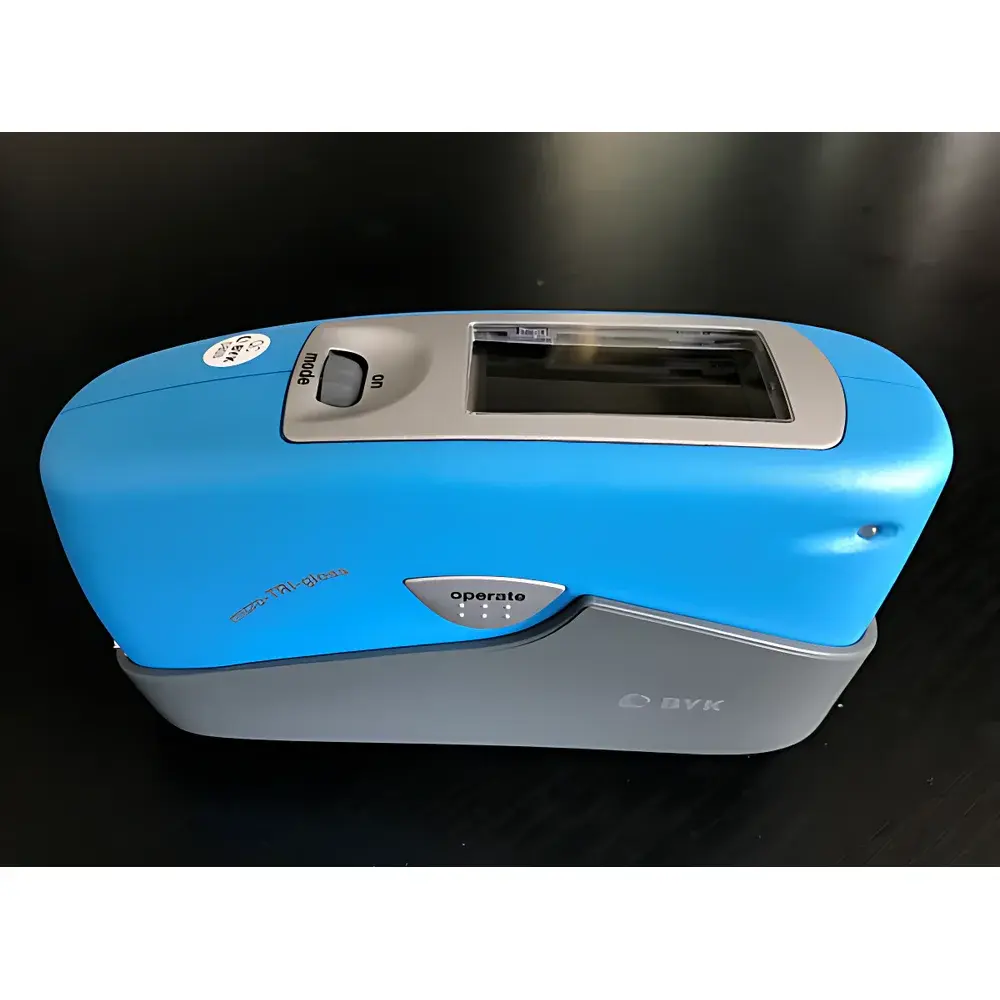
BYK-Gardner Micro-TRI-Gloss 4563 Tri-Angle Gloss Meter (20°, 60°, 85°)
| Brand | BYK-Gardner |
|---|---|
| Origin | Germany |
| Model | BYK 4563 |
| Measurement Angles | 20°, 60°, 85° |
| Compliant Standards | ISO 2813, ASTM D523, DIN 67530, JIS Z8741 |
| Display | Full-color TFT screen with intuitive navigation |
| Calibration | Integrated auto-diagnostic system with certified reference standard stored in protective calibration base |
| Repeatability | ±0.1 GU (0–20 GU), ±0.2 GU (20–100 GU), ±0.2% (100–2000 GU) |
| Reproducibility | ±0.2 GU (0–20 GU), ±0.5 GU (20–100 GU), ±0.5% (100–2000 GU) |
| Measurement Area | 20°: 10×10 mm, 60°: 9×15 mm, 85°: 5×38 mm |
| Data Interface | USB |
| Software Compatibility | smart-lab Gloss & smart-process Gloss (30-day free trial per package) |
Overview
The BYK-Gardner Micro-TRI-Gloss 4563 is a precision-engineered tri-angle gloss meter designed for rigorous quality control in industrial coating, automotive, packaging, and surface finishing applications. It operates on the principle of specular reflectance measurement—quantifying the ratio of reflected light intensity at defined geometric angles (20°, 60°, and 85°) relative to incident illumination under standardized CIE illuminant D65 conditions. This instrument conforms to internationally recognized optical metrology standards including ISO 2813, ASTM D523, DIN 67530, and JIS Z8741, ensuring traceable, inter-laboratory comparable results. Its compact ergonomic form factor—optimized for one-handed operation—integrates three independent optical paths into a single handheld unit, eliminating the need for angle-switching hardware or recalibration between measurements. The device is manufactured in Germany and calibrated against NIST-traceable reference standards, supporting full compliance with GLP and GMP documentation requirements.
Key Features
- Triple-angle simultaneous capability: Measures 20° (high-gloss surfaces, e.g., automotive clearcoats, lacquers), 60° (medium-gloss substrates, e.g., powder coatings, plastics), and 85° (low-gloss finishes, e.g., matte paints, interior trim) without manual reconfiguration.
- Auto-diagnostic calibration assurance: Continuously monitors status of the integrated reference standard housed in its protective calibration base; alerts user when cleaning or recalibration is required based on real-time optical feedback.
- High-resolution full-color TFT display: Provides immediate visual differentiation between angle-specific readings, statistical summaries (mean, range, standard deviation), and pass/fail indicators aligned with preset tolerance limits.
- Ergonomic tactile interface: Features a precision scroll wheel and context-sensitive soft keys enabling rapid navigation—even with gloves—while minimizing operator-induced measurement variability.
- Extended dynamic range: Covers 0–2000 Gloss Units (GU) across all angles, with enhanced resolution in the critical low-gloss region (0–20 GU at 60°) for applications such as automotive interior plastics and architectural textiles.
- Robust mechanical architecture: IP54-rated housing resists dust and incidental moisture; anodized aluminum body ensures long-term dimensional stability under repeated thermal cycling and mechanical stress.
Sample Compatibility & Compliance
The Micro-TRI-Gloss 4563 accommodates diverse substrate geometries and surface topographies—including flat, curved, textured, and flexible materials—without requiring sample masking or fixturing. Its modular aperture design enables consistent illumination geometry across metallic substrates (e.g., painted steel, anodized aluminum), polymeric films, ceramic glazes, paperboard, and laminated composites. Regulatory alignment includes full support for FDA 21 CFR Part 11-compliant audit trails when used with smart-process Gloss software, as well as compatibility with ISO/IEC 17025-accredited calibration workflows. All factory calibrations are documented with individual certificates of traceability to PTB (Physikalisch-Technische Bundesanstalt) standards. The instrument meets CE marking requirements under the EU Measuring Instruments Directive (MID) and RoHS 3 compliance for restricted substances.
Software & Data Management
Data acquisition and reporting are managed via two dedicated PC applications: smart-lab Gloss (for R&D and laboratory environments) and smart-process Gloss (for production line integration). Both support automated export to PDF, CSV, and Excel formats; configurable report templates; and time-stamped measurement histories with operator ID tagging. smart-process Gloss further enables real-time SPC charting, statistical process control (X̄-R, Cp/Cpk), and seamless integration with MES/SCADA systems via OPC UA or Modbus TCP protocols. Each instrument ships with two concurrent software licenses; after a 30-day evaluation period, users select one licensed version for permanent deployment. Firmware updates and calibration certificate management are handled through the unified BYK Connect portal, which maintains version-controlled firmware archives and digital calibration logs compliant with ISO 9001 clause 7.1.5.2.
Applications
- Automotive OEM and Tier-1 suppliers: Monitoring gloss uniformity across body panels, bumpers, and interior components during final inspection and process validation.
- Coating manufacturers: Verifying batch-to-batch consistency of solvent-based, waterborne, and UV-curable formulations per ASTM D3679 and ISO 13803.
- Packaging converters: Assessing varnish and metallization gloss on folding cartons, flexible films, and label stocks—particularly where 75° or 45° variants supplement the core 4563 configuration.
- Architectural coatings: Quantifying weathering-induced gloss loss on façade systems and cladding materials per ISO 4892-3 accelerated aging protocols.
- Electronics enclosures: Controlling aesthetic consistency of injection-molded housings for consumer devices where micro-textured surfaces demand high-repeatability low-gloss assessment.
- Quality assurance labs: Supporting internal audits and customer-facing certification reports requiring multi-angle gloss profiles per TAPPI T 480 or EN 13808.
FAQ
Does the BYK 4563 require annual recalibration?
Yes—BYK-Gardner recommends annual recalibration by an accredited service center to maintain traceability to national standards. Field verification using the included reference standard should be performed before each shift.
Can the instrument measure curved surfaces?
It can provide reliable readings on gently curved surfaces (radius ≥ 50 mm); for tighter radii, use the optional curvature-compensated probe adapter kit (Order No. A4563-CURV).
Is the 4563 compatible with non-English operating systems?
Yes—the smart-lab and smart-process Gloss software support Unicode and are fully localized for English, German, French, Spanish, Chinese, and Japanese language interfaces.
What is the battery life under typical usage?
With alkaline AA batteries, continuous operation lasts ≥ 20 hours; rechargeable NiMH batteries extend this to ≥ 35 hours. Low-power mode activates automatically after 90 seconds of inactivity.
How does the auto-diagnostic function verify standard plate cleanliness?
The system performs spectral reflectance analysis of the reference plate surface at startup and during idle periods; deviations exceeding ±0.3 GU from baseline indicate contamination requiring cleaning with isopropyl alcohol and lint-free cloth.




