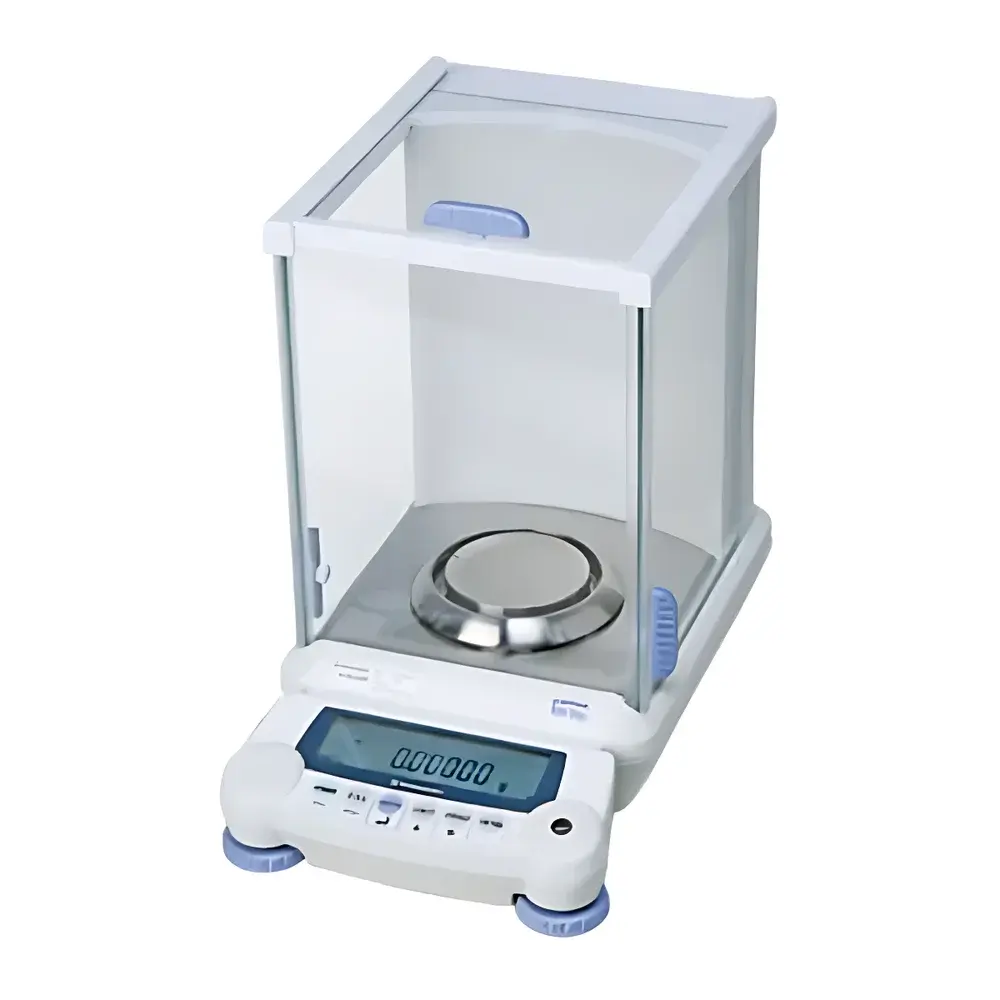
Shimadzu AUW320 Advanced Analytical Balance
| Brand | Shimadzu |
|---|---|
| Origin | Japan |
| Model | AUW320 |
| Instrument Type | Analytical Balance |
| Maximum Capacity | 320 g |
| Readability | 0.1 mg |
| Repeatability | ±0.1 mg |
| Linearity | ±0.5 mg |
| Average Response Time | 0.3 s |
| Pan Size | 380 mm diameter |
| Calibration | Internal, PSC (Power-on Self-Calibration) and Clock-CAL (Scheduled Automatic Calibration) |
| Compliance | GLP/GMP/ISO-compliant calibration logging |
| Data Interface | Direct Windows-compatible RS-232 output (no driver required) |
| Anti-static | STABLO-EX electrostatic eliminator integrated |
| Display | Backlit LCD |
Overview
The Shimadzu AUW320 is a high-precision analytical balance engineered for laboratories requiring trace-level mass measurement with exceptional stability, repeatability, and regulatory compliance. Utilizing Shimadzu’s proprietary Unibloc monolithic electromagnetic force restoration sensor, the AUW320 eliminates mechanical linkages and traditional load cell dependencies—delivering superior long-term drift resistance, thermal stability, and dynamic response. Its 0.1 mg readability (1 part in 3,200,000 of full scale) meets the stringent requirements of quantitative gravimetric analysis, standard preparation, and method validation across regulated environments. Designed and manufactured in Japan, the AUW320 operates on the principle of electromagnetic force compensation: when a sample is placed on the pan, the system generates a counterbalancing current proportional to the mass; this current is digitally converted into a stable, high-resolution weight reading. The balance is optimized for ISO 17025-accredited labs, pharmaceutical QC units operating under USP and , and research facilities adhering to GLP and GMP frameworks.
Key Features
- Unibloc single-piece sensor architecture ensures mechanical rigidity, minimized hysteresis, and immunity to environmental vibration and temperature gradients.
- Dual internal calibration modes: PSC (Power-on Self-Calibration) activates automatically at startup or after significant ambient temperature shifts (>1.5 °C), while Clock-CAL performs scheduled calibrations at user-defined intervals (e.g., every 2, 4, or 12 hours), ensuring continuous metrological traceability.
- GLP/GMP/ISO-compliant audit trail: Each calibration event—including date, time, operator ID (if configured via optional keypad), and deviation values—is timestamped and stored in non-volatile memory; records are exportable via RS-232 for integration into LIMS or electronic lab notebooks.
- STABLO-EX integrated electrostatic neutralizer actively dissipates static charge from samples and containers—critical for low-mass powders, polymers, and dry pharmaceutical actives where electrostatic interference compromises repeatability.
- Backlit LCD display with adjustable contrast supports operation under variable lighting conditions; real-time stability indicator and draft shield status monitoring enhance procedural reliability.
- Windows Direct interface enables seamless data transfer to Excel, Word, or custom QA software without third-party drivers or configuration—compliant with FDA 21 CFR Part 11 when used with validated host applications.
Sample Compatibility & Compliance
The AUW320 accommodates diverse sample forms—including volumetric flasks, weighing boats, crucibles, filter papers, and API powders—within its 380 mm diameter stainless-steel weighing pan. Its draft shield (sold separately, compatible with Shimadzu WSD series) provides Class I protection per ISO 14644-1 (ISO 5 cleanroom equivalent). The balance conforms to OIML R76-1 (2021) accuracy class I, ANSI/NCSL Z540-1, and JIS B 7721. All firmware and calibration logic are developed and verified in accordance with IEC 61508 SIL 2 functional safety principles. For regulated industries, the device supports 21 CFR Part 11–compliant electronic signatures when paired with validated data acquisition systems.
Software & Data Management
Data output follows NIST-traceable ASCII protocol over RS-232 (9600 bps, 8N1), supporting both automatic print-on-stabilization and manual trigger modes. Optional Shimadzu WinCT-Balance software (v4.x) provides advanced features including statistical process control (SPC) charting, tolerance band visualization, multi-user access control, and automated report generation compliant with Annex 11 and ALCOA+ data integrity principles. Raw calibration logs include serial number, firmware revision, ambient temperature/humidity at time of calibration, and pass/fail status against internal linearity and repeatability thresholds.
Applications
The AUW320 serves as a primary mass standard in pharmaceutical formulation (e.g., active ingredient dosing, excipient blending), environmental testing (e.g., TSS, TOC filter weighing), clinical diagnostics (reagent kit calibration), polymer characterization (ash content, volatile loss), and academic research involving stoichiometric synthesis, isotopic labeling, and nanomaterial dispersion quantification. It is routinely deployed in ISO/IEC 17025 testing labs for uncertainty budgeting per GUM (JCGM 100:2018) and supports ASTM E898-22 (Standard Practice for Calibration of Analytical Balances).
FAQ
What does “0.1 mg readability” mean in practical laboratory use?
It indicates the smallest mass increment the balance can resolve and display—equivalent to 100 µg—under optimal conditions (draft-free environment, stabilized temperature, proper leveling, and calibrated state.
Does the AUW320 meet USP requirements for repeatability?
Yes: its ±0.1 mg repeatability at full load satisfies USP ’s criterion of ≤0.10% RSD for weights ≥50% of capacity when tested with standard masses per USP .
Can calibration records be exported for internal audit?
Yes—via RS-232 to CSV or TXT format; timestamps, calibration weights used, and deviation values are embedded in each record.
Is external draft shielding mandatory for ISO Class 5 environments?
While not mandatory, Shimadzu WSD-series draft shields are recommended to maintain repeatability below ±0.2 mg in laminar flow hoods or cleanrooms where air turbulence exceeds 0.2 m/s.
How frequently should Clock-CAL be scheduled in a 24/7 QC lab?
Shimadzu recommends 4-hour intervals for high-throughput environments; intervals may be extended to 12 hours in climate-controlled R&D labs with minimal thermal cycling.