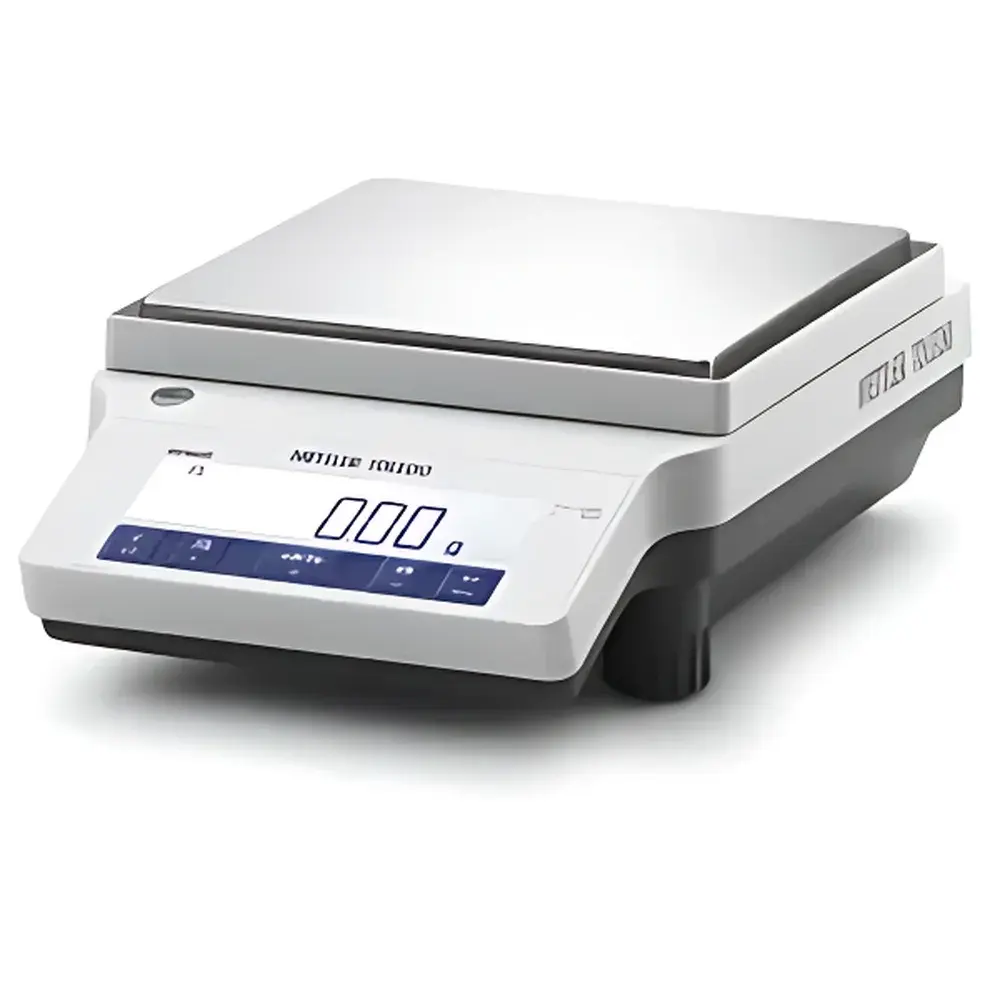
METTLER TOLEDO ME302 Precision Electronic Balance with Internal Calibration
| Brand | METTLER TOLEDO |
|---|---|
| Origin | Shanghai, China |
| Model | ME3002 / 02 |
| Maximum Capacity | 3200 g |
| Readability | 0.01 g |
| Repeatability (typ.) | 0.007 g |
| Minimum Weight (USP, 0.1% tolerance, typ.) | 14 g |
| Stabilization Time | 1.5 s |
| Calibration | Internal (built-in weight) |
| Interface | RS232 (integrated), Bluetooth (optional) |
| Display | Backlit LCD |
| Pan Dimensions (W × D) | 180 mm × 180 mm |
| Dimensions (H × W × D) | 100 mm × 200 mm × 319 mm |
| Housing | Die-cast aluminum and ABS |
| Weighing Pan | Stainless steel |
| Overload Protection | Yes |
| Leveling | Adjustable feet |
Overview
The METTLER TOLEDO ME302 Precision Electronic Balance is an entry-level analytical-grade instrument engineered for reliable, high-reproducibility mass measurement in routine laboratory, quality control, and production environments. Utilizing electromagnetic force compensation (EMFC) transduction technology—a hallmark of METTLER TOLEDO’s precision weighing systems—the ME302 delivers stable, drift-resistant measurements under variable ambient conditions. With a maximum capacity of 3200 g and readability of 0.01 g (10 mg), it meets the definition of a Class II precision balance per OIML R 76 and ISO/IEC 17025 requirements for non-automatic weighing instruments. Its internal calibration mechanism—activated via single-button operation—employs a factory-installed, temperature-compensated reference mass to ensure traceable accuracy without external weights, reducing operator dependency and procedural variability. Designed for compliance-critical workflows, the ME302 supports foundational data integrity practices required in GLP, GMP, and ISO 9001-regulated settings.
Key Features
- Internal calibration system with automatic temperature-triggered recalibration and manual one-touch verification—eliminates need for external calibration weights and minimizes downtime.
- Dual-material housing: die-cast aluminum base for mechanical stability and ABS polymer upper enclosure for ESD resistance and impact resilience.
- Stainless steel weighing pan (180 mm × 180 mm) with integrated overload protection—withstanding transient loads up to 150% of max capacity without sensor damage.
- Backlit LCD display with high-contrast digits and intuitive icon-based navigation—optimized for readability under low-light or high-glare conditions.
- RS232 interface as standard; Bluetooth connectivity available as optional module—enabling seamless integration with LIMS, ELN, or statistical process control (SPC) software.
- Leveling assistance via adjustable front feet and built-in bubble level—ensuring proper alignment before operation without auxiliary tools.
- Stabilization time of ≤1.5 seconds at full load—accelerating throughput in high-volume sample preparation or batching operations.
Sample Compatibility & Compliance
The ME302 accommodates a broad range of solid and granular samples—including powders, tablets, reagents, food ingredients, and packaged goods—within its 3200 g capacity and 180 mm × 180 mm pan geometry. Its minimum weight (14 g at USP 0.1% tolerance, k = 2) ensures regulatory-compliant weighing for pharmacopeial applications such as content uniformity testing or assay preparation. While not certified for USP “Class I” analytical use (which requires ≤0.001 g readability), the ME302 satisfies USP criteria for “routine weighing” where uncertainty budgets permit ±0.01 g resolution. The balance conforms to EN 45501:2015 (OIML R 76-1), CE marking directives, and EMC Directive 2014/30/EU. It supports audit-ready documentation through optional printer integration and basic electronic record export via RS232.
Software & Data Management
Data output follows ASCII protocol over RS232, compatible with standard terminal emulators (e.g., Tera Term), Microsoft Excel (via serial-to-USB adapters), and validated third-party laboratory informatics platforms. No proprietary software is required for basic data capture; however, METTLER TOLEDO’s LabX Lite (freeware) can be deployed for automated report generation, user access logging, and simple trend analysis. The balance stores no internal data—ensuring no residual records remain post-session—and does not implement FDA 21 CFR Part 11 electronic signature functionality. For environments requiring full ALCOA+ principles (Attributable, Legible, Contemporaneous, Original, Accurate), integration with enterprise-grade LIMS or validated custom scripts is recommended.
Applications
- Food and beverage QC labs: portion control verification, ingredient batching, and net weight compliance checks per FDA 21 CFR Part 101 and EU Regulation (EU) No 1169/2011.
- Pharmaceutical manufacturing: excipient dispensing, tablet weight sampling, and raw material receipt inspection per ICH Q7 Annex 19.
- Educational laboratories: teaching fundamental metrology concepts including repeatability, linearity, eccentricity, and sensitivity tests.
- Materials testing labs: density determination (with auxiliary density kit), moisture content pre-weighing, and sample preparation for FTIR or XRD analysis.
- Environmental labs: filter weighing for particulate matter (PM10/PM2.5) analysis per EPA Method 201A and ISO 12103-1.
FAQ
What is the minimum weight requirement for compliant weighing per USP?
For 0.1% tolerance (USP ), the minimum weight is 14 g (typical). This value is determined empirically per USP using repeatability testing at 10% of max capacity.
Does the ME302 support external calibration or only internal?
It supports internal calibration exclusively. External calibration is not possible due to absence of user-accessible calibration port or manual adjustment firmware.
Is the balance suitable for use in regulated GMP environments?
Yes—as a supporting balance for non-critical mass tasks—but requires documented risk assessment, periodic verification against traceable standards, and inclusion in equipment qualification (IQ/OQ/PQ) protocols.
Can the RS232 interface transmit real-time weight data with timestamps?
No. RS232 output provides only instantaneous mass values (e.g., “3200.00 g”) without embedded timestamps; time-stamping must be handled externally by host software.
What is the expected service life under typical lab usage?
With proper handling and annual preventive maintenance (including sensor diagnostics and mechanical inspection), the EMFC sensor and electronics are rated for ≥10 years of continuous operation per METTLER TOLEDO MTBF specifications.