
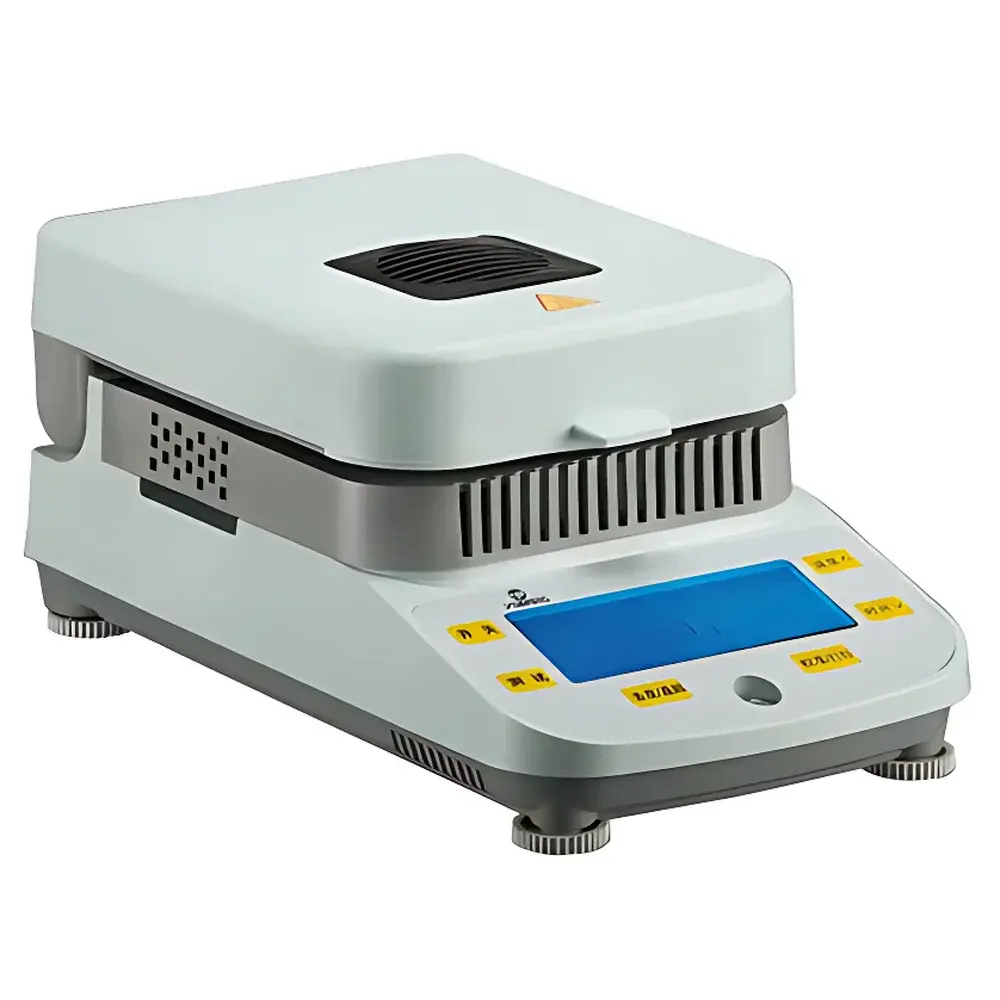
SHYP DSH-50-10 Halogen Moisture Analyzer
| Brand | SHYP |
|---|---|
| Origin | Shanghai, China |
| Model | DSH-50-10 |
| Maximum Capacity | 50 g |
| Readability | 10 mg |
| Repeatability (3 g sample) | ±0.5% |
| Minimum Sample Mass | 0.5 g |
| Recommended Sample Mass | 3–10 g |
| Heating Source | Halogen Lamp |
| Temperature Range | 50–180 °C (1 °C increments) |
| Heating Time | 1–99 min (10 s step) |
| Display | Dot-matrix LCD with backlight |
| Interface | RS232 serial port |
| Pan Diameter | 100 mm |
| Dimensions (L×W×H) | 285 × 160 × 150 mm |
| Net Weight | 3.0 kg |
| Operating Ambient | 10–30 °C |
Overview
The SHYP DSH-50-10 Halogen Moisture Analyzer is a precision benchtop instrument engineered for rapid, reliable quantification of moisture content in solid and semi-solid samples via thermogravimetric principle. It employs a high-intensity halogen lamp as the heating source, delivering uniform radiant energy to accelerate sample drying while minimizing thermal lag and surface charring—critical for maintaining measurement integrity across diverse matrices. Unlike conventional convection ovens, this analyzer integrates real-time mass monitoring with programmable temperature control, enabling direct determination of moisture loss as a function of time and temperature. Designed for routine QC laboratories, R&D facilities, and production environments, the DSH-50-10 complies with fundamental principles outlined in ASTM D4442 (Standard Test Methods for Direct Moisture Content Measurement of Wood and Wood-Based Materials), ISO 712 (Cereals and Cereal Products — Determination of Moisture Content), and USP (Water Determination). Its operational architecture supports GLP-compliant workflows through timestamped data logging and traceable endpoint criteria.
Key Features
- Halogen heating system with precise digital temperature regulation (50–180 °C, adjustable in 1 °C increments) ensures reproducible thermal profiles across repeated runs.
- High-stability隔热-style load cell (10 mg readability, 50 g capacity) isolates the weighing mechanism from thermal drift during active drying—eliminating the need for post-heating stabilization delays.
- Backlit dot-matrix LCD display presents concurrent readouts of moisture %, solid %, residual mass (g), elapsed time (min:s), and current chamber temperature (°C)—enabling real-time assessment of drying kinetics.
- Six-key intuitive interface bypasses nested menu structures; all functions—including start/stop, tare, parameter entry, and mode selection—are accessible without scrolling or submenus.
- RS232 serial interface supports bidirectional communication with external PCs and thermal printers, facilitating automated report generation and long-term data archival in CSV or TXT formats.
- Programmable endpoint logic includes fixed-time drying, automatic termination based on mass change threshold (Δm/t), and manual override—providing flexibility for method development and validation.
Sample Compatibility & Compliance
The DSH-50-10 accommodates a broad spectrum of hygroscopic and thermally sensitive materials, including but not limited to: pharmaceutical excipients and APIs, cereal grains and flour blends, polymer pellets and resins, mineral ores and clays, paper pulp and coated substrates, herbal extracts, and dairy powders. Its shallow-depth pan design (100 mm diameter) facilitates even sample distribution and maximizes surface-to-volume ratio for efficient moisture evaporation. The instrument operates within ambient conditions of 10–30 °C and ≤80% RH (non-condensing), meeting environmental specifications referenced in ISO/IEC 17025:2017 for testing laboratory competence. While not certified to IEC 61000-4 electromagnetic compatibility standards out-of-box, its analog signal conditioning and shielded internal cabling minimize susceptibility to common lab-grade electrical noise.
Software & Data Management
Data output adheres to ASCII-based RS232 protocol (9600 baud, 8N1), compatible with standard terminal emulators (e.g., Tera Term, PuTTY) and custom LabVIEW or Python scripts for integration into LIMS or MES platforms. Each measurement record includes instrument ID, date/time stamp, user-defined sample ID, initial/final mass, calculated moisture %, drying profile duration, and selected temperature setpoint. Optional PC software (available separately) enables method storage, statistical summary (mean, SD, RSD), trend charting, and PDF report export compliant with FDA 21 CFR Part 11 requirements when deployed with electronic signature modules and audit trail configuration.
Applications
This analyzer serves as a validated alternative to Karl Fischer titration for non-aqueous or low-water-content samples where speed and simplicity outweigh ultra-trace sensitivity requirements. It is routinely deployed for incoming raw material inspection in food processing plants (e.g., starch moisture verification prior to extrusion), batch release testing of tablet granules in pharmaceutical manufacturing, moisture specification checks for lithium battery cathode precursors, and quality screening of recycled paper fiber before pulping. In academic settings, it supports teaching labs focused on material science fundamentals, such as hygroscopicity modeling and Arrhenius-based drying kinetics analysis.
FAQ
What calibration standards are recommended for routine verification?
Certified anhydrous sodium tartrate (15.66% moisture) and microcrystalline cellulose (5–7% moisture) are commonly used reference materials per ASTM E1447 guidelines.
Can the DSH-50-10 be used for volatile organic compound (VOC) loss quantification?
No—it measures total mass loss under defined thermal conditions and cannot distinguish between water and other volatiles; complementary techniques like TGA-FTIR are required for speciation.
Is GMP documentation support available?
Yes—factory-supplied IQ/OQ protocols, calibration certificates traceable to NIST standards, and blank URS templates are provided upon request for regulated environments.
How often should zero-point drift correction be performed?
Before each analytical session and after significant ambient temperature shifts (>2 °C), using the built-in auto-zero function with empty pan.
Does the halogen lamp require periodic replacement?
Typical service life exceeds 5,000 hours; replacement is only necessary upon visible filament degradation or inconsistent heating performance—no scheduled maintenance interval is mandated.






