
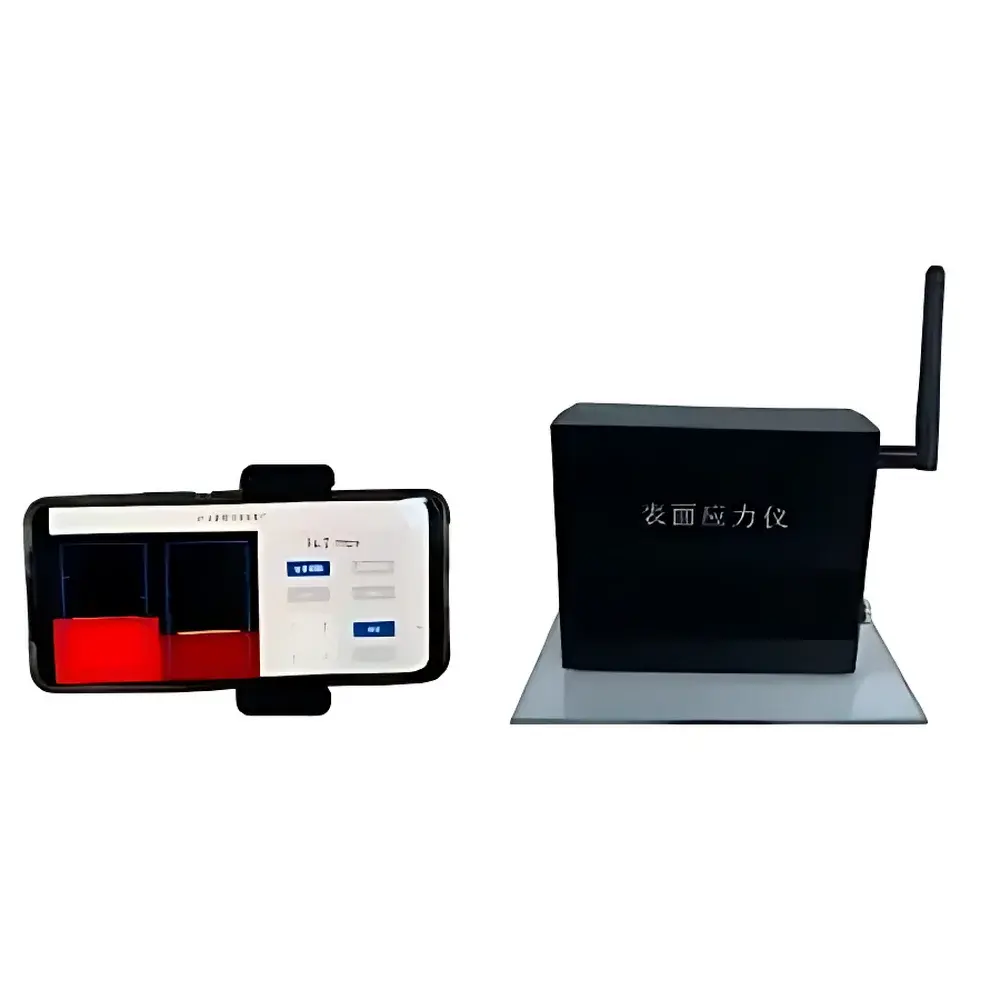
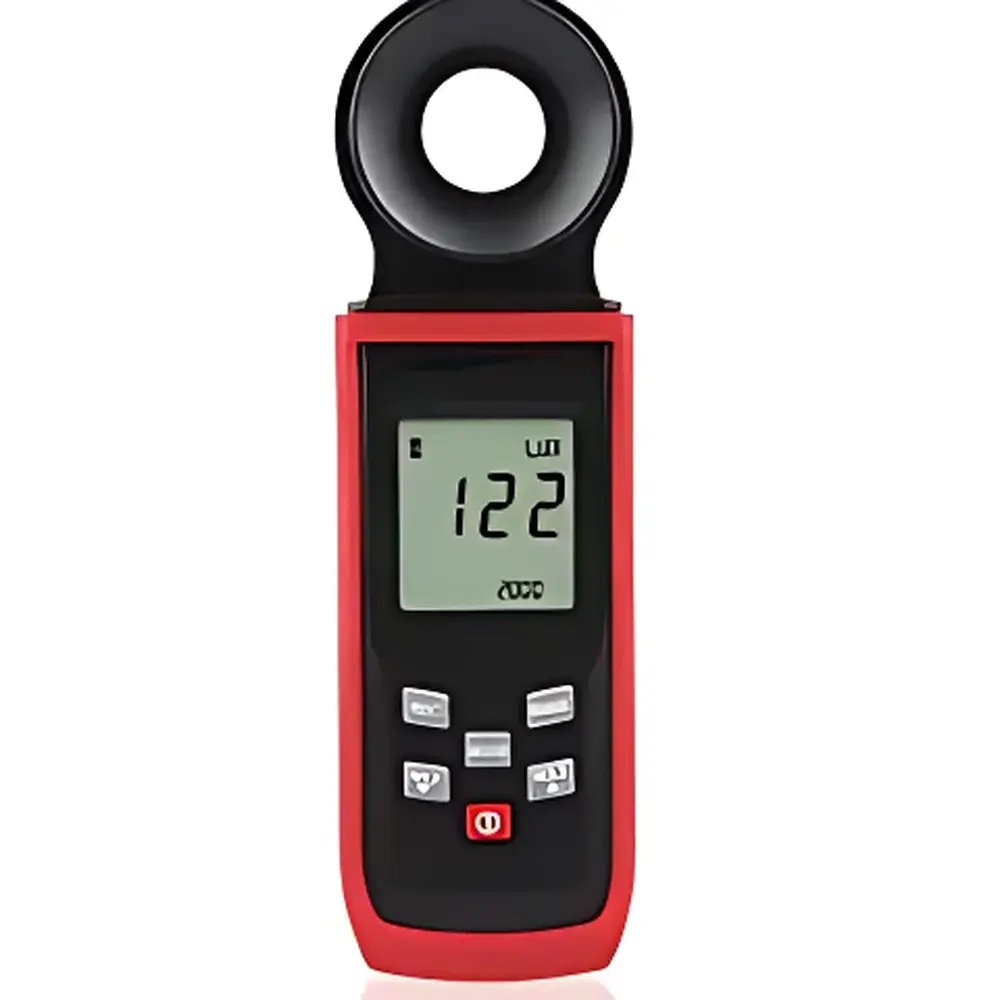
HengaoDe HAD-JF1 Optical Waveguide Effect Surface Stress Analyzer for Tempered Glass
| Brand | HengaoDe |
|---|---|
| Origin | Beijing, China |
| Manufacturer Type | Authorized Distributor |
| Product Origin | Domestic (China) |
| Model | HAD-JF1 |
| Price | USD 138 |
| Measurement Range | 15–300 MPa |
| Resolution | 2.1 MPa (soda-lime silicate glass), 1.9 MPa (borosilicate glass) |
| Dimensions (w/o stand & antenna) | 120 × 101 × 46 mm |
| Weight | 0.6 kg |
| Power Supply | Two 18650 rechargeable Li-ion batteries |
| Connectivity | Built-in Wi-Fi hotspot (IEEE 802.11 b/g/n), mobile app control |
Overview
The HengaoDe HAD-JF1 Optical Waveguide Effect Surface Stress Analyzer is a portable, non-destructive instrumentation system engineered for quantitative measurement of compressive surface stress in thermally tempered glass—specifically soda-lime silicate and borosilicate glass substrates. It operates on the principle of optical waveguide effect (OWE), a well-established interferometric technique wherein polarized light propagates along the stressed surface layer of glass, experiencing phase retardation proportional to the magnitude of residual compressive stress. This method leverages birefringence induced by mechanical stress in isotropic dielectric materials, enabling direct correlation between measured retardation and surface stress via the stress-optic coefficient (C) of the glass composition. Unlike photoelastic or scattered-light methods, OWE provides high spatial resolution at the surface interface without requiring coupling gels or vacuum chambers, making it ideal for inline quality assurance in fire-rated glazing production lines and architectural glass fabrication facilities.
Key Features
- Multi-glass compatibility: Hardware-configurable firmware supports dedicated calibration modes for soda-lime silicate glass (C = 2.79 × 10⁻¹² Pa⁻¹) and borosilicate glass (C = 2.15 × 10⁻¹² Pa⁻¹), with optional dual-mode operation.
- Embedded Wi-Fi module: Generates a local access point (AP) for secure, low-latency connection to iOS/Android devices; no external router or network infrastructure required.
- Intelligent image analysis: Combines real-time auto-recognition of stress fringe patterns with manual ROI adjustment to ensure robust quantification under variable lighting or surface contamination conditions.
- Field-deployable architecture: Compact form factor (120 × 101 × 46 mm), sub-600 g mass, and dual 18650 battery operation enable >8 hours of continuous use in plant-floor or warehouse environments.
- Traceable metrology: Factory calibration traceable to NIM (National Institute of Metrology, China); includes certificate of conformity with uncertainty budget per ISO/IEC 17025 guidelines.
Sample Compatibility & Compliance
The HAD-JF1 is validated for use on flat or gently curved tempered glass panels ≥1.5 mm thickness, including monolithic and laminated configurations. It complies with ASTM C1036-22 (Standard Specification for Flat Glass) and EN 12150-1:2020 (Thermally toughened soda-lime silicate safety glass), supporting quality verification per ISO 9001:2015 clause 8.5.1 (Control of production and service provision). While not certified to IEC 61000-4 electromagnetic immunity standards, its shielded optical path and isolated analog front-end meet functional safety requirements for Class II industrial equipment operating in ambient temperatures from 5 °C to 40 °C and relative humidity ≤80% RH (non-condensing). Data output conforms to GLP-compliant metadata tagging (timestamp, operator ID, sample ID, glass type, measurement mode).
Software & Data Management
The companion Android/iOS application provides full instrument control, live fringe visualization, and automated stress calculation using preloaded material constants. All measurements are timestamped and stored locally in encrypted SQLite format (AES-256), exportable as CSV or PDF reports with embedded digital signatures. The app supports multi-user session management, role-based access control (RBAC), and audit trail logging compliant with FDA 21 CFR Part 11 requirements for electronic records and signatures when deployed with enterprise server integration. No cloud storage is enabled by default; data residency remains fully on-device unless explicitly configured for secure SFTP transfer to internal QA servers.
Applications
- Quality control of fire-resistance rated glazing systems where surface compression must exceed 100 MPa (per EN 1363-1) to ensure thermal break resistance.
- In-process verification during tempering furnace commissioning and periodic recalibration of quench pressure profiles.
- Root cause analysis of spontaneous glass fracture incidents linked to nickel sulfide (NiS) inclusion or edge damage-induced stress relaxation.
- Validation of post-tempering handling protocols—including cutting, drilling, and edge grinding—to quantify residual stress redistribution.
- Third-party certification testing for CE marking (EN 14449 for laminated glass) and UL 9, UL 10B fire door assemblies.
FAQ
Does the HAD-JF1 require optical coupling fluid or surface preparation before measurement?
No. The optical waveguide effect relies on total internal reflection at the air–glass interface; clean, dry surfaces are sufficient. Wiping with lint-free cloth and isopropyl alcohol is recommended if fingerprints or dust are present.
Can the device measure stress through laminated interlayers (e.g., PVB or EVA)?
No. The HAD-JF1 measures only the outermost tempered pane’s surface stress. Interlayers attenuate the evanescent wave and invalidate OWE assumptions.
Is firmware update capability available?
Yes. Over-the-air (OTA) updates are delivered via the mobile app; version history and release notes are published on the manufacturer’s technical support portal.
What is the typical measurement repeatability under controlled lab conditions?
Based on internal validation per ISO 5725-2:2019, the standard deviation across 10 repeated measurements on a stable 12-mm soda-lime glass reference sample is ≤±1.4 MPa at 200 MPa nominal stress.
How is traceability maintained across different operators and shifts?
Each measurement embeds operator ID (assigned during app login), GPS-derived location (optional), environmental temperature/humidity (via integrated sensor), and unique device serial number—enabling full forensic reconstruction per ISO/IEC 17025 clause 7.7.





