
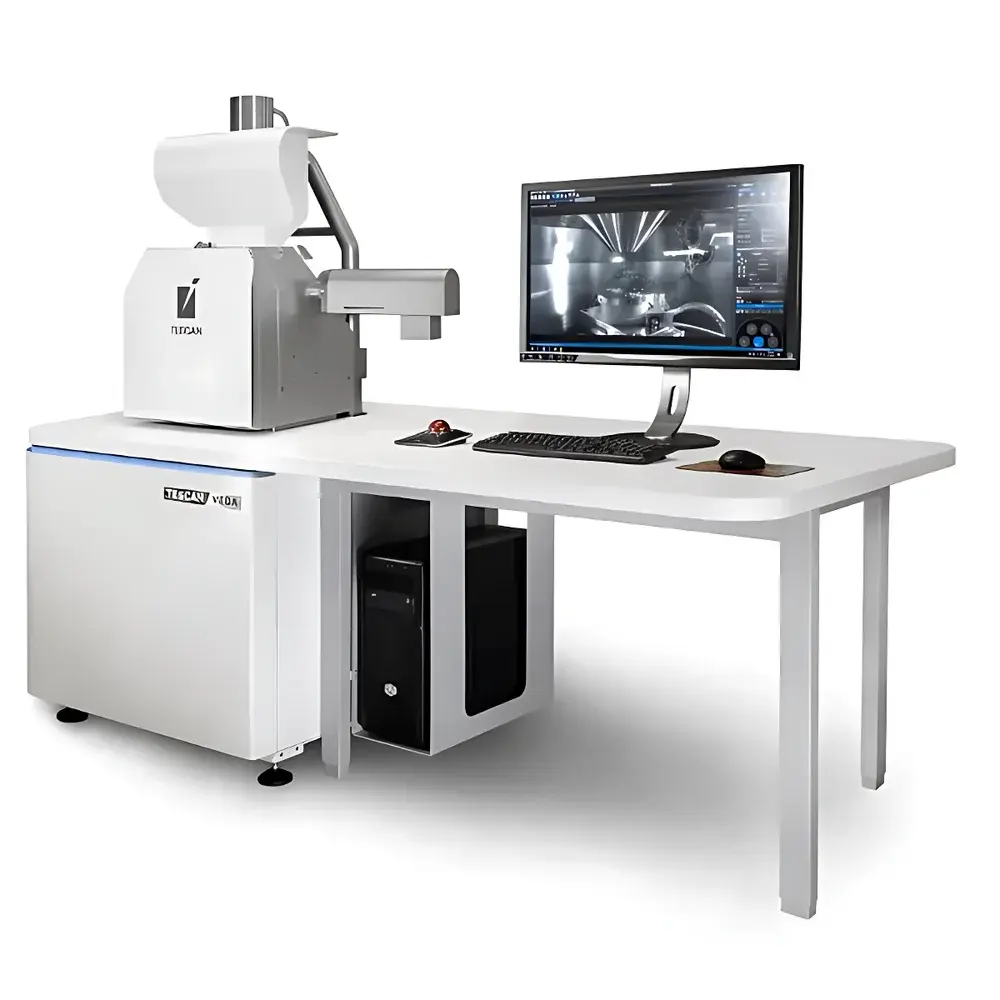
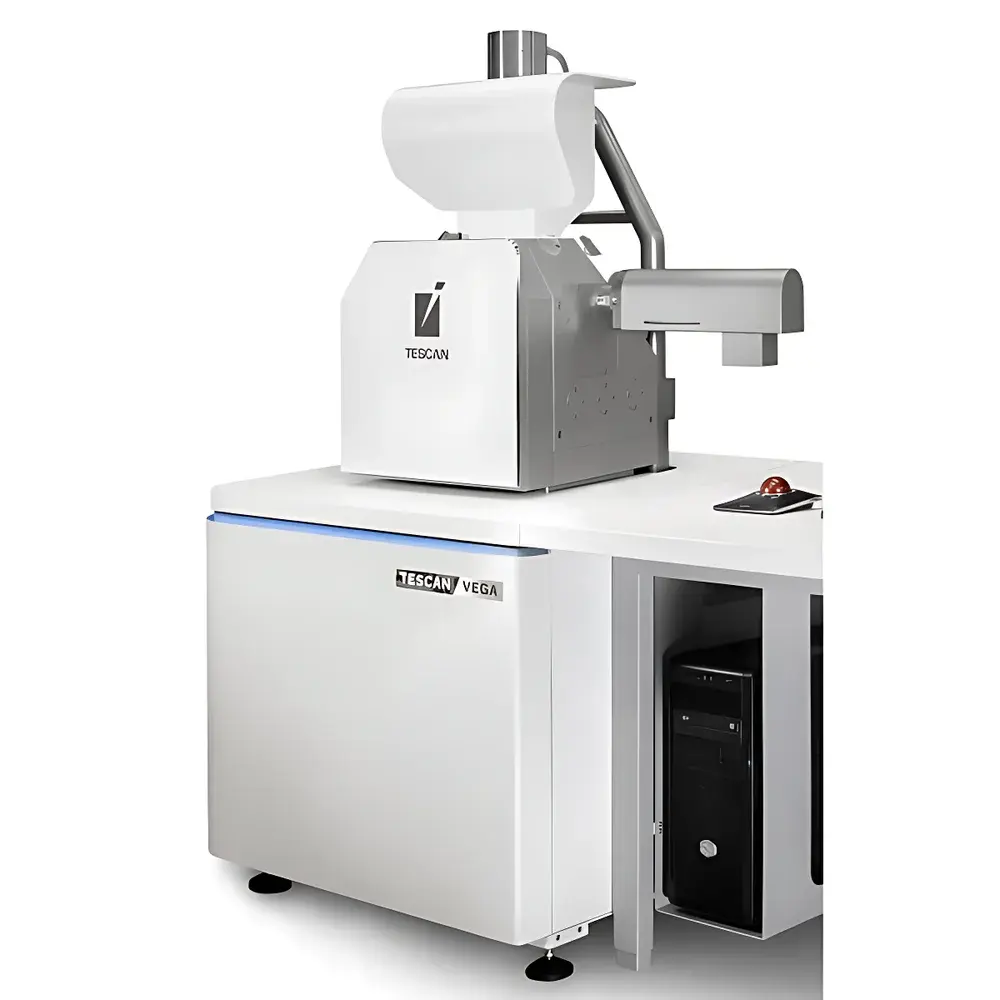
TESCAN VEGA Tungsten-Filament Scanning Electron Microscope
| Brand | TESCAN |
|---|---|
| Origin | Czech Republic |
| Model | TESCAN VEGA |
| Instrument Type | Floor-standing SEM |
| Electron Source | Tungsten Filament |
| Resolution (Secondary Electrons) | 3.0 nm @ 30 kV |
| Resolution (Backscattered Electrons) | 3.5 nm @ 30 kV |
| Magnification Range | 2× to 1,000,000× |
| Accelerating Voltage | 0.2–30 kV (continuously adjustable) |
| Software Platform | TESCAN Essence™ |
| Vacuum Mode | SingleVac™ (standard) |
| Optical Design | Wide Field Optics™ |
| Beam Control | In-Flight Beam Tracing™ |
| Safety System | Essence™ 3D Collision Prevention Module |
| Energy Efficiency | Vacuum Buffer Unit |
Overview
The TESCAN VEGA Tungsten-Filament Scanning Electron Microscope (SEM) is a robust, entry-level floor-standing electron imaging system engineered for high reproducibility, operational stability, and broad analytical versatility in academic, industrial, and quality assurance laboratories. Operating on the principle of raster-scanned electron beam interaction with solid specimens, the VEGA generates high-fidelity topographic contrast via secondary electrons (SE) and compositional contrast via backscattered electrons (BSE), enabling nanoscale surface characterization down to 3.0 nm resolution at 30 kV. Designed as the fourth-generation platform in TESCAN’s VEGA series, it integrates a thermionic tungsten filament electron source—selected for its cost-effectiveness, long service life, and stable emission under routine operation—within a mechanically optimized column architecture that minimizes thermal drift and vibration sensitivity. Its modular vacuum chamber accommodates diverse sample geometries up to 200 mm in diameter, while maintaining compatibility with standard ISO 80000-compliant metrology workflows.
Key Features
- Essence™ Integrated Software Platform: A unified graphical interface consolidates real-time SEM imaging, energy-dispersive X-ray spectroscopy (EDS) mapping, and quantitative elemental analysis within a single scan window—eliminating context switching and streamlining workflow continuity.
- In-Flight Beam Tracing™: A proprietary beam alignment algorithm dynamically monitors and corrects electron trajectory during acquisition, reducing setup time for optimal focus, stigmation, and astigmatism correction without mechanical aperture adjustments.
- Wide Field Optics™: Enables seamless navigation from ultra-low magnifications (2×) to high-resolution imaging without auxiliary optical cameras or stage repositioning—critical for rapid region-of-interest localization in heterogeneous samples.
- SingleVac™ Environmental Mode: Standard configuration permits variable-pressure operation (up to 130 Pa) using water vapor or nitrogen, enabling direct observation of non-conductive, hydrated, or beam-sensitive specimens—including polymers, biological tissues, and uncoated geological sections—without sputter coating.
- 3D Beam Technology: Supports synchronized dual-detector acquisition (e.g., SE + BSE) with geometrically registered tilt-series generation for real-time stereo reconstruction and depth perception—enhancing morphological interpretation in failure analysis and microstructural evaluation.
- Essence™ 3D Collision Prevention: A real-time spatial monitoring system visualizes detector positions, stage coordinates, and specimen height within the chamber volume, preventing hardware collisions during automated tilt, rotation, or multi-point acquisition sequences.
Sample Compatibility & Compliance
The VEGA accommodates a wide range of bulk, particulate, and sectioned specimens across materials science, life sciences, and geosciences. Its chamber design supports standard 100 mm stubs, 200 mm wafers, and custom holders for in-situ heating or cooling stages. The system complies with IEC 61000-6-3 (EMC emissions) and IEC 61000-6-2 (immunity), and meets CE marking requirements for laboratory instrumentation. For regulated environments, the Essence™ software supports audit trail logging, user access levels, and electronic signature capability aligned with FDA 21 CFR Part 11 principles—facilitating GLP/GMP-compliant documentation in pharmaceutical QC and medical device development.
Software & Data Management
Essence™ provides native support for TIFF, BMP, and JPEG export; calibrated measurement tools (line, area, particle counting); and batch processing of multi-field acquisitions. EDS data is acquired in parallel with imaging and processed using standardless quantification algorithms traceable to NIST SRM reference materials. All raw image and spectrum files are stored in open-format HDF5 containers, ensuring long-term archival integrity and third-party interoperability with Python-based analysis frameworks (e.g., HyperSpy, scikit-image). Optional integration with TESCAN’s AMBER™ analytics suite enables automated phase identification, grain boundary detection, and statistical microstructure reporting per ASTM E112 and ISO 13067 standards.
Applications
- Materials Science: Fractography of metallic alloys, dispersion analysis of fillers in polymer composites, porosity quantification in cementitious matrices, fiber morphology in textiles and paper.
- Life Sciences: Surface topography of freeze-dried pharmaceutical tablets, cell membrane architecture in fixed tissue sections, pollen grain ultrastructure, biofilm formation on implant surfaces.
- Earth Sciences: Mineral phase discrimination in polished thin sections, pore-network characterization in shale reservoirs, microfossil preservation assessment, slag inclusion analysis in metallurgical slags.
- Failure Analysis & QA/QC: Contamination identification on semiconductor wafers, solder joint voiding inspection, coating adhesion evaluation, wear debris morphology in tribological studies.
FAQ
What vacuum modes does the VEGA support?
The VEGA operates in high vacuum (HV), low vacuum (LV), and SingleVac™ modes—enabling flexible imaging of conductive, semi-conductive, and insulating samples without mandatory metal coating.
Is EDS integration optional or included?
A fully integrated EDS module is available as a factory-configured option; all VEGA systems are pre-wired and mechanically aligned for plug-and-play detector installation.
Can the VEGA be upgraded to field-emission capability?
No—the VEGA platform is specifically engineered for thermionic tungsten filament operation; field-emission upgrades require migration to the TESCAN MIRA or LYRA series.
What is the typical pump-down time from atmosphere to high vacuum?
Using the standard turbomolecular pump and vacuum buffer unit, the system achieves high vacuum (<1×10⁻³ Pa) in ≤3 minutes after chamber venting.
Does the system support automated stage navigation and scripting?
Yes—Essence™ includes Python API access, macro recording, and coordinate-based stage positioning with sub-micron repeatability across the full 100 × 100 mm travel range.





