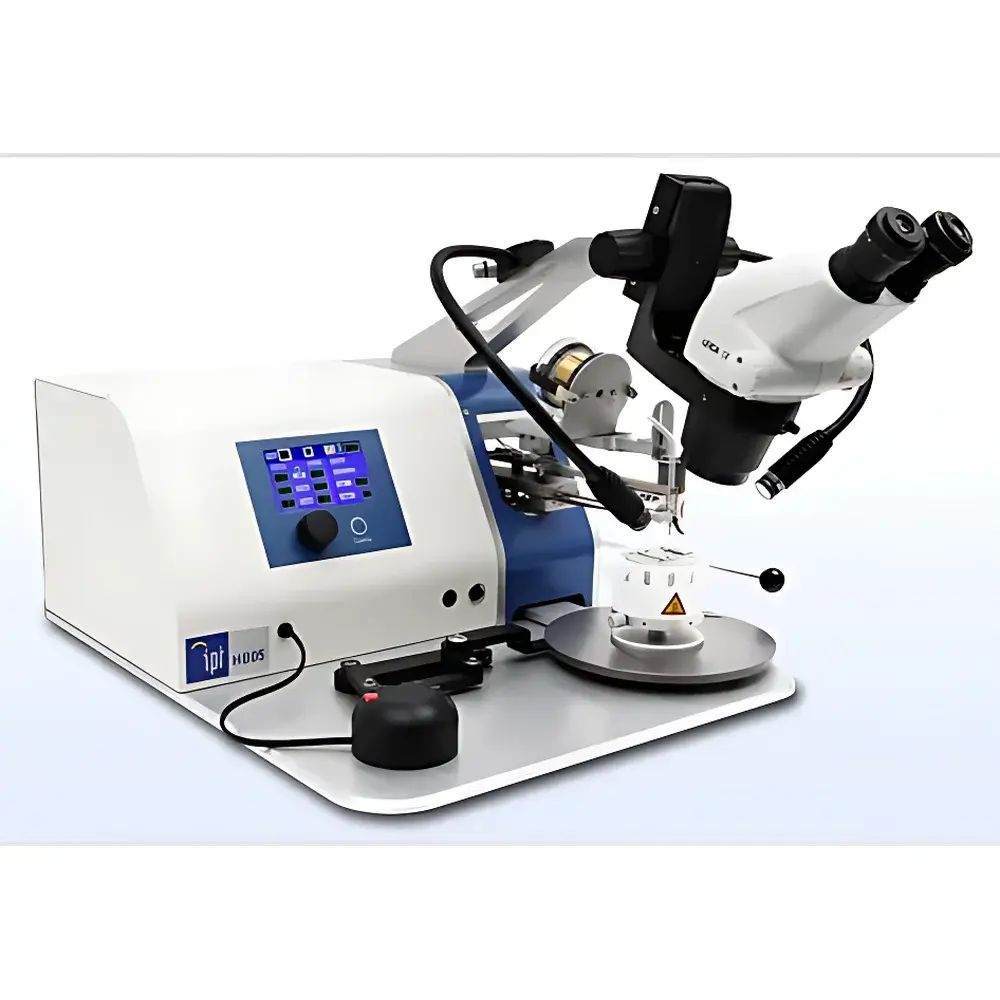
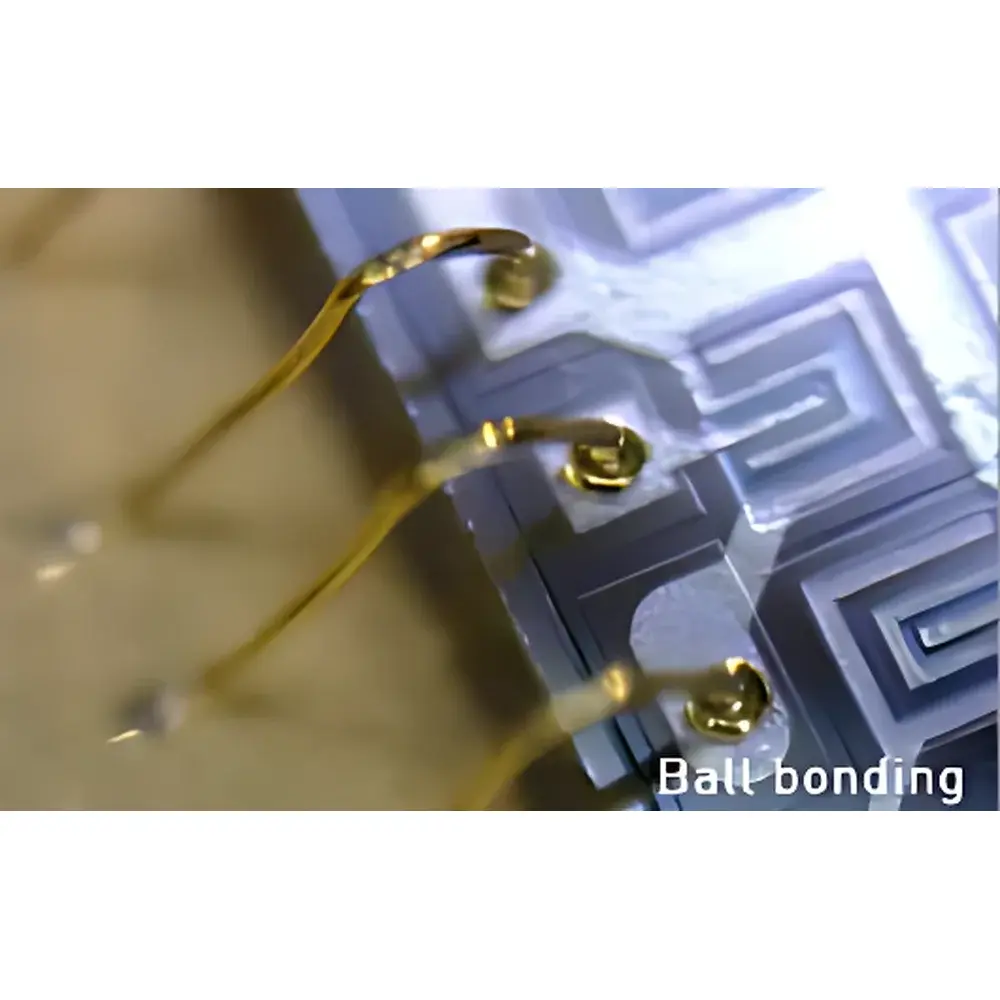
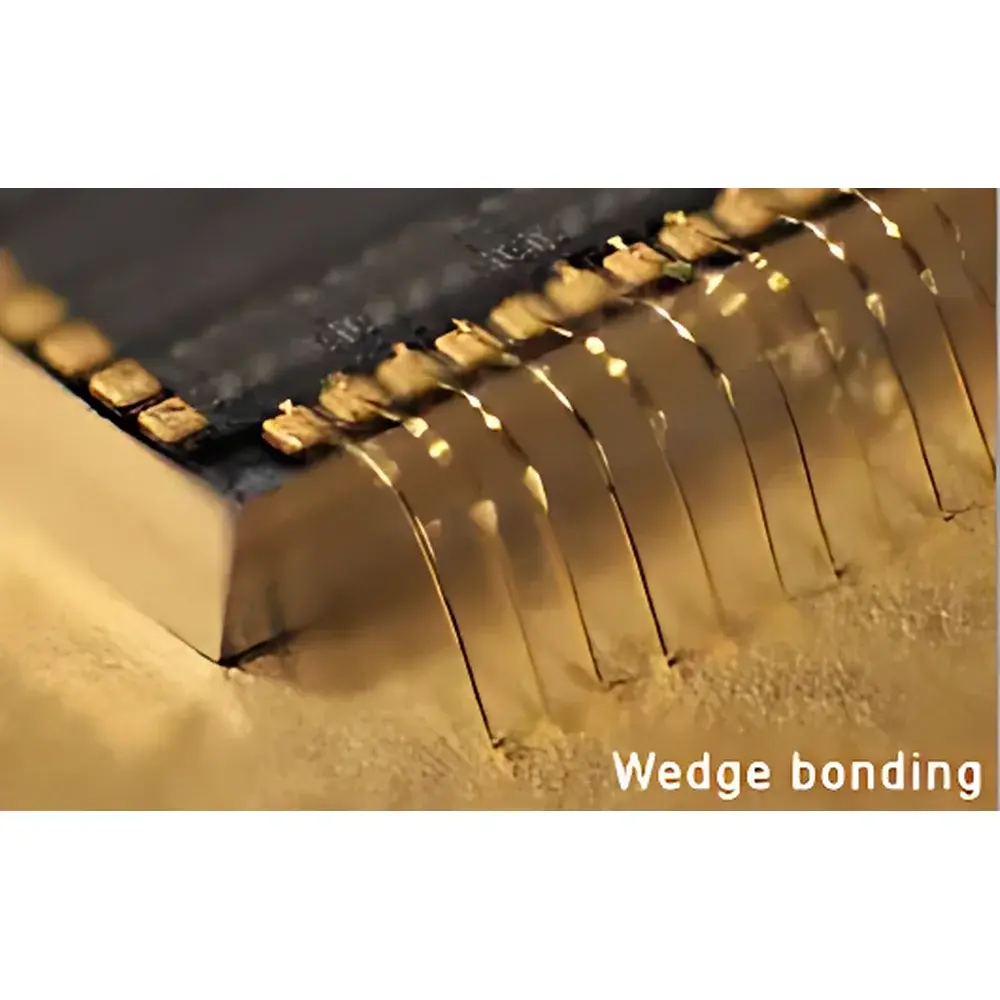
TPT HB05 Hybrid Thermosonic Wire Bonder
| Brand | TPT |
|---|---|
| Origin | Germany |
| Model | HB05 |
| Bonding Methods | Wedge-Wedge, Ball-Wedge, Ribbon & Bump Bonding |
| Wire Diameter Range | 17–75 µm (gold/aluminum) |
| Ribbon Size | up to 25 × 250 µm |
| Ultrasonic Frequency | 62 kHz, PLL-controlled |
| Ultrasonic Power Output | 0–5 W |
| Bond Time | 0–1 s |
| Bond Force | 5–130 cNm |
| Capillary/Tool | Ø1.58 mm, L19 mm |
| Bond Head Cavity Depth | 16 mm |
| Bond Arm Length | 165 mm |
| Temperature Control | up to 250 °C ±1 °C |
| Power Supply | 100–240 V ±10%, 50/60 Hz, max. 10 A |
| Dimensions | 550 × 450 × 250 mm |
| Weight | 25 kg |
Overview
The TPT HB05 Hybrid Thermosonic Wire Bonder is a precision-engineered, benchtop bonding platform designed for R&D laboratories, process development centers, and low-volume pilot production environments in semiconductor packaging. It integrates thermosonic bonding capability with mechanical flexibility to support multiple interconnect methodologies—including ball-wedge, wedge-wedge, ribbon, and bump bonding—within a single, reconfigurable head architecture. Unlike dedicated single-mode bonders, the HB05 enables rapid transition between bonding modalities by swapping only the bonding tool (capillary or wedge), eliminating the need for separate machines or complex recalibration. Its core transduction system employs a phase-locked loop (PLL)-stabilized 62 kHz ultrasonic generator, ensuring consistent energy delivery across varying load conditions and material interfaces. Combined with precise thermal control (up to 250 °C ±1 °C) and motorized force actuation, the HB05 delivers repeatable metallurgical interfacial bonding essential for high-reliability microelectronic assemblies.
Key Features
- Multi-modal bonding head compatible with ball, wedge, ribbon (max. 25 × 250 µm), and bump configurations via tool interchangeability
- Motor-driven wire feed and clamp mechanism enabling programmable tail control and consistent loop formation
- High-resolution 4.3-inch LCD interface with intuitive keypad navigation for direct parameter entry and real-time monitoring
- Deep-cavity bond head (16 mm cavity depth) accommodating high-profile packages and stacked-die configurations
- 20-user-programmable recipes with non-volatile storage for process traceability and reproducibility
- Integrated temperature controller with ±1 °C stability over 25–250 °C range, compliant with JEDEC J-STD-020 moisture sensitivity level (MSL) pre-conditioning requirements
- 6:1 mechanical reduction ratio on micro-adjustment stage (10 mm travel) for sub-micron Z-axis positioning accuracy
- Ultrasonic output digitally regulated from 0–5 W with closed-loop feedback, minimizing drift during extended operation
Sample Compatibility & Compliance
The HB05 accommodates standard gold and aluminum wires ranging from 17 µm to 75 µm (0.7–3 mil), as well as flat ribbon conductors up to 25 × 250 µm (1 × 8 mil). Its bond force range (5–130 cNm) and programmable bond time (0–1 s) enable optimization for both soft-metal (e.g., Au) and harder metallizations (e.g., Al, Cu alloys). The system meets mechanical and electrical safety requirements per IEC 61000-6-2 (immunity) and IEC 61000-6-4 (emissions), and supports GLP-compliant documentation workflows when integrated with external data logging systems. While not certified to ISO 9001 out-of-box, its parameter logging, recipe versioning, and audit-ready setup align with internal quality system requirements for semiconductor packaging validation per AEC-Q200 and IPC-7095 guidelines.
Software & Data Management
The HB05 operates via embedded firmware with no external PC dependency. All bonding parameters—including ultrasonic power, temperature ramp profiles, force ramp rates, bond time, and loop height—are configured directly through the front-panel interface. Each of the 20 stored programs retains full parameter sets with timestamped revision history. Though the unit does not include native Ethernet or USB data export, analog voltage outputs (0–10 V) are available for external oscilloscope capture of ultrasonic envelope signals and force transducer responses. For regulatory environments requiring electronic records, integration with third-party SCADA or MES platforms is achievable via RS-232 serial communication (Modbus RTU protocol supported), enabling alignment with FDA 21 CFR Part 11 expectations for electronic signatures and audit trails when paired with validated middleware.
Applications
- Development and qualification of flip-chip underfill processes requiring controlled thermosonic bump bonding
- Prototyping of RF and MEMS packages where ribbon bonding minimizes inductance and improves current handling
- Failure analysis labs performing rework bonding on failed die or substrate-level interconnects
- University research into advanced intermetallic formation kinetics using variable temperature/ultrasonic coupling
- Qualification of new wire alloys (e.g., palladium-coated copper) under accelerated thermal cycling conditions
- Process window characterization for automotive-grade power modules (AEC-Q102 qualified substrates)
FAQ
Can the HB05 perform both ball and wedge bonding without hardware modification?
Yes—only the bonding tool (capillary for ball bonding or wedge for wedge bonding) must be replaced; the bond head, ultrasonic transducer, and thermal stage remain unchanged.
Is the ultrasonic frequency fixed at 62 kHz, or is it tunable?
The system operates exclusively at 62 kHz with PLL stabilization; frequency tuning is not supported, as this ensures optimal energy transfer for standard wire diameters and metallurgies.
Does the HB05 support nitrogen purge or vacuum bonding environments?
No—the unit is designed for ambient air operation only; integration with external gloveboxes or inert-atmosphere chambers requires custom mounting and feedthrough adaptations.
What calibration standards apply to the force and temperature sensors?
Force transducers are factory-calibrated against NIST-traceable dead-weight standards; temperature calibration is verified using ITS-90 platinum resistance thermometers at three points (100 °C, 150 °C, 250 °C).
Is remote diagnostics or firmware update capability available?
Firmware updates require physical access and use of proprietary TPT service software via RS-232; remote diagnostics are not implemented in the base configuration.