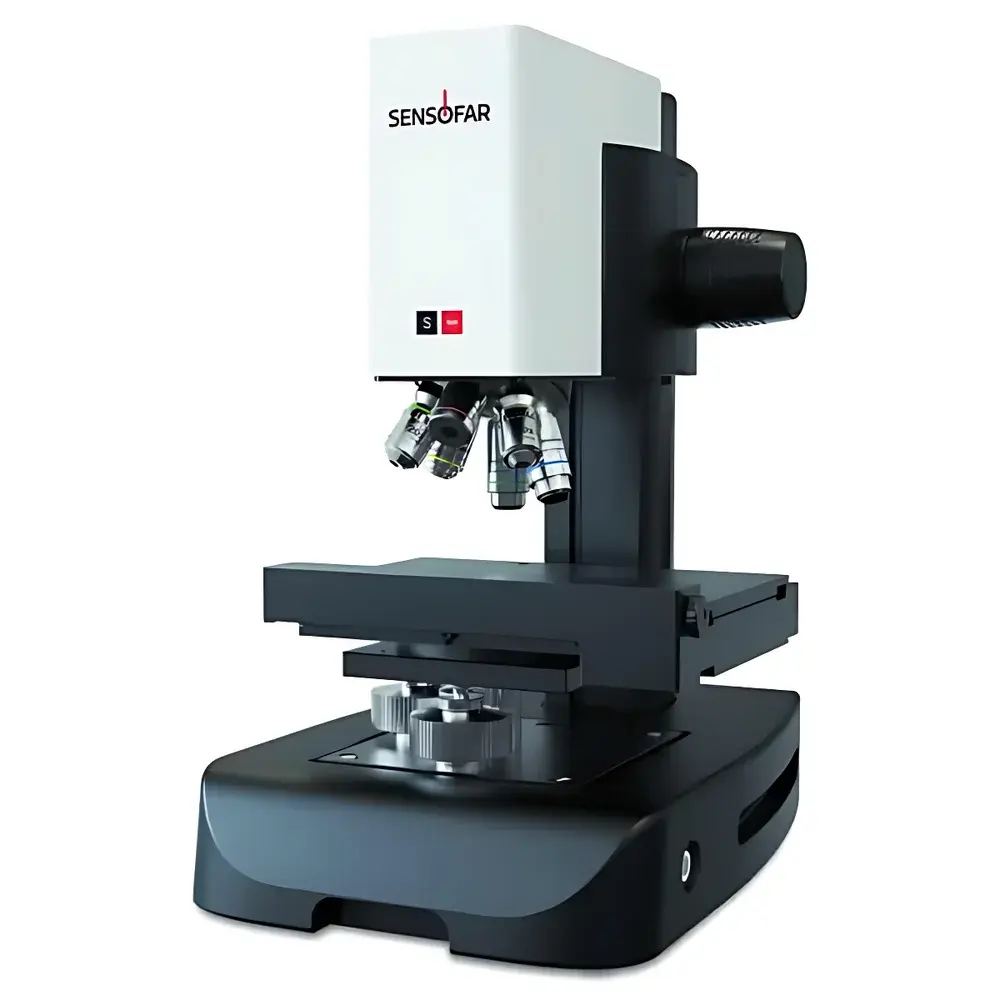
Sensofar S lynx 2 3D Optical Profilometer
| Brand | Sensofar |
|---|---|
| Origin | Spain |
| Model | S lynx 2 |
| Measurement Principle | White-Light Interferometry |
| Product Type | Non-contact 3D Optical Profilometer / Surface Roughness Analyzer |
| Key Technologies | Vertical Scanning Interferometry (VSI), Confocal Microscopy, AI-Powered Multi-Focal Plane Fusion |
| Maximum Scan Area (Stitched) | 125 × 75 mm |
| On-Sensor Real-Time Processing | Yes |
| Form Factor | Compact Benchtop System |
Overview
The Sensofar S lynx 2 is a compact, high-performance 3D optical profilometer engineered for precision surface topography characterization across research laboratories and industrial quality control environments. Based on white-light interferometry (WLI), the system delivers nanoscale vertical resolution and sub-micron lateral accuracy for quantitative analysis of surface roughness (Ra, Rq, Rz), step heights, volume, curvature, and critical dimension (CD) features. Unlike contact stylus profilers, the S lynx 2 operates entirely non-destructively—eliminating tip wear, sample deformation, or contamination risks. Its hybrid optical architecture integrates three complementary measurement modalities: vertical scanning interferometry (VSI) for smooth to moderately rough surfaces, confocal microscopy for high-contrast, steep-slope, or transparent substrates, and AI-driven multi-focal plane fusion for enhanced signal-to-noise ratio and extended depth-of-field in heterogeneous or complex topographies. This tri-modal capability ensures robust data acquisition across diverse material classes—including metals, semiconductors, polymers, ceramics, thin films, and micro-optical components—without requiring hardware reconfiguration.
Key Features
- Tri-Modal Optical Engine: Seamless switching between VSI, confocal, and AI-enhanced multi-focal stacking enables optimal technique selection per surface morphology and reflectivity.
- On-Sensor Real-Time Processing: Embedded FPGA-based computation within the sensor head offloads raw data processing from the host PC, accelerating acquisition throughput and enabling immediate preview of height maps and roughness parameters.
- Automated Stitching with Sub-Pixel Registration: Proprietary stitching algorithms maintain metrological traceability across motorized XY stages, supporting full-field coverage up to 125 × 75 mm while preserving <1 nm vertical repeatability.
- Benchtop Footprint & Vibration-Insensitive Design: Compact form factor (≤400 × 350 × 300 mm) facilitates integration into cleanrooms, production lines, or shared lab spaces; passive damping minimizes sensitivity to ambient mechanical noise.
- Modular Illumination & Objective Support: Compatible with a range of high-NA objectives (5×–100×) and configurable LED illumination (white, green, UV) to optimize contrast for reflective, translucent, or structured surfaces.
Sample Compatibility & Compliance
The S lynx 2 accommodates samples ranging from bare silicon wafers and MEMS devices to machined metal parts, medical implants, and coated optical lenses—regardless of conductivity, transparency, or thermal sensitivity. It complies with ISO 25178-2:2012 (Geometrical product specifications — Surface texture: Areal — Part 2: Terms, definitions and surface texture parameters) and supports traceable calibration via NIST-traceable step-height standards. The system’s software architecture meets requirements for regulated environments: audit trail logging, user access control, electronic signatures, and data integrity safeguards align with FDA 21 CFR Part 11 and EU Annex 11 principles. Routine verification protocols support GLP and GMP-compliant workflows in semiconductor manufacturing, biomedical device QA, and advanced materials R&D.
Software & Data Management
Sensofar’s MountainsMap® 9.0 software provides a unified platform for acquisition, visualization, analysis, and reporting. It includes over 300 standardized surface texture parameters per ISO 25178 and ASME B46.1, automated defect detection, cross-section profiling, grain analysis, and statistical process control (SPC) charting. All measurement data—including raw interferograms, confocal intensity stacks, and fused height maps—are stored in vendor-neutral HDF5 format with embedded metadata (instrument settings, calibration history, operator ID). Export options include CSV, STEP AP210, and industry-standard GD&T annotations compatible with CAD comparison tools. Software updates are delivered via secure HTTPS channels with version-controlled release notes and validation documentation.
Applications
- Semiconductor Process Control: Quantifying etch depth uniformity, CMP planarity, photoresist profile fidelity, and through-silicon via (TSV) geometry.
- Microfabrication & MEMS: Characterizing actuator displacement, cantilever curvature, and packaging-induced warpage with <0.1 nm vertical noise floor.
- Medical Device Manufacturing: Validating surface finish of orthopedic implants, stent strut edges, and polymer-based diagnostic microfluidics.
- Optics & Photonics: Measuring coating thickness variation, lens surface irregularity (PV, RMS), and diffractive optical element (DOE) feature fidelity.
- Advanced Materials Development: Correlating surface texture evolution with tribological performance, adhesion strength, or catalytic activity in battery electrodes and fuel cell membranes.
FAQ
What surface roughness parameters does the S lynx 2 calculate in compliance with international standards?
It computes all primary areal parameters defined in ISO 25178-2, including Sa, Sq, Sz, Ssk, Sku, Sal, Str, Std, and functional parameters such as Smr, Sdc, and Spc—fully traceable to NIST reference standards.
Can the system measure transparent or semi-transparent layers?
Yes—confocal mode provides high-contrast imaging of buried interfaces (e.g., SiO₂ on Si, polymer coatings on glass), while VSI enables precise thickness mapping of optically clear films down to ~100 nm.
Is remote operation supported for factory-floor deployment?
The system supports Ethernet-based remote control, live streaming of acquisition previews, and scheduled unattended measurements via Windows Remote Desktop or third-party MES/SCADA integrations.
How is calibration maintained over time?
Built-in auto-calibration routines verify objective magnification, Z-stage linearity, and photometric response daily; optional annual certification by Sensofar-accredited metrology labs ensures ongoing ISO/IEC 17025 compliance.
Does the software support custom script-based analysis?
MountainsMap® includes Python API integration (via MountainsSDK), enabling automated batch processing, machine learning–assisted classification, and bespoke report generation aligned with internal QA templates.