
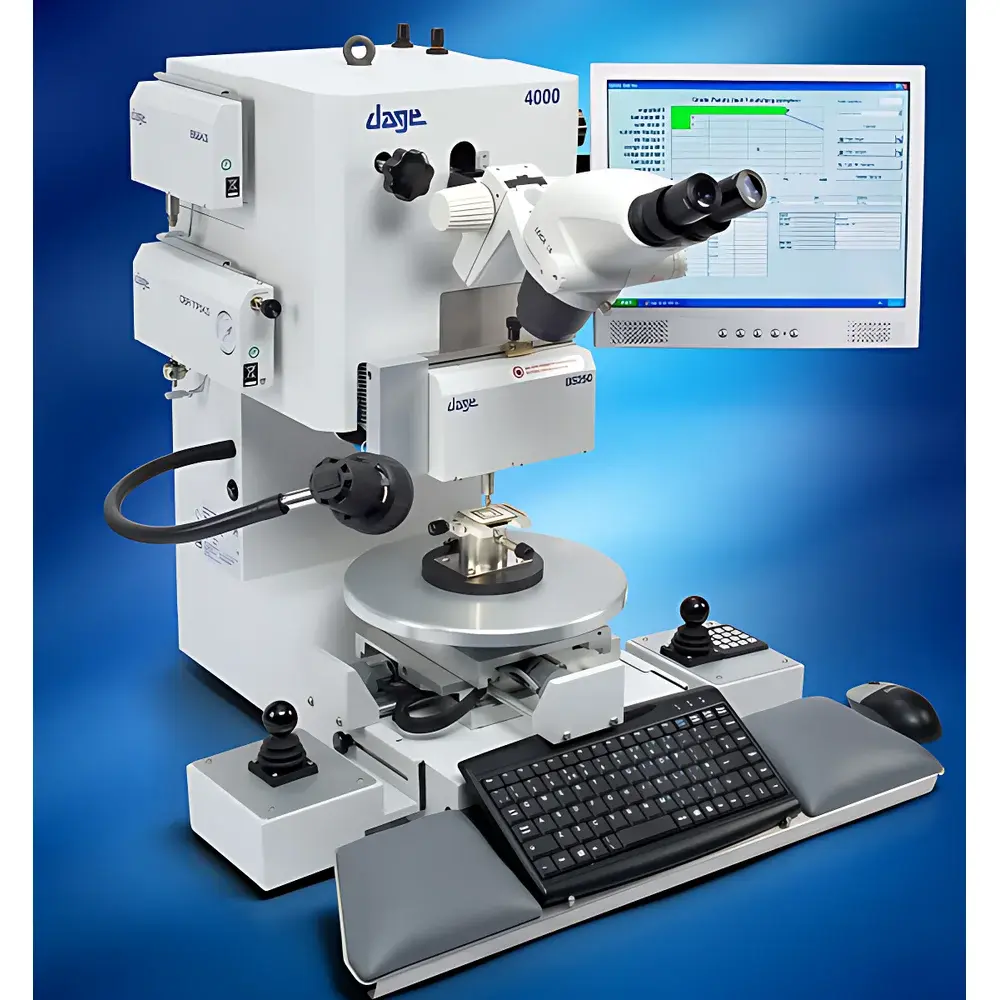
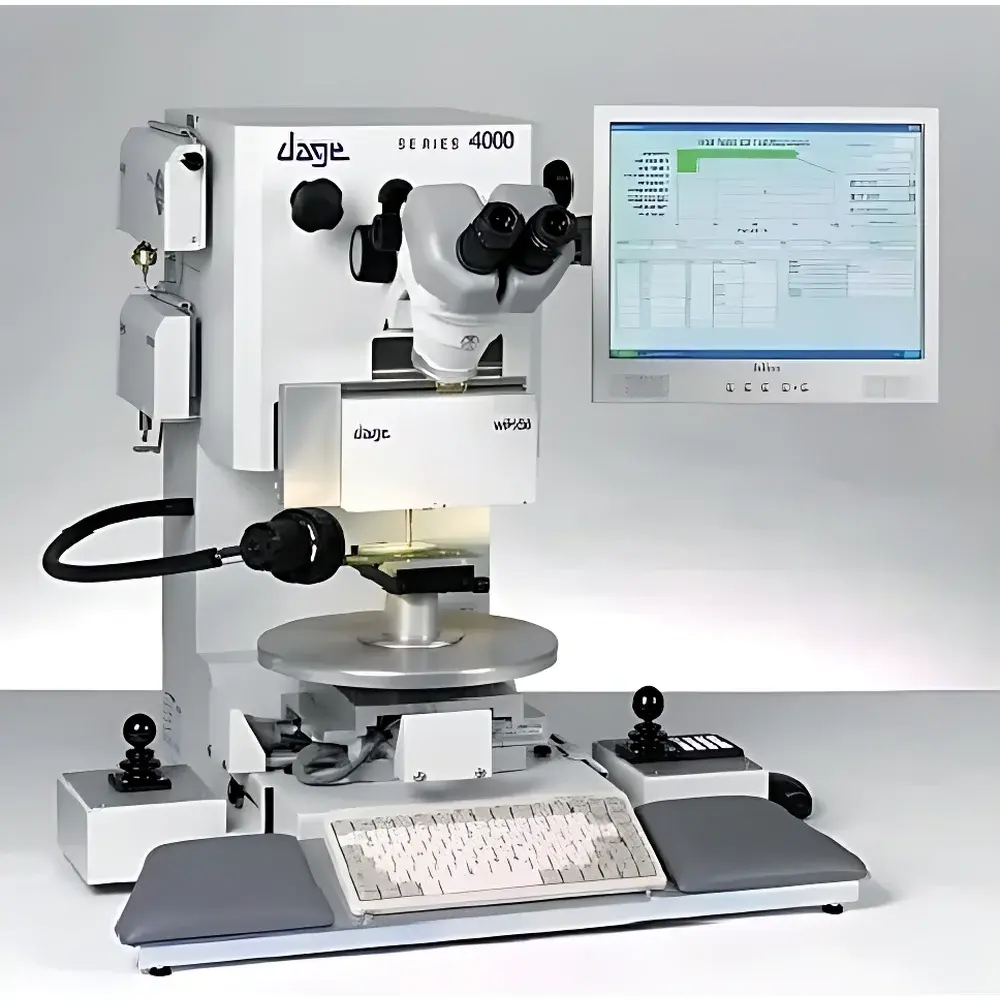
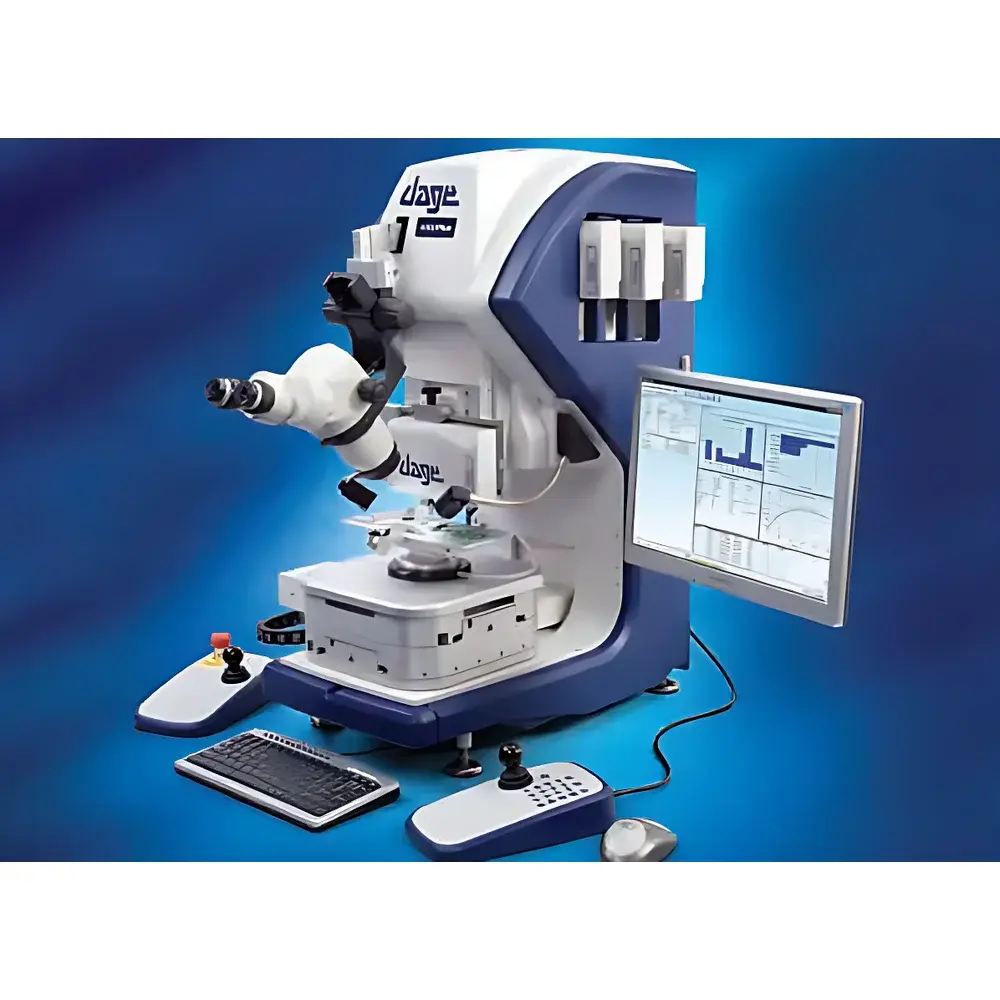
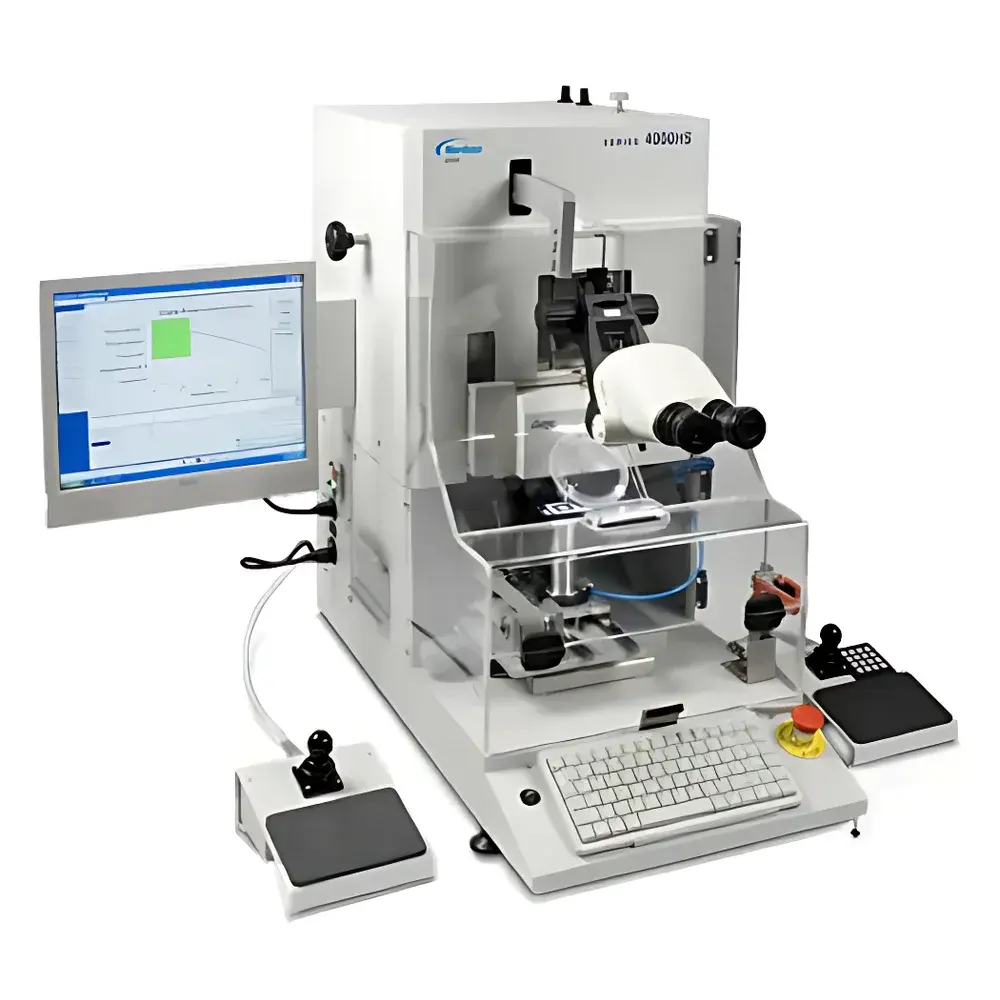
Nordson Dage DAGE4000 Bond Strength Tester
| Brand | Nordson Dage |
|---|---|
| Origin | United Kingdom |
| Model | DAGE4000 |
| Test Force Range (Pull) | 0–100 g, 0–1 kg, 0–10 kg |
| Test Force Range (Shear/Thrust) | 0–250 g (ball shear), 0–5 kg (solder ball, tweezer pull), 0–100 kg (chip shear), 0–200 kg (optional high-force chip shear) |
| Dimensions (L×W×H) | 730 × 425 × 670 mm |
| Weight | 45 kg |
| Power Supply | 100–240 V AC, 50/60 Hz |
| Compliance | MIL-STD-883, JESD22, JEITA ED-4701, CE Machinery Directive 2006/42/EC, Low Voltage Directive 2014/35/EU |
Overview
The Nordson Dage DAGE4000 Bond Strength Tester is a precision-engineered mechanical force measurement system designed for quantitative evaluation of interfacial adhesion integrity in microelectronic packaging and assembly processes. Operating on the principles of calibrated tensile and shear force transduction, the instrument delivers traceable, repeatable mechanical stress application to bond interfaces—including wire bonds (Au/Al), solder bumps (SnPb, SAC), die attach layers, BGA solder balls, and surface-mount component terminations. Its modular architecture supports standardized test methodologies defined by international semiconductor reliability standards, enabling direct correlation between measured failure loads and process capability indices (Cpk) or qualification thresholds. The system is not a generic materials tester; rather, it is purpose-built for the geometric constraints, force sensitivities, and spatial resolution demands of sub-millimeter bond structures encountered in advanced packaging—such as fan-out wafer-level packaging (FOWLP), 2.5D/3D IC integration, and high-brightness LED assemblies.
Key Features
- Motorized X-Y stage with programmable positioning accuracy ≤ ±1 µm, enabling precise alignment to bond pads, wire loops, or bump arrays under optical guidance
- Ergonomic joystick-controlled motion interface for intuitive manual operation and rapid setup—reducing operator training time without compromising measurement repeatability
- Modular tooling system supporting interchangeable test heads: wedge pull, ball shear, chip shear, tweezer peel, vector pull, and BGA ball lift configurations
- High-resolution load cell technology with dual-range calibration (e.g., 0–100 g and 0–10 kg full-scale) ensuring optimal signal-to-noise ratio across micro- and macro-force regimes
- Integrated real-time force–displacement curve acquisition at ≥1 kHz sampling rate, capturing brittle fracture onset, plastic deformation, and post-failure residual load behavior
- Robust mechanical frame with vibration-damped granite base and rigid Z-axis column, minimizing parasitic deflection during high-force chip shear tests up to 200 kg
Sample Compatibility & Compliance
The DAGE4000 accommodates a wide range of substrate formats—from bare die and leadframes to populated PCBs, ceramic packages, and flexible hybrid circuits—without requiring custom fixturing for standard JEDEC-compliant packages (e.g., QFP, SOIC, BGA, CSP). It meets the mechanical test requirements specified in MIL-STD-883 Method 2011 (Wire Bond Pull Test), JESD22-B116 (Ball Shear), JESD22-B117 (Chip Shear), and JEITA ED-4701 300 Series (Solder Joint Reliability). All force measurements are NIST-traceable via factory calibration certificates issued per ISO/IEC 17025-accredited procedures. The system conforms to EU CE marking directives, including the Machinery Directive (2006/42/EC) and Electromagnetic Compatibility Directive (2014/30/EU), and incorporates safety interlocks compliant with EN ISO 13857 for access protection during operation.
Software & Data Management
Control and analysis are performed via DageBond™ software—a Windows-based platform supporting ASTM E29 and ISO 5725-compliant statistical reporting. The software enables automated test sequencing, pass/fail threshold definition per bond type, batch-level SPC charting (X̄–R, Cp, Cpk), and export of raw force–displacement data in CSV or XML format for integration into enterprise MES or quality management systems (QMS). Audit trails comply with FDA 21 CFR Part 11 requirements when configured with user authentication, electronic signatures, and immutable data logging. Optional modules include auto-focus vision alignment, multi-point sequential testing, and GLP/GMP-compliant report generation with embedded calibration status and environmental condition metadata.
Applications
- Qualification and process monitoring of Au/Al wire bond strength in power modules, RF devices, and automotive ASICs
- Solder bump shear testing for flip-chip interconnects in image sensors and AI accelerators
- Die attach adhesion assessment in high-power LED packages subjected to thermal cycling
- BGA rework validation through controlled ball lift testing per IPC-J-STD-020
- Component-level mechanical reliability screening for aerospace-grade SMT assemblies per ECSS-Q-ST-70-08C
- Failure mode analysis (ductile vs. brittle fracture, pad cratering, heel cracking) using synchronized high-speed imaging and force profiling
FAQ
What standards does the DAGE4000 support for wire bond pull testing?
MIL-STD-883 Method 2011, JESD22-B112, and JEITA ED-4701 300 Series define the procedural and acceptance criteria used by the system.
Can the DAGE4000 perform both static and dynamic shear tests?
It executes quasi-static shear per industry standards; dynamic or high-strain-rate shear requires specialized add-on modules not included in the base configuration.
Is calibration traceable to national metrology institutes?
Yes—each load cell is supplied with a UKAS- or A2LA-accredited calibration certificate traceable to NPL (UK) or NIST (US).
Does the system support automated test reporting for ISO 9001 audits?
Yes—DageBond™ generates fully customizable PDF reports with operator ID, timestamp, calibration ID, environmental conditions, and statistical summaries aligned with ISO 9001 clause 8.5.2.
What is the maximum recommended sample height for chip shear testing?
The standard Z-axis travel allows clearance up to 60 mm above the stage surface; taller fixtures require optional extended-column configurations.



