
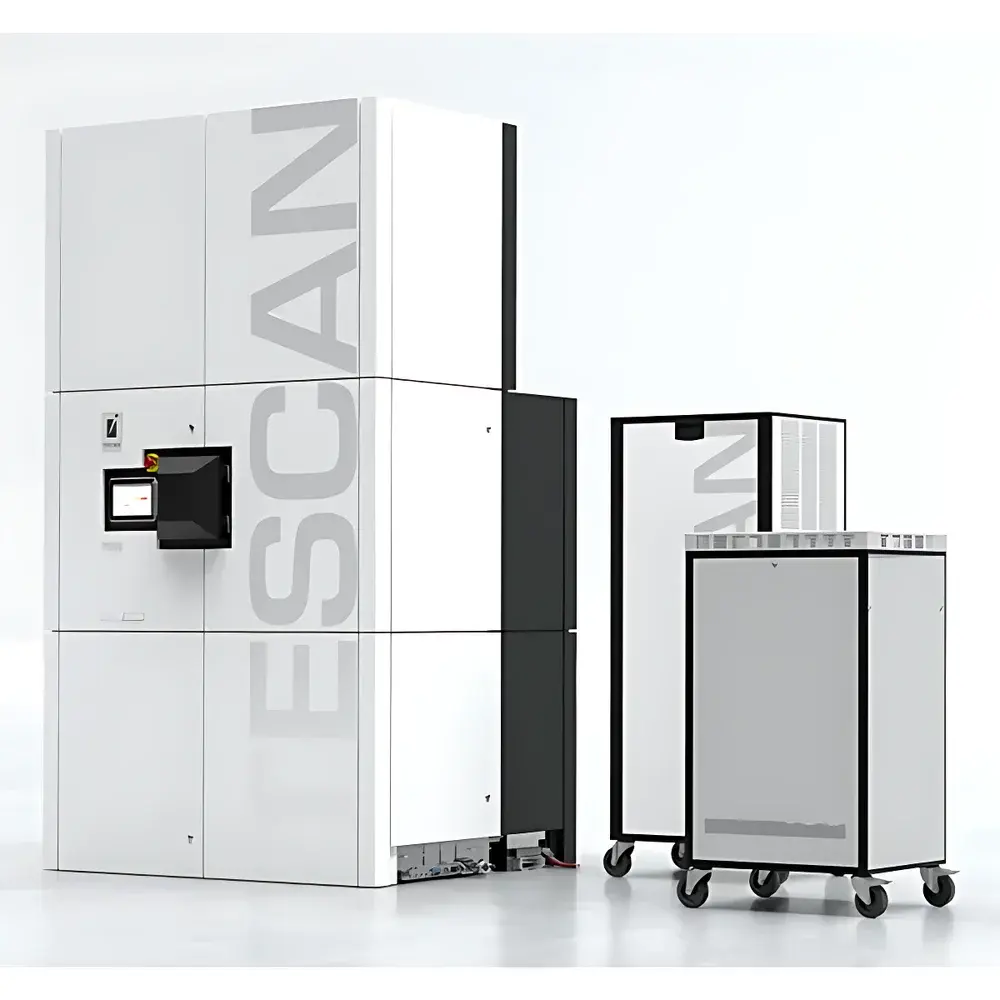
TESCAN TENSOR 4D Scanning Transmission Electron Microscope
| Brand | TESCAN |
|---|---|
| Origin | Czech Republic |
| Model | TESCAN TENSOR |
| Acceleration Voltage | Medium-voltage (80–200 kV) |
| Vacuum Level | Near-UHV (10⁻⁶ Pa in specimen chamber) |
| Integrated 4D-STEM Platform | Yes |
| Direct Detection Diffraction Camera | Hybrid-pixel, electron-sensitive |
| EDS Detectors | Two windowless, large-solid-angle SDDs |
| Precession Frequency | Up to 72 kHz |
| Beam Blanking | Integrated electrostatic |
| Software Platform | TESCAN Explore (real-time 4D-STEM processing & visualization) |
| Compatibility | HyperSpy, LiberTEM, Py4DSTEM (API-supported data export) |
| Operating Mode | STEM BF/ADF/HAADF, lattice-resolved imaging, orientation mapping, phase distribution, strain mapping, virtual STEM, EDS tomography, diffraction reconstruction |
| Regulatory Compliance | Designed for GLP/GMP-aligned workflows |
Overview
The TESCAN TENSOR 4D is a purpose-built, medium-acceleration-voltage scanning transmission electron microscope engineered for comprehensive nanoscale multimodal characterization. Leveraging advanced 4D-STEM (scanning transmission electron microscopy with pixelated detector arrays), the system captures full 2D diffraction patterns at every probe position across a raster-scanned specimen — enabling simultaneous extraction of morphological, crystallographic, chemical, and strain-related information from a single acquisition. Unlike conventional STEM, which records only intensity-integrated signals (e.g., HAADF or BF), the TENSOR acquires complete reciprocal-space data cubes (qx, qy, x, y), making it uniquely suited for quantitative structure-property correlation in functional materials, thin films, nanoparticles, and heterogeneous catalysts. Its near-ultra-high vacuum environment (10⁻⁶ Pa in the specimen chamber), Schottky field-emission gun, and integrated precession electron diffraction (PED) module ensure high beam coherence, minimal contamination, and robust signal-to-noise performance across diverse sample classes.
Key Features
- Native 4D-STEM architecture with hybrid-pixel direct electron detection camera for high-dynamic-range, low-noise diffraction pattern acquisition
- Two windowless silicon drift detectors (SDDs) with large solid angles for rapid, high-fidelity energy-dispersive X-ray spectroscopy (EDS) synchronized with diffraction collection
- Electrostatic beam blanking integrated into the column for precise dwell-time control and dose management during sensitive measurements
- Precession-assisted electron diffraction up to 72 kHz frequency, enhancing kinematical approximation and improving phase identification reliability
- Modular high-voltage platform (80–200 kV) optimized for balance between penetration depth, spatial resolution, and radiation damage mitigation
- Real-time data handling via TESCAN Explore — a dedicated software suite enabling on-the-fly indexing, strain quantification, orientation mapping, and virtual detector synthesis without requiring prior expertise in diffraction physics
Sample Compatibility & Compliance
The TESCAN TENSOR accommodates standard TEM grids (3 mm), lamellae prepared by FIB-SEM, and bulk sections mounted on specialized holders. It supports cryo-compatible stages for low-dose analysis of beam-sensitive materials including MOFs, polymers, and biological hybrids. All vacuum interlocks, emission stability protocols, and stage motion calibrations conform to ISO 16700:2016 (electron optical measurement standards) and ASTM E1558 (standard guide for electron backscatter diffraction). When configured with validated software modules and electronic logbooks, the system meets traceability and audit-readiness criteria outlined in FDA 21 CFR Part 11 and EU Annex 11 for regulated R&D environments. Routine calibration procedures align with ISO/IEC 17025 requirements for testing laboratories.
Software & Data Management
TESCAN Explore serves as the central hub for 4D-STEM data ingestion, preprocessing, and interpretation. It provides GPU-accelerated algorithms for Bragg peak detection, center-of-mass (COM) tracking, differential phase contrast (DPC) reconstruction, and ptychographic phase retrieval. Raw datasets are stored in standardized HDF5 format with embedded metadata (accelerating voltage, scan parameters, detector geometry), ensuring FAIR (Findable, Accessible, Interoperable, Reusable) compliance. The system exposes RESTful APIs for integration into laboratory information management systems (LIMS) and supports direct export to open-source analysis ecosystems — including HyperSpy for multivariate statistical analysis, LiberTEM for large-scale pattern matching, and Py4DSTEM for custom algorithm development. Audit trails record all user actions, parameter modifications, and processing steps, fulfilling GLP documentation requirements.
Applications
- Nanoscale strain mapping in semiconductor heterostructures and gate-all-around transistors
- Crystallographic phase identification and grain boundary characterization in battery cathode materials (e.g., NMC, LFP)
- Atomic-scale lattice distortion analysis in ferroelectric thin films and topological insulators
- Correlative EDS + diffraction tomography for 3D compositional and orientational reconstruction of nanoparticle assemblies
- In situ thermal and electrical biasing experiments coupled with real-time 4D-STEM monitoring (with optional holders)
- Quantitative defect density estimation in metal–organic frameworks using fluctuation electron microscopy (FEM) workflows
FAQ
What vacuum level does the TENSOR achieve in the specimen chamber?
The specimen chamber maintains a base pressure of ≤10⁻⁶ Pa under operating conditions, enabled by a combination of turbomolecular pumping and ion gettering.
Can I import TENSOR 4D-STEM datasets into third-party Python-based analysis tools?
Yes — raw data is exported in HDF5 format with complete metadata; native compatibility exists with HyperSpy, LiberTEM, and Py4DSTEM via documented APIs.
Is precession electron diffraction (PED) hardware-integrated or add-on?
PED functionality is fully integrated into the electron optical column, with programmable tilt amplitude and frequency up to 72 kHz.
Does TESCAN Explore support automated phase mapping for polycrystalline samples?
Yes — automated indexing pipelines use template matching against crystallographic databases (e.g., ICDD PDF-4+) and generate orientation distribution functions (ODFs) with confidence metrics.
How is beam damage minimized during long-duration 4D-STEM acquisitions?
Through synchronized electrostatic beam blanking, adaptive dwell time modulation, and optional low-dose acquisition modes that prioritize diffraction pattern fidelity over frame rate.




