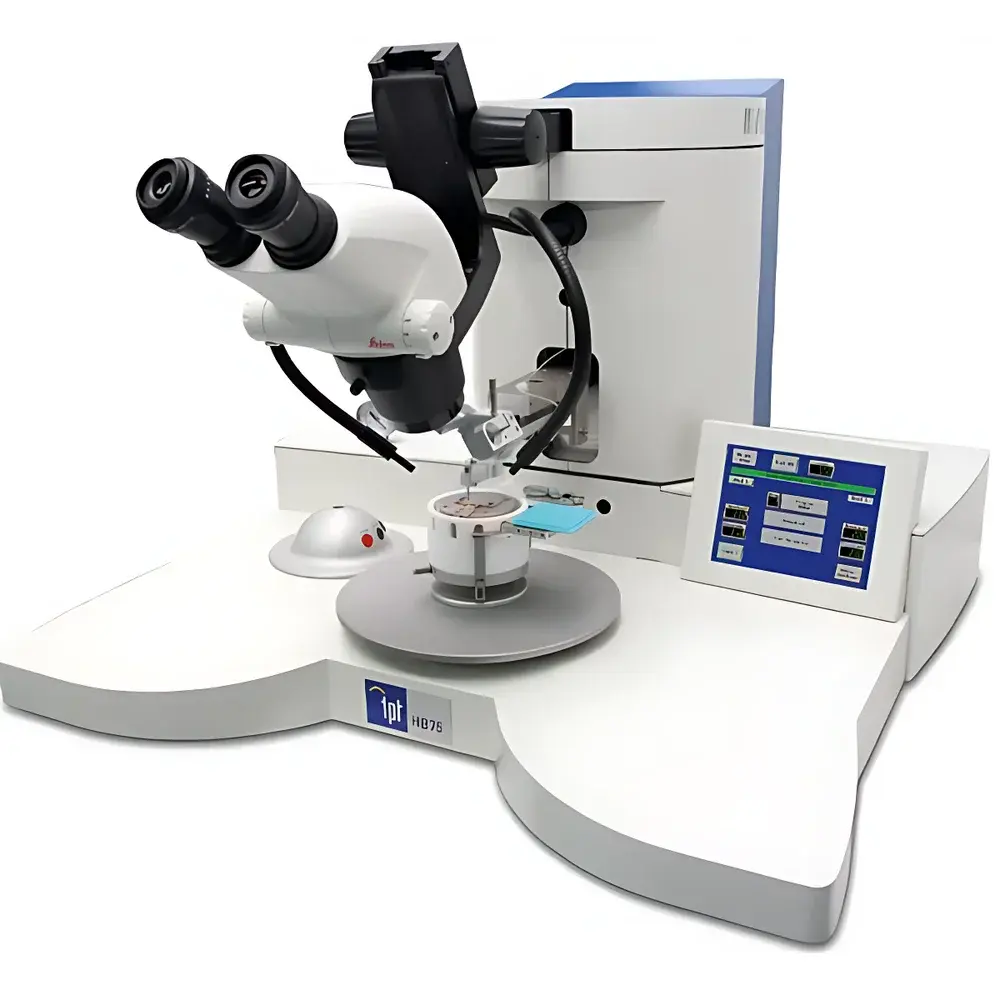
TPT HB30 Semi-Automatic Heavy Wire Bonder
| Brand | TPT |
|---|---|
| Origin | Germany |
| Model | TPT HB30 |
| Bonding Wire Diameter | 100–500 µm (Al) |
| Touchscreen Interface | 6.5" LCD |
| Program Storage Capacity | 100 recipes |
| Ultrasonic Power Output | 50 W |
| Bond Time Range | 0–10 s |
| Bond Force Range | 50–1500 cN |
| Motorized Z-Axis Stroke | 20 mm |
| Motorized Y-Axis Retract Stroke | up to 17 mm |
| Manual X-Y Stage Travel | 15 mm |
| Mechanical Reduction Ratio | 6:1 (3:1 optional) |
| Wire Cut Position | Front-cut |
| Wire Feed Angle | 90° |
| Bonding Modes | Semi-Automatic, Step-by-Step, Manual |
| Dimensions (W×D×H) | 680 × 640 × 490 mm |
| Net Weight | 50 kg |
| Electrical Supply | 100–240 V ±10%, 50/60 Hz, max. 10 A |
Overview
The TPT HB30 Semi-Automatic Heavy Wire Bonder is a precision-engineered benchtop bonding system designed for aluminum wire interconnection in semiconductor packaging, power device assembly, and high-reliability microelectronics prototyping. Utilizing ultrasonic wedge-wedge bonding technology with phase-locked loop (PLL) controlled transduction, the HB30 delivers consistent metallurgical bonds across wire diameters ranging from 100 µm to 500 µm—enabling robust interconnects for high-current applications such as IGBT modules, LED packages, and automotive power electronics. Its modular architecture integrates motorized Z- and Y-axis motion control with manual fine-positioning capability, supporting both single-point and seam welding configurations. The system operates without vacuum or inert gas requirements, making it suitable for cleanroom-adjacent lab environments and low-volume pilot production lines where flexibility, repeatability, and rapid process iteration are critical.
Key Features
- 6.5-inch high-resolution LCD touchscreen interface with intuitive graphical workflow navigation and real-time parameter feedback
- Dual-fiber optic coaxial illumination system providing uniform, shadow-free visualization of bond sites and wire trajectory
- Motorized Z-axis bonding head with 20 mm stroke and programmable descent velocity for precise force application and touchdown control
- Motorized Y-axis retraction mechanism (up to 17 mm travel) enabling dynamic arc height modulation and optimized loop profile generation
- Adjustable mechanical reduction ratio (standard 6:1; optional 3:1) for enhanced resolution in fine positioning tasks
- Front-cut wire severing mechanism with fixed 90° feed angle ensuring repeatable wire termination and minimal tail formation
- Onboard storage for up to 100 independent bonding recipes, each configurable with ultrasonic energy, time, force, temperature (if equipped), and arc geometry parameters
- Support for semi-automatic, step-by-step guided, and fully manual operation modes—facilitating operator training, process development, and failure analysis
Sample Compatibility & Compliance
The HB30 accommodates standard substrate formats including ceramic DBCs, leadframes, PCBs, and silicon dies with bond pad metallizations such as Al, Au, Cu, and NiPdAu. It supports wedge-type bonding tools compatible with industry-standard tool holders (e.g., K&S 7000 series). The system complies with CE marking requirements under the EU Machinery Directive 2006/42/EC and Low Voltage Directive 2014/35/EU. All electrical safety and EMC testing documentation is available upon request. While not certified to ISO 13485 or IATF 16949 out-of-the-box, the HB30’s parameter logging, recipe traceability, and hardware stability support integration into GLP/GMP-compliant workflows when paired with validated SOPs and change-control procedures.
Software & Data Management
The embedded control firmware enables full parameter logging per bond cycle—including ultrasonic amplitude, bond time, applied force, Z-axis position, and arc coordinates—exportable via USB to CSV format for statistical process control (SPC) analysis. Audit trail functionality records user login events, recipe modifications, and system error logs with timestamps. Although the HB30 does not include native 21 CFR Part 11 compliance features (e.g., electronic signatures or role-based access control), its deterministic behavior and deterministic parameter retention make it suitable for validation under FDA-regulated environments when deployed with external document management systems and procedural controls.
Applications
- Prototyping and qualification of aluminum-heavy wire interconnects for SiC and GaN power modules
- Low-volume manufacturing of medical-grade implantable electronics requiring high-bond-strength reliability
- Failure analysis laboratories performing cross-sectional bond inspection and pull-test correlation studies
- University research labs investigating intermetallic formation kinetics and ultrasonic energy coupling efficiency in thick-wire systems
- Process development for automotive AEC-Q200 qualified components where thermal cycling and vibration resistance are mission-critical
FAQ
What wire materials and diameters is the HB30 rated for?
The HB30 is specifically calibrated and validated for aluminum wire between 100 µm and 500 µm diameter. While copper and gold wires may be bonded experimentally, TPT does not guarantee bond quality or tool life outside the specified Al wire range.
Does the HB30 support thermosonic bonding?
No—the HB30 is an ultrasonic-only bonder. It lacks integrated heating capability for the substrate or bonding tool. For thermosonic processes, consult TPT’s HB40 series or third-party hot-chuck retrofit options.
Can the machine be integrated into an automated production line?
The HB30 is a standalone semi-automatic platform. It features digital I/O ports (24 V DC) for external trigger input and status output, enabling basic PLC synchronization—but it does not support SECS/GEM or EtherNet/IP protocols natively.
Is calibration certification included with shipment?
Yes—each unit ships with a factory calibration report covering Z-axis encoder linearity, force sensor accuracy (±3% FS), and ultrasonic output power verification at three setpoints (25 W, 50 W, 75 W).
What maintenance intervals are recommended?
TPT recommends quarterly inspection of ultrasonic transducer preload torque, annual recalibration of the bond force sensor, and biannual replacement of the wire clamp jaws and wedge tool based on cumulative bond count (typically every 50,000 cycles under standard Al wire conditions).