
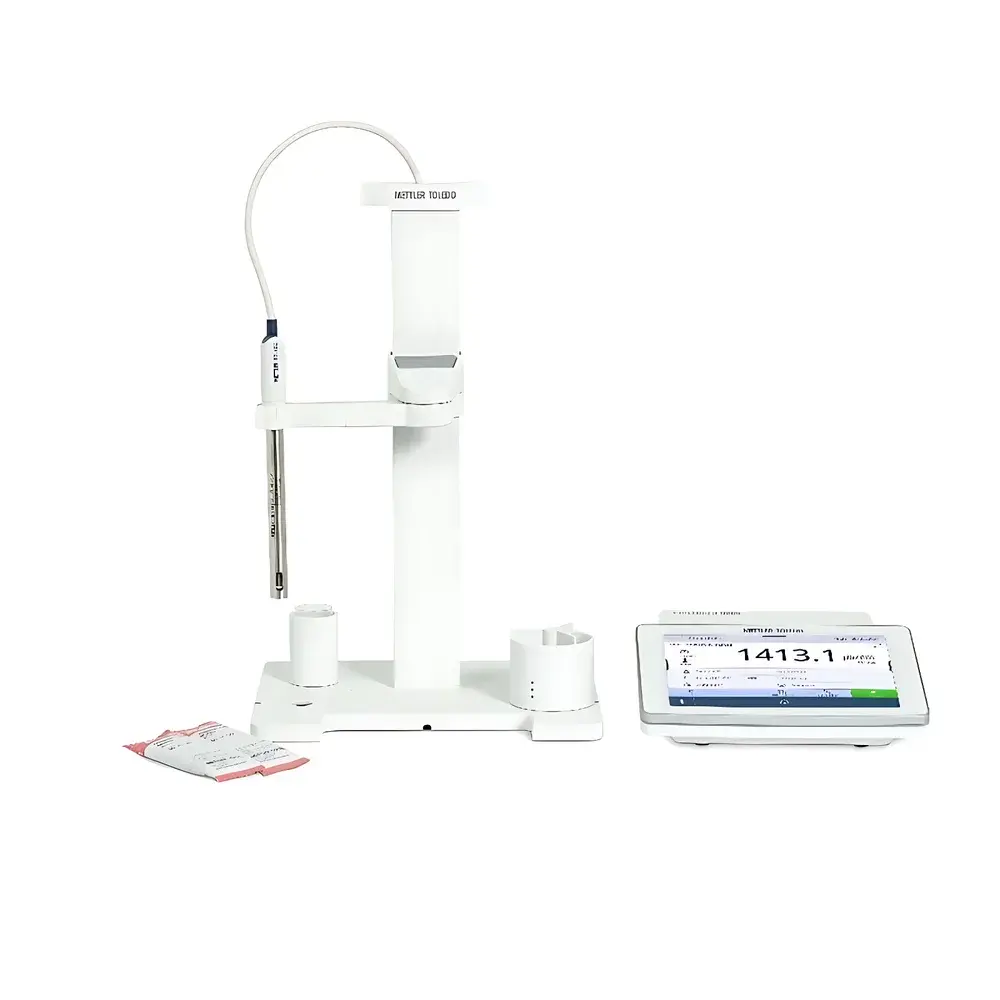
METTLER TOLEDO SevenDirect SD30 Conductivity Meter
| Brand | METTLER TOLEDO |
|---|---|
| Origin | Switzerland |
| Instrument Type | Benchtop |
| Measurement Parameters | Conductivity, TDS, Resistivity, Salinity, Temperature |
| Conductivity Range | 0.000 µS/cm to 2,000 mS/cm |
| TDS Range | 0.00 mg/L to 1,000 g/L |
| Salinity Range | 0.00–80.00 psu |
| Resistivity Range | 0.00–100.0 MΩ·cm |
| Temperature Range | −30.0 to 130.0 °C |
| Resolution | Auto-ranging, up to 0.001 (conductivity), 0.1 °C (temperature) |
| Accuracy | ±0.5% of reading (conductivity), ±0.1 °C (0–100 °C) |
| Temperature Compensation | Automatic/manual |
| Calibration | Up to 2-point, auto-identification of standard solutions, built-in 13 calibration standards + 10 user-defined |
| Endpoint Modes | Auto, manual, time-based |
| Data Storage | 2,000 GLP-compliant records with timestamp, sample ID, electrode ID, operator ID |
| Connectivity | USB for data export (U-disk or PC software), optional printer interface |
| Compliance | Fully GLP-compliant |
| Enclosure Rating | IP54 (dust-protected, splash-resistant) |
| Display | 7-inch full-color capacitive touchscreen with glove-mode support |
| User Interface | 10 languages (English, Chinese, German, French, Italian, Russian, Korean, Spanish, Portuguese, Japanese) |
| Security | Dual-level user management (administrator/operator) |
| Accessories Included | InLab® 731-ISM conductivity electrode, EasyMix™ magnetic stirrer, precision electrode stand with vertical adjustment and multi-directional positioning, replaceable protective cover, corrosion-resistant sealed interface housing, pouch-packaged calibration standards |
Overview
The METTLER TOLEDO SevenDirect SD30 Conductivity Meter is a benchtop electrochemical instrument engineered for high-precision, traceable, and fully compliant measurement of conductivity, total dissolved solids (TDS), resistivity, salinity, and temperature across diverse aqueous and non-aqueous liquid samples. Built upon METTLER TOLEDO’s ISM (Intelligent Sensor Management) platform, the SD30 employs digital sensor communication to ensure automatic recognition, real-time calibration status monitoring, and full traceability of sensor history—including usage time, calibration events, and diagnostic alerts. Its core measurement principle relies on four-electrode AC conductivity detection, minimizing polarization effects and enabling stable, reproducible readings across an exceptionally wide dynamic range—from ultra-pure water (0.000 µS/cm) to highly concentrated brines (2,000 mS/cm). Designed for routine QC laboratories, R&D facilities, and regulated environments—including pharmaceutical, food & beverage, environmental, and academic settings—the SD30 delivers metrological rigor without compromising operational efficiency.
Key Features
- 7-inch full-color capacitive touchscreen with intuitive, context-sensitive navigation—optimized for glove operation (latex or cotton) and guided workflows.
- ISM-enabled InLab® 731-ISM conductivity electrode with integrated memory chip storing serial number, calibration history, and sensor diagnostics—eliminating manual entry errors and supporting full audit readiness.
- EasyMix™ magnetic stirrer and precision electrode stand with vertical travel and multi-axis positioning to ensure consistent immersion depth and hydrodynamic control during stirred measurements.
- Auto-ranging resolution down to 0.001 µS/cm, combined with ±0.5% conductivity accuracy and ±0.1 °C temperature accuracy (0–100 °C), meeting stringent method validation requirements.
- Dual-level user management (administrator/operator) with password protection and configurable access rights—preventing unauthorized modification of methods, calibration parameters, or system settings.
- IP54-rated enclosure with removable protective cover and corrosion-resistant sealed interface housing—ensuring long-term reliability in humid or chemically aggressive lab environments.
- Three endpoint modes (auto, manual, time-interval) and programmable limit alerts with color-coded visual feedback for rapid pass/fail assessment.
Sample Compatibility & Compliance
The SD30 accommodates a broad spectrum of sample matrices—including ultrapure water, process streams, wastewater, seawater, electrolyte solutions, and viscous industrial fluids—thanks to its adaptive four-electrode cell design and configurable cell constant selection (via ISM electrode identification). All measurements adhere to internationally recognized standards including ASTM D1125 (conductivity of water), ISO 7888 (electrical conductivity of water), and USP (water conductivity testing). The instrument’s embedded GLP functionality records every measurement with mandatory metadata: date/time stamp, sample ID, electrode ID, operator ID, calibration status, and environmental temperature. When paired with METTLER TOLEDO LabX software, the system satisfies FDA 21 CFR Part 11 requirements for electronic records and signatures—including full audit trail, electronic signature capture, and role-based access control—making it suitable for GMP and ISO/IEC 17025-accredited laboratories.
Software & Data Management
Data integrity is maintained through native GLP-compliant storage of up to 2,000 measurement records directly on the instrument. Each record includes timestamped raw values, calculated parameters (e.g., temperature-compensated conductivity at 25 °C), and contextual metadata. Export is supported via USB flash drive (CSV format) or seamless integration with LabX software for centralized data management, automated report generation, trend analysis, and electronic archiving. The SD30 supports automatic time synchronization with network-connected PCs, ensuring chronological consistency across distributed instruments. Validation protocols—including system suitability checks and guided performance verification—are embedded within the firmware, delivering clear Pass/Fail indicators aligned with internal SOPs or regulatory expectations.
Applications
- Pharmaceutical water systems monitoring (PW, WFI, Purified Water per USP )
- Environmental water quality assessment (surface water, groundwater, effluent)
- Food & beverage formulation and process control (brine concentration, cleaning solution verification)
- Chemical manufacturing QC (electrolyte strength, acid/base concentration, rinse water purity)
- Academic research requiring traceable, temperature-compensated conductivity profiling
- Calibration laboratory reference measurements supporting ISO/IEC 17025 accreditation
FAQ
Does the SD30 support automatic temperature compensation (ATC)?
Yes—it provides both automatic (using integrated Pt1000 sensor or external probe) and manual temperature compensation, with selectable reference temperatures (e.g., 20 °C or 25 °C) and linear or non-linear (NaCl curve) compensation models.
Can I import custom calibration curves or define my own standard solutions?
Yes—the instrument allows definition of up to 10 user-specific calibration standards, including custom TDS conversion factors and cell constants, stored securely with full versioning.
Is the SD30 compatible with non-METTLER TOLEDO electrodes?
No—only ISM-enabled METTLER TOLEDO conductivity electrodes (e.g., InLab® 731-ISM, InLab® 741-ISM) are fully supported for automatic recognition, diagnostic reporting, and GLP-compliant data linkage.
How is data security enforced during export or remote transfer?
All USB exports generate timestamped, read-only CSV files without embedded credentials; LabX integration enforces TLS-encrypted communication and role-based permissions for remote access.
What maintenance is required to sustain measurement accuracy over time?
Routine verification using certified reference standards is recommended before critical measurements; the ISM electrode self-diagnostic function continuously monitors coating, aging, and cable integrity—alerting users proactively to potential drift or failure modes.




