
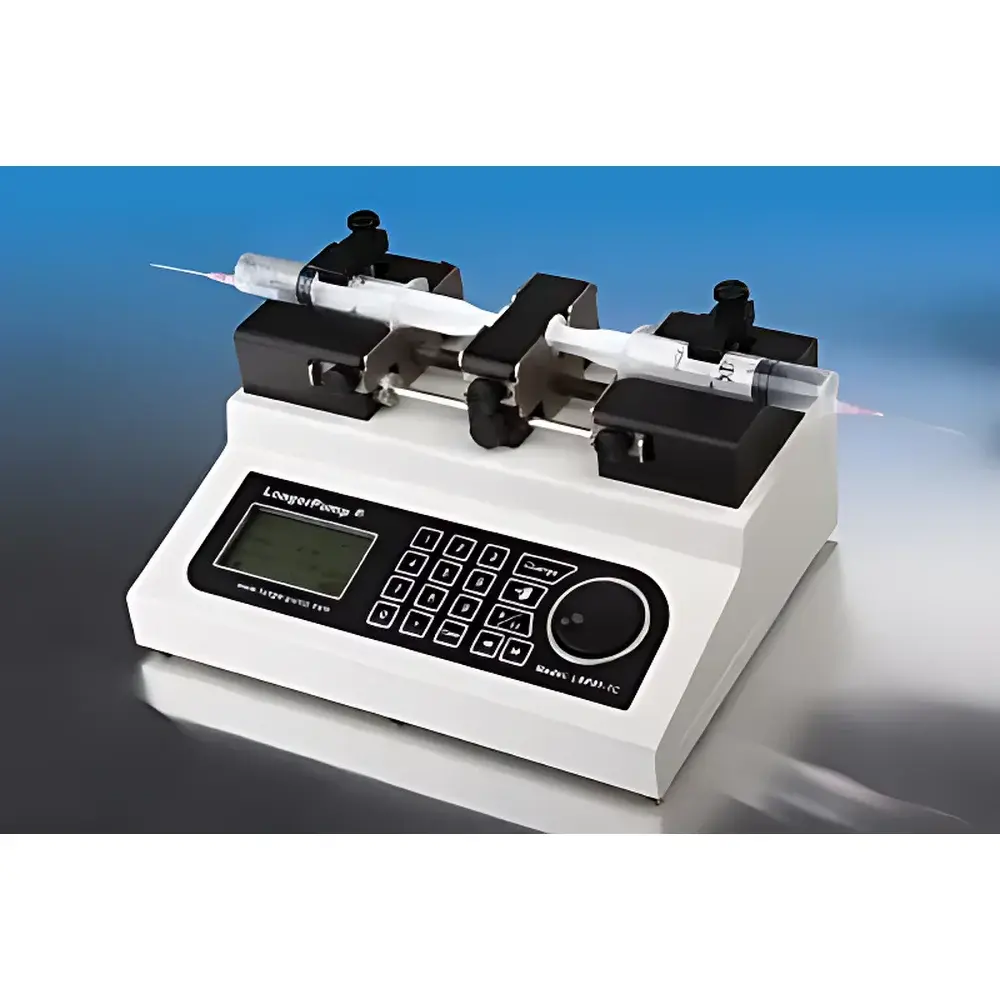
LongerPump LSP01-1C Single-Channel Bidirectional Syringe Pump
| Brand | LongerPump |
|---|---|
| Origin | Hebei, China |
| Manufacturer Type | Direct Manufacturer |
| Product Category | Domestic |
| Model | LSP01-1C |
| Instrument Type | Micro-syringe Pump |
| Flow Rate | 0.001 µL/min – 14.068 mL/min |
| Accuracy | ≤ ±0.5% (when stroke ≥ 30% of maximum stroke) |
| Maximum Stroke | 140 mm |
| Stroke Resolution | 0.156 µm |
| Linear Speed Range | 5 µm/min – 65 mm/min |
| Linear Speed Resolution | 5 µm/min |
| Rated Linear Thrust | >90 N |
| Syringe Compatibility | 10 µL – 10 mL |
| Power Supply | AC 90–260 V, 15 W |
| Dimensions (W×D×H) | 280 × 220 × 140 mm |
| Weight | 3.6 kg |
| Operating Temperature | 0–40 °C |
| Relative Humidity | <80% RH |
| Communication Interface | RS485 |
| Control I/O | 2 trigger inputs (one falling-edge, one TTL), 1 open-collector status output |
Overview
The LongerPump LSP01-1C is a single-channel, bidirectional syringe pump engineered for precision fluid delivery and withdrawal in laboratory environments where continuous, low-flow, high-reproducibility liquid handling is required. Based on stepper motor-driven linear actuation and microstepping control architecture, the LSP01-1C operates via push-pull motion—simultaneously infusing and withdrawing fluid through a single syringe—enabling true continuous flow without dead volume interruption or valve switching. Its core principle relies on deterministic displacement: volumetric output is calculated directly from motor step count, lead screw pitch, and user-defined syringe inner diameter (ID), eliminating reliance on pressure-based feedback loops. This makes it especially suitable for applications demanding stable laminar flow, such as microfluidic system priming, chromatographic mobile phase delivery, electrochemical cell dosing, and controlled reagent addition in kinetic studies.
Key Features
- Bidirectional push-pull operation enables uninterrupted continuous flow with zero dead-volume transition between infusion and withdrawal phases.
- Precision linear actuation with 0.156 µm stroke resolution and ≤ ±0.5% volumetric accuracy (valid at ≥30% of full 140 mm stroke), ensuring high repeatability across extended run times.
- Wide operational range: linear speed from 5 µm/min to 65 mm/min; corresponding flow rates span 0.001 µL/min to 14.068 mL/min when paired with syringes from 10 µL to 10 mL capacity.
- Integrated syringe ID input—either selected from an embedded database of major manufacturers (e.g., Hamilton, BD, SGE) or manually entered—to enable real-time volumetric conversion and eliminate manual scaling errors.
- Onboard flow calibration routine allows users to perform gravimetric or timed-volume verification and apply correction factors to compensate for mechanical hysteresis or syringe manufacturing tolerances.
- Robust mechanical design with >90 N rated linear thrust supports high-viscosity fluids and maintains positional integrity under backpressure up to typical HPLC-compatible levels.
- Comprehensive protection logic includes stall detection with audible alarm and automatic shutdown, adjustable mechanical end-stop limits to prevent syringe barrel damage, and EEPROM-based parameter retention for seamless recovery after power interruption.
Sample Compatibility & Compliance
The LSP01-1C accommodates standard Luer-lock and Luer-slip syringes ranging from 10 µL microsyringes to 10 mL glass or plastic barrels. Its modular mounting platform accepts both cylindrical and conical syringe geometries without adapter modification. While not certified to ISO 8536 or ISO 7886 for medical use, the pump meets general-purpose laboratory equipment requirements per IEC 61010-1:2010 for electrical safety and EMC compliance (EN 61326-1). Its RS485 interface supports Modbus RTU protocol, enabling integration into automated lab systems compliant with GLP/GMP data integrity expectations—including audit-trail-capable SCADA or LIMS platforms—when configured with appropriate host software logging.
Software & Data Management
The LSP01-1C communicates exclusively via RS485 using ASCII command protocol, supporting remote configuration and real-time monitoring from custom or third-party control software (e.g., LabVIEW, Python with PySerial, MATLAB). All operational parameters—including target volume, elapsed time, current flow rate, and linear position—are queryable and modifiable in real time. The device stores all user settings (syringe ID, flow mode, acceleration profiles, etc.) in non-volatile EEPROM, preserving configuration across power cycles. Though no proprietary GUI is bundled, the open command set facilitates validation documentation (IQ/OQ/PQ) and integration into 21 CFR Part 11–compliant workflows when paired with validated host software that enforces electronic signatures, change tracking, and secure audit logs.
Applications
- Continuous infusion in perfusion culture systems and organ-on-chip devices requiring sub-µL/min stability over hours or days.
- Controlled reagent addition in stopped-flow spectrophotometry and rapid-mixing kinetics experiments.
- Mobile phase delivery in preparative or analytical-scale liquid chromatography setups where pulseless flow improves baseline stability.
- Calibration standard delivery for flow sensor validation and gravimetric balance testing protocols.
- Electrospinning precursor solution feeding with synchronized withdrawal to maintain reservoir level and pressure equilibrium.
- Automated sample introduction in elemental analysis (ICP-MS, AAS) where precise, bubble-free aspiration minimizes signal drift.
FAQ
Does the LSP01-1C support multi-syringe synchronization?
No—it is a single-channel pump. Synchronization of multiple units requires external master controller coordination via RS485 commands.
Can the pump operate unattended for extended periods?
Yes, provided ambient conditions remain within 0–40 °C and <80% RH, and mechanical load remains within torque specifications. The built-in stall protection and EEPROM memory enhance long-duration reliability.
Is syringe calibration traceable to national standards?
The onboard calibration routine is user-performed and traceable only to the user’s reference mass or volumetric standard; formal metrological traceability requires external gravimetric validation against NIST-traceable balances.
What safety certifications does the unit carry?
It conforms to IEC 61010-1:2010 for laboratory electrical equipment and EN 61326-1 for EMC. No FDA 510(k) or CE medical device certification applies.
How is flow accuracy affected by syringe manufacturing variance?
Accuracy specification assumes correct syringe inner diameter entry. Variance in actual ID (±1–2% typical for glass syringes) contributes directly to volumetric error; thus, direct ID measurement or gravimetric calibration is recommended for critical applications.



