
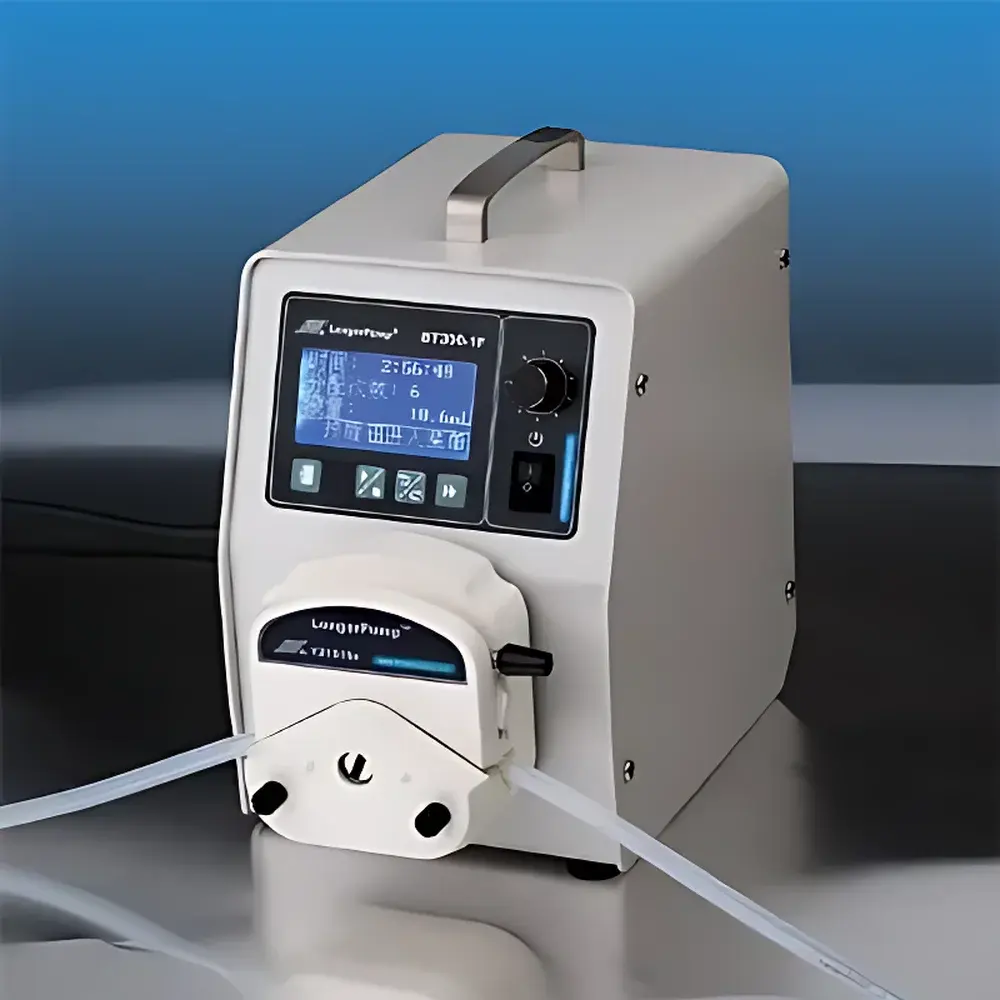
LongerPump BT300-1F Precision Peristaltic Pump for Laboratory Fluid Dispensing
| Brand | LongerPump |
|---|---|
| Origin | Hebei, China |
| Manufacturer Type | Direct Manufacturer |
| Model | BT300-1F |
| Pump Type | Peristaltic Pump |
| Flow Rate Range | 0.07–1140 mL/min |
| Speed Range | 1–300 rpm |
| Display | Dot-Matrix LCD |
| Control Interfaces | Analog (4–20 mA / 0–5 V / 0–10 V), RS485 Serial |
| Power Supply | AC 110 V ±10% or 220 V ±10%, 50 W |
| Dimensions (L×W×H) | 202 × 160 × 239 mm |
| Weight | 4.3 kg |
| Protection Rating | IP31 |
| Operating Temperature | 0–40 °C |
| Relative Humidity | <80% RH |
Overview
The LongerPump BT300-1F is a high-precision, microprocessor-controlled peristaltic pump engineered for accurate, repeatable fluid dispensing in analytical laboratories, bioprocessing R&D, and quality control environments. Based on the fundamental principle of peristalsis—where rollers compress flexible tubing to displace fluid without contacting the medium—the BT300-1F eliminates cross-contamination risks and enables safe handling of aggressive, viscous, or shear-sensitive liquids including cell suspensions, reagents, buffers, and organic solvents. Its dual-mode architecture supports both continuous flow regulation and discrete volumetric dispensing, making it suitable for applications ranging from automated sample preparation and titration to media filling and column priming. Designed with ISO-compliant mechanical construction and electromagnetic compatibility (EMC) per IEC 61326-1, the unit meets general requirements for laboratory instrumentation used in GLP-aligned workflows.
Key Features
- Precision dispensing capability with programmable volume ranges from 0.1 mL to 99.9 L per cycle, adjustable in 0.1 mL increments for low-volume accuracy
- Two operational modes: Flow Mode (mL/min) and Dispense Mode (mL/cycle), each supporting real-time parameter adjustment via intuitive dot-matrix LCD interface
- Multi-pump-head compatibility—including YZ1515X, YZ2515X, YZII15, and YZII25—enabling broad flow range coverage (0.07–1140 mL/min) and optimal tube selection for viscosity and pressure requirements
- High-resolution speed control: 1 rpm step resolution across full 1–300 rpm range; reversible rotation with programmable back-suction angle (0–360°, 18° steps) to minimize drip and improve dispense repeatability
- Comprehensive external control suite: analog input support (4–20 mA, 0–5 V, 0–10 V) for speed/direction/start-stop commands, plus isolated open-collector status outputs (run, direction, speed-proportional 0–5 V)
- RS485 serial interface compliant with Modbus RTU protocol; factory-provided communication documentation enables seamless integration into SCADA, LIMS, or custom LabVIEW/Python-based automation systems
- Power-loss recovery function retains all active settings and operational state (including remaining dispense count and elapsed interval), resuming execution upon power restoration
Sample Compatibility & Compliance
The BT300-1F interfaces exclusively with standard peristaltic pump tubing (e.g., Norprene®, PharMed® BPT, Tygon®), ensuring chemical resistance and USP Class VI compliance where appropriate. No wetted metal parts contact fluid—eliminating corrosion concerns and enabling use with acids, bases, and halogenated solvents. The device complies with CE marking directives (2014/30/EU EMC, 2014/35/EU LVD) and conforms to IEC 61010-1 safety standards for laboratory electrical equipment. While not certified for sterile or cleanroom operation (ISO 14644), its IP31-rated enclosure provides protection against vertically falling drips and solid objects >2.5 mm—suitable for controlled lab environments under routine maintenance protocols.
Software & Data Management
The pump operates autonomously without host software but includes full ASCII-based RS485 command set documentation for third-party integration. Users may implement audit-trail-capable control logic using external PLCs or PCs, with timestamped command logs stored externally. For regulated environments, the device supports 21 CFR Part 11–compatible system architectures when paired with validated upper-layer software that enforces user authentication, electronic signatures, and change history logging. Factory firmware supports firmware version reporting and secure parameter locking to prevent unauthorized configuration changes during production runs.
Applications
- Automated liquid handling in HPLC mobile phase delivery, dissolution testing (USP ), and spectrophotometric calibration workflows
- Cell culture media dispensing with programmable fill-and-hold cycles to reduce foaming and shear stress
- Reagent distribution in ELISA, PCR setup, and microplate assay preparation
- Calibration standard delivery for gravimetric or conductivity-based flow verification
- Process validation support in pharmaceutical QC labs requiring traceable, repeatable volumetric transfer per ASTM E2758 and ISO 8655-3
- Integration into modular synthesis platforms where precise stoichiometric addition of catalysts or monomers is required
FAQ
Does the BT300-1F support flow calibration against gravimetric measurement?
Yes—users can input measured actual flow values (via balance/timer) to perform linear flow correction, updating internal scaling factors for improved long-term accuracy.
Can multiple BT300-1F units be daisy-chained via RS485?
Yes—Modbus RTU addressing allows up to 32 devices on a single bus with configurable slave IDs and termination resistors.
Is tubing life monitoring available?
No built-in sensor-based wear detection; however, runtime tracking and dispense cycle counters can be implemented externally using pulse output signals.
What is the maximum backpressure tolerance for common tubing sizes?
Maximum sustainable pressure depends on tubing material and inner diameter; typical Norprene® L/S 17 tubing (ID 1.6 mm) maintains integrity up to ~1.5 bar at 300 rpm—consult tubing manufacturer specifications for exact ratings.
Does the pump retain dispense history after power-off?
No—only current operational state (mode, speed, remaining count, interval timer) is preserved; historical data must be logged externally via RS485 or analog output signals.



