
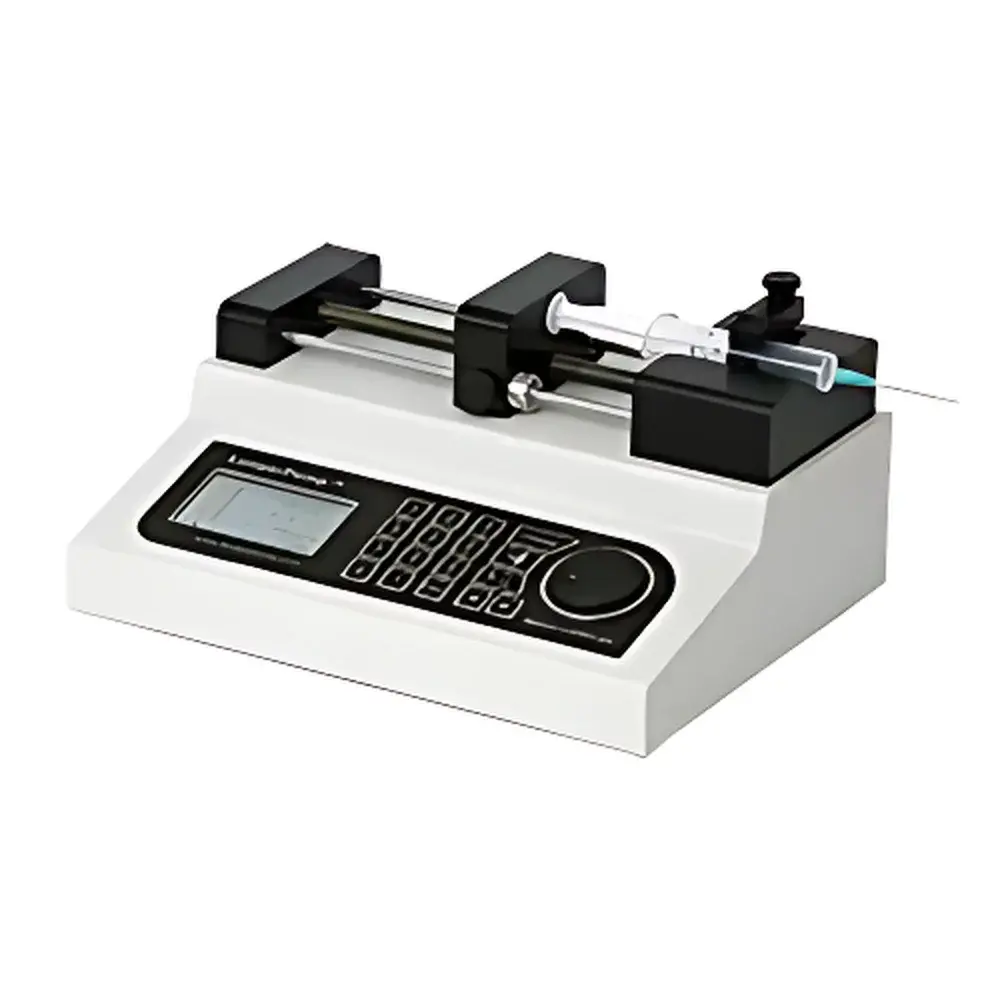
LongerPump LSP01-3A Single-Channel Micro-Syringe Pump
| Brand | LongerPump |
|---|---|
| Model | LSP01-3A |
| Type | Micro-syringe pump |
| Channels | 1 |
| Flow rate range | 0.001 µL/min – 43.349 mL/min |
| Accuracy | ±0.5% (full-scale, ≥30% stroke) |
| Repeatability | ≥99.9% |
| Stroke length | 140 mm |
| Stroke resolution | 0.156 µm |
| Linear speed range | 5 µm/min – 65 mm/min |
| Linear speed resolution | 5 µm/min |
| Rated linear force | >90 N |
| Syringe ID input | Manual or preset selection (0.5–29.14 mm) |
| Communication interface | RS485 |
| Power supply | AC 196–240 V, 20 W |
| Dimensions (W×D×H) | 280 × 210 × 140 mm |
| Weight | 3.6 kg |
| Operating temperature | 0–40 °C |
| Relative humidity | <80% RH (non-condensing) |
| EMC compliance | IEC 61000-4-2, ESD immunity ≥ Level IV |
Overview
The LongerPump LSP01-3A is a single-channel, precision micro-syringe pump engineered for accurate, low-flow liquid delivery in research laboratories and analytical workflows. It operates on a stepper-motor-driven linear actuation principle, converting rotational motion into precise axial displacement of the syringe plunger. This mechanical architecture ensures stable, pulseless flow—critical for applications demanding high volumetric fidelity at sub-microliter-per-minute rates. Unlike peristaltic or diaphragm-based systems, the LSP01-3A delivers true volumetric control by directly coupling motor step resolution to plunger displacement, enabling traceable flow calibration independent of fluid viscosity or backpressure (within rated force limits). Its design targets environments where reproducibility, regulatory traceability, and long-term operational stability are non-negotiable—such as method development in pharmaceutical formulation, microfluidic device priming, electrophysiology perfusion, and controlled reagent dosing in analytical sample preparation.
Key Features
- High-resolution linear actuation: 0.156 µm stroke resolution supports ultra-low flow delivery down to 0.001 µL/min with ≤±0.5% volumetric error (at ≥30% of maximum stroke)
- Flexible syringe compatibility: Built-in database of >10 standard syringe models (from 10 µL to 60 mL), plus manual inner diameter entry (0.5–29.14 mm) for custom or legacy glass/metal syringes
- Intelligent flow calibration: On-device volumetric correction routine compensates for mechanical backlash and syringe geometry tolerances, improving long-term accuracy without external metrology
- Robust electromagnetic compatibility: Certified to IEC 61000-4-2 ESD immunity Level IV (±8 kV contact / ±15 kV air discharge), ensuring reliable operation in electrically noisy lab environments
- Dual-mode control architecture: Local operation via large LCD screen and intuitive rotary encoder + membrane keypad; remote operation via RS485 serial bus with Modbus RTU protocol support
- Fault-resilient operation: Integrated stall detection halts plunger advancement and triggers audible alarm upon mechanical obstruction; EEPROM retains all user parameters across power cycles
- Configurable I/O interface: Two opto-isolated OC outputs (start/stop, direction status) and two TTL-compatible control inputs (edge-triggered and level-controlled start/stop) enable seamless integration into automated test benches or PLC-controlled systems
Sample Compatibility & Compliance
The LSP01-3A accommodates all standard Luer-lock and Luer-slip syringes within its mechanical stroke and force envelope—including borosilicate glass, polypropylene, and stainless-steel variants. No fluid-path wetted components are present; compatibility is governed solely by syringe material resistance to the transported medium. The pump meets CE marking requirements for laboratory equipment (2014/30/EU EMC Directive and 2014/35/EU Low Voltage Directive). While not intrinsically certified for hazardous locations, its ESD-hardened design aligns with good engineering practice for GLP-compliant instrument qualification. For regulated environments, audit trails may be implemented externally via RS485 logging—supporting alignment with FDA 21 CFR Part 11 when paired with validated host software.
Software & Data Management
The LSP01-3A communicates exclusively via RS485 using an open Modbus RTU register map, allowing integration with LabVIEW, Python (pyModbus), MATLAB, or custom SCADA platforms. All operational parameters—including target volume, infusion time, syringe ID, flow mode (volume/time or linear speed), and calibration offsets—are programmatically readable and writable. The device stores configuration in non-volatile EEPROM, eliminating reconfiguration after power loss. Although no proprietary GUI is bundled, LongerPump provides register documentation and basic command-line utilities for Windows/Linux. For GxP environments, users may implement electronic record retention by capturing Modbus transaction logs with timestamps, satisfying ALCOA+ principles when combined with procedural controls.
Applications
- Controlled delivery of nanoliter-volume standards in LC-MS or ICP-MS calibration sequences
- Steady-state perfusion of neuronal cultures in patch-clamp electrophysiology rigs
- Sequential reagent injection in automated dissolution testing (USP )
- Low-flow mobile phase blending in preparative HPLC method scouting
- Gas-phase precursor delivery in CVD or ALD reactor experiments
- Calibration of microflow sensors and micro-calorimeters requiring traceable volumetric sources
FAQ
Does the LSP01-3A support bidirectional flow (infuse and withdraw)?
No—it operates in single-direction “infuse-only” mode. Withdrawal capability requires dual-motor or reversible-drive architectures not present in this model.
Can it maintain specified flow under elevated backpressure?
Yes, up to its rated linear force (>90 N). Actual pressure tolerance depends on syringe inner diameter; e.g., with a 10 mL syringe (ID ≈ 16.6 mm), maximum sustainable pressure exceeds 430 kPa.
Is flow rate affected by fluid viscosity?
Mechanically, no—the pump displaces fixed volumes per motor step. However, highly viscous or non-Newtonian fluids may induce transient lag due to syringe seal friction; volumetric calibration mitigates this effect.
How is traceability ensured for ISO/IEC 17025 accreditation?
Traceability relies on external calibration of delivered volume against a gravimetric or piston-prover standard. The LSP01-3A’s repeatability (≥99.9%) and documented linearity allow uncertainty budgets to be calculated per ISO/IEC 17025 Clause 6.5.2.
What maintenance is required?
Annual inspection of lead screw lubrication and syringe clamp integrity is recommended. No consumables other than standard syringes are required.



