
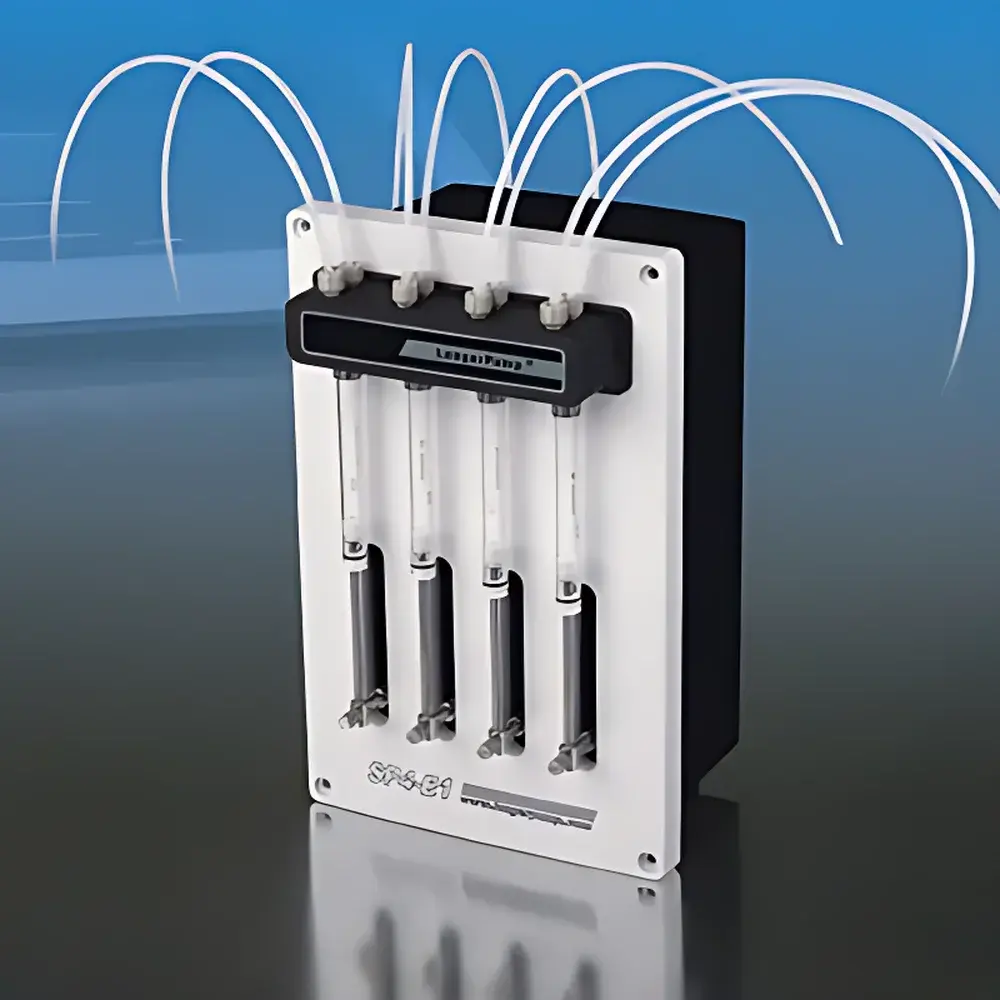
LongerPump SP4-E1 Industrial Multi-Channel Syringe Pump
| Brand | LongerPump |
|---|---|
| Origin | Hebei, China |
| Manufacturer Type | Direct Manufacturer |
| Product Category | Domestic |
| Model | SP4-E1 |
| Instrument Type | Industrial Syringe Pump |
| Flow Rate | ≤120 mL/min |
| Accuracy | ≤1% error at rated stroke |
| Repeatability | ≤0.5% at rated stroke |
| Rated Stroke | 60 mm (1000 steps) |
| Linear Speed Range | 0.03–24 mm/s |
| Stroke Execution Time | 2.5–2000 s |
| Control Resolution | 0.06 mm per step |
| Drive Mechanism | Synchronous belt drive |
| Max Piston Driving Force | ≥68 N (sum across 4 channels) |
| Compatible Syringe Volumes | 50 µL, 100 µL, 500 µL, 1 mL, 2.5 mL, 5 mL |
| Valve Type | 2-Position, 3-Way Solenoid Valve |
| Valve Switching Time | ≤100 ms |
| Fluid Path Materials | Borosilicate Glass, PTFE, PEEK |
| Max Fluid Path Pressure Rating | 0.1 MPa (valve-limited) |
| Tubing Interface | 1/4"-28 internal thread |
| Syringe Mount Interface | 1/4"-28 internal thread |
| TTL Input Signals | 2 channels (≥16 mA drive current, for resume-after-hold control) |
| Open-Collector Outputs | 3 channels (status indication) |
| Solenoid Driver Outputs | 4 independent DC 24 V / 200 mA channels |
| Communication Interface | Configurable RS485/RS232 |
| Baud Rate | 9600 or 38400 bps |
| Device Address Setting | BCD DIP switch (address 1–15) |
| Parameter Configuration | 4-bit DIP switch (interface mode, baud rate, etc.) |
| Dimensions (L×W×H) | 140 × 167 × 261.5 mm |
| Power Supply | DC 24 V / 1.5 A |
| Operating Temperature | 15–40 °C |
| Operating Relative Humidity | <80% RH |
| Weight | 2.4 kg |
| Part Number | 050327A |
Overview
The LongerPump SP4-E1 is an industrial-grade, four-channel syringe pump engineered for precise, synchronized fluid delivery in automated laboratory and process instrumentation environments. Unlike benchtop single-channel units, the SP4-E1 employs a closed-loop stepper motor system with synchronous belt transmission to achieve high positional fidelity and mechanical robustness under continuous duty cycles. Its operation is based on displacement-driven volumetric delivery—where linear piston motion is translated directly into defined fluid volumes via calibrated syringe geometry—ensuring traceable flow rates without reliance on pressure feedback or external calibration. Designed explicitly for integration into OEM equipment and programmable automation systems, the SP4-E1 supports deterministic timing control, real-time status monitoring, and deterministic valve actuation—making it suitable for applications requiring coordinated multi-reagent dispensing, sequential sample injection, or closed-loop process control in analytical, bioprocessing, and materials synthesis workflows.
Key Features
- Four independent, electrically isolated pumping channels operating in strict synchronization with sub-millisecond inter-channel timing alignment.
- Ruggedized housing constructed from high-strength engineering thermoplastics, rated for panel-mount and base-mount configurations per IEC 60950-1 mechanical mounting standards.
- High-resolution linear actuation with 0.06 mm per step resolution (1000 steps over 60 mm stroke), enabling reproducible micro-dispensing down to nanoliter-scale increments when paired with low-volume syringes (e.g., 50 µL).
- Integrated solenoid valve drivers (4 × DC 24 V / 200 mA) with ≤100 ms switching latency, supporting rapid fluid path reconfiguration without external relay modules.
- Dual TTL input lines compatible with standard logic-level industrial controllers (≥16 mA sink capability), permitting hardware-triggered resumption after programmable hold states—a critical requirement for GLP-compliant assay sequencing.
- Three open-collector status outputs (running, paused, fault) enable direct integration with PLCs, SCADA systems, or safety interlock circuits without signal conditioning.
- Configurable serial communication interface (RS232 or RS485) with dual baud rate options (9600 / 38400 bps) and BCD-addressable addressing (1–15), facilitating daisy-chained deployment in multi-pump networks compliant with Modbus RTU protocol conventions.
Sample Compatibility & Compliance
The SP4-E1 accommodates a defined range of commercially available glass and plastic syringes—from 50 µL micro-syringes to 5 mL standard units—each secured via standardized 1/4″-28 internal thread mounts. All wetted components—including fluid paths, valves, and syringe barrels—are constructed from chemically inert, USP Class VI-certified materials: borosilicate glass (for optical clarity and thermal stability), PTFE (for broad solvent compatibility), and PEEK (for mechanical strength and hydrolytic resistance). The maximum allowable system pressure is conservatively limited to 0.1 MPa (1 bar), dictated by the burst rating of the integrated 2-position, 3-way solenoid valves—not the pump mechanics—thereby ensuring long-term reliability in low-pressure liquid handling applications. While not certified to ISO 13485 or FDA 21 CFR Part 11 out-of-the-box, the device’s deterministic behavior, audit-ready parameter configuration (via physical DIP switches), and hardware-based trigger inputs support validation pathways required for GMP-aligned instrument qualification (IQ/OQ/PQ) in regulated environments.
Software & Data Management
The SP4-E1 operates as a controller-agnostic peripheral: it does not include embedded firmware-based user interfaces or proprietary software stacks. Instead, it relies on ASCII command protocols transmitted over RS232/RS485, enabling seamless integration with LabVIEW, Python (pySerial), MATLAB, or custom C/C++ control applications. All operational parameters—including stroke length, speed profile, valve state, and pause/resume commands—are issued as discrete text commands with CRC-verified responses. Critical state transitions (e.g., completion of a full stroke, valve actuation confirmation, or overcurrent fault detection) generate asynchronous status pulses on dedicated OC outputs, allowing time-stamped logging without host polling. For audit-trail requirements, users may log command sequences and corresponding timestamped status acknowledgments externally—consistent with ALCOA+ data integrity principles when implemented within validated software environments.
Applications
- OEM integration into automated chromatography systems for gradient eluent delivery and fraction collector triggering.
- Multi-reagent dosing in clinical chemistry analyzers, where precise stoichiometric mixing of calibrators, controls, and samples is required prior to photometric or electrochemical detection.
- Sequential catalyst injection in flow chemistry reactors, leveraging synchronized channel output to maintain fixed molar ratios across variable residence times.
- Calibration fluid delivery in environmental monitoring instruments (e.g., dissolved oxygen or pH sensor auto-calibration modules).
- Microfluidic platform priming and buffer exchange in academic and industrial microfabrication labs, where repeatable dead-volume minimization is essential.
FAQ
Is the SP4-E1 suitable for sterile or aseptic applications?
While fluid path materials meet USP Class VI biocompatibility criteria, the device lacks IP-rated sealing or autoclavable construction; therefore, it is not intended for direct use in sterile barrier systems without additional containment or sterilization validation.
Can the pump operate continuously for extended periods?
Yes—the synchronous belt drive and thermally managed stepper motors are rated for continuous operation within the specified ambient temperature (15–40 °C) and humidity (<80% RH) ranges, provided adequate ventilation is maintained around the chassis.
Does the SP4-E1 support flow rate feedback or pressure sensing?
No. It is a displacement-controlled, open-loop system. Flow rate is derived solely from commanded linear velocity and syringe cross-sectional area. External pressure transducers or flow meters must be added separately if closed-loop regulation is required.
What documentation is provided for regulatory submissions?
Manufacturers supply dimensional drawings, material certifications (PTFE/PEEK/BSG), electrical safety test reports (per IEC 61010-1), and ASCII command protocol specifications—all essential for risk assessment and verification testing during instrument qualification.
Related Products



