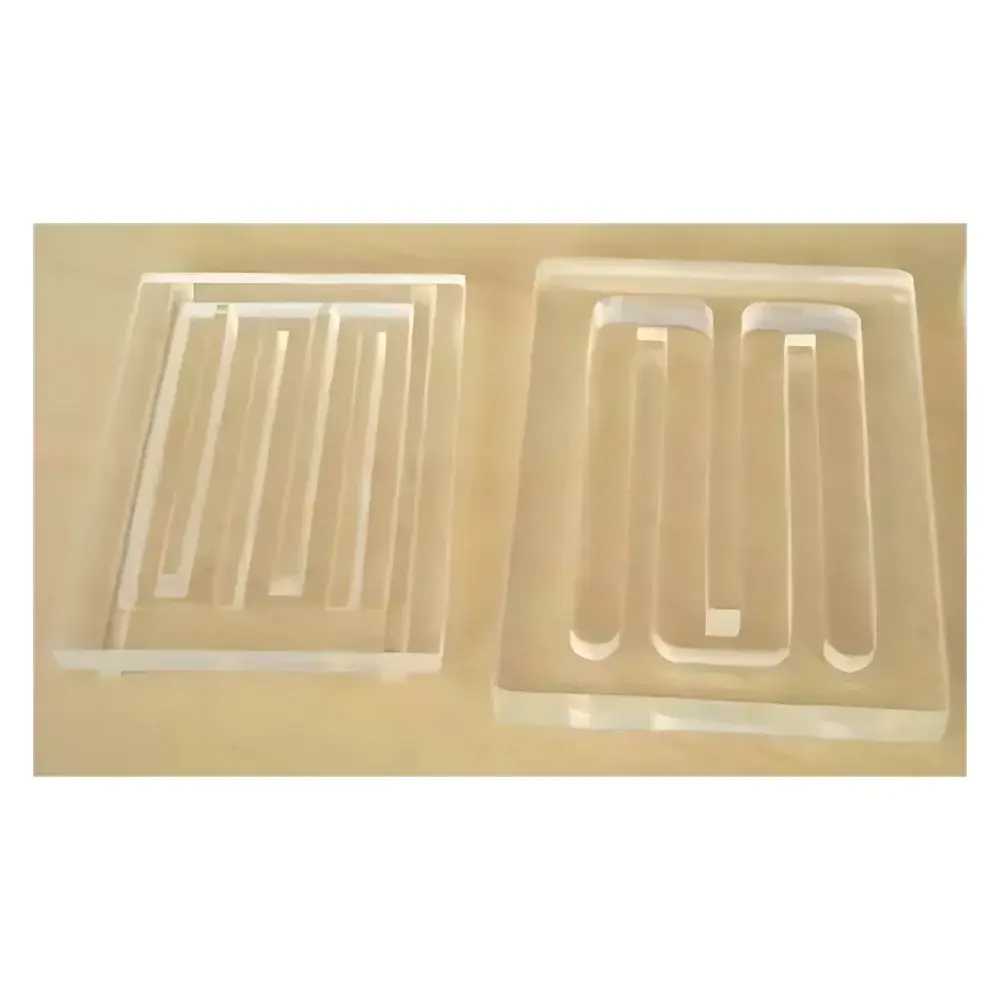
HengaoDe HAD/PP Acrylic Plankton Counting Frame for Microscopic Phytoplankton Enumeration
| Brand | HengaoDe |
|---|---|
| Origin | Beijing, China |
| Manufacturer Type | Authorized Distributor |
| Country of Origin | China |
| Model | HAD/PP |
| Volume Options | 0.1 mL and 1 mL |
| Material | Optical-Grade Glass |
| Application | Microscopic enumeration of phytoplankton and algae in water samples |
| Price | USD 32.50 (FOB) |
Overview
The HengaoDe HAD/PP Acrylic Plankton Counting Frame is a precision optical counting device engineered for standardized microscopic quantification of phytoplankton and microalgae in aquatic environmental monitoring, limnological research, and wastewater treatment process control. Though commonly referred to as “acrylic” in marketing contexts, the HAD/PP variant is constructed from high-transparency, low-fluorescence borosilicate glass—selected specifically to minimize light scattering and refractive distortion under transmitted-light microscopy (e.g., phase contrast or brightfield illumination at 100–400× magnification). This material choice ensures accurate cell delineation and reduces observer bias during manual or semi-automated counting protocols. The frame defines a fixed volumetric chamber (0.1 mL or 1 mL nominal volume), enabling direct conversion of counted cells per field-of-view to concentration units (cells/mL) without volumetric dilution corrections. Its design conforms to internationally recognized plankton enumeration methodologies, including those referenced in ISO 14442:2021 (Water quality — Guidance on enumeration of phytoplankton by microscopy) and APHA Standard Methods 10200G.
Key Features
- Optically matched borosilicate glass construction with polished edges and parallel surfaces to eliminate parallax error during focus adjustment
- Two calibrated chamber volumes: 0.1 mL (for high-density algal blooms) and 1 mL (for oligotrophic or low-biomass samples)
- Integrated alignment grooves and indexing notches for repeatable placement on microscope stage micrometers
- Chemically inert surface resistant to common preservation agents (e.g., Lugol’s iodine, glutaraldehyde) and cleaning solvents (ethanol, acetone)
- Autoclavable up to 121°C for sterility-critical applications such as culture isolation or bioassay preparation
- Compliant with GLP documentation requirements when used with traceable calibration records and operator training logs
Sample Compatibility & Compliance
The HAD/PP counting frame is validated for use with preserved and live freshwater, marine, and estuarine samples. It supports standard fixation protocols per EPA Method 445.1 (Phytoplankton Identification and Enumeration) and is compatible with settling chambers (e.g., Utermöhl technique) when inverted onto Sedgwick-Rafter or Palmer-Maloney slides. Its dimensional stability (< ±0.5 µm thermal expansion coefficient over 10–30°C) ensures reproducibility across seasonal laboratory temperature fluctuations. While not certified to ISO/IEC 17025 for accredited testing, the frame meets metrological traceability requirements when paired with NIST-traceable stage micrometers and calibrated ocular reticles. It is routinely employed in regulatory monitoring programs aligned with EU Water Framework Directive (WFD) Annex V phytoplankton assessment criteria.
Software & Data Management
The HAD/PP frame itself is hardware-only and requires no embedded firmware or connectivity. However, it integrates seamlessly into digital microscopy workflows using third-party image analysis platforms such as ImageJ (with Cell Counter or PlanktonCounter plugins), Olympus cellSens, or Zeiss ZEN Blue. When coupled with automated stage controllers and motorized focus systems, users may implement audit-trail-enabled counting sessions compliant with FDA 21 CFR Part 11—provided electronic records include timestamped metadata, user authentication, and raw image archiving. Calibration certificates for associated micrometers and pipettes should be maintained per ISO/IEC 17025 Clause 6.4.
Applications
- Quantitative phytoplankton community analysis in reservoirs, lakes, and coastal zones
- Monitoring harmful algal bloom (HAB) species dynamics (e.g., Microcystis, Dinophysis, Pseudo-nitzschia)
- Effluent quality control in tertiary wastewater treatment plants
- Ecotoxicological bioassays assessing algal growth inhibition (OECD 201, ISO 8692)
- Educational laboratories for teaching taxonomic identification and population density estimation
FAQ
Is the HAD/PP frame suitable for zooplankton counting?
No. The HAD/PP is optimized for phytoplankton and unicellular algae. For metazoan zooplankton (e.g., rotifers, cladocerans, copepodids), use the complementary HAD/ZP frame—fabricated from UV-stabilized acrylic with larger 5 mL and 10 mL chambers to accommodate motile organisms and reduce settling artifacts.
Can the frame be cleaned with sodium hypochlorite solution?
Yes, but only at ≤1% available chlorine concentration and for ≤5 minutes immersion. Prolonged exposure may etch the glass surface. Rinse thoroughly with deionized water and dry in laminar flow hood to prevent residue crystallization.
Does the 0.1 mL chamber require specialized pipetting technique?
Yes. Use positive-displacement pipettes (e.g., Gilson Pipetman P10) with low-retention tips to ensure volumetric accuracy. Gravimetric verification against Class A volumetric standards is recommended for QC validation.
Is there a documented uncertainty budget for concentration calculations using this frame?
Per ISO/IEC Guide 98-3 (GUM), combined standard uncertainty typically ranges from ±3.2% to ±5.7% (k=2), dominated by pipetting repeatability (±2.1%), chamber depth tolerance (±1.5%), and observer counting variability (±2.8%). Full uncertainty analysis templates are available upon request for ISO 17025-accredited labs.