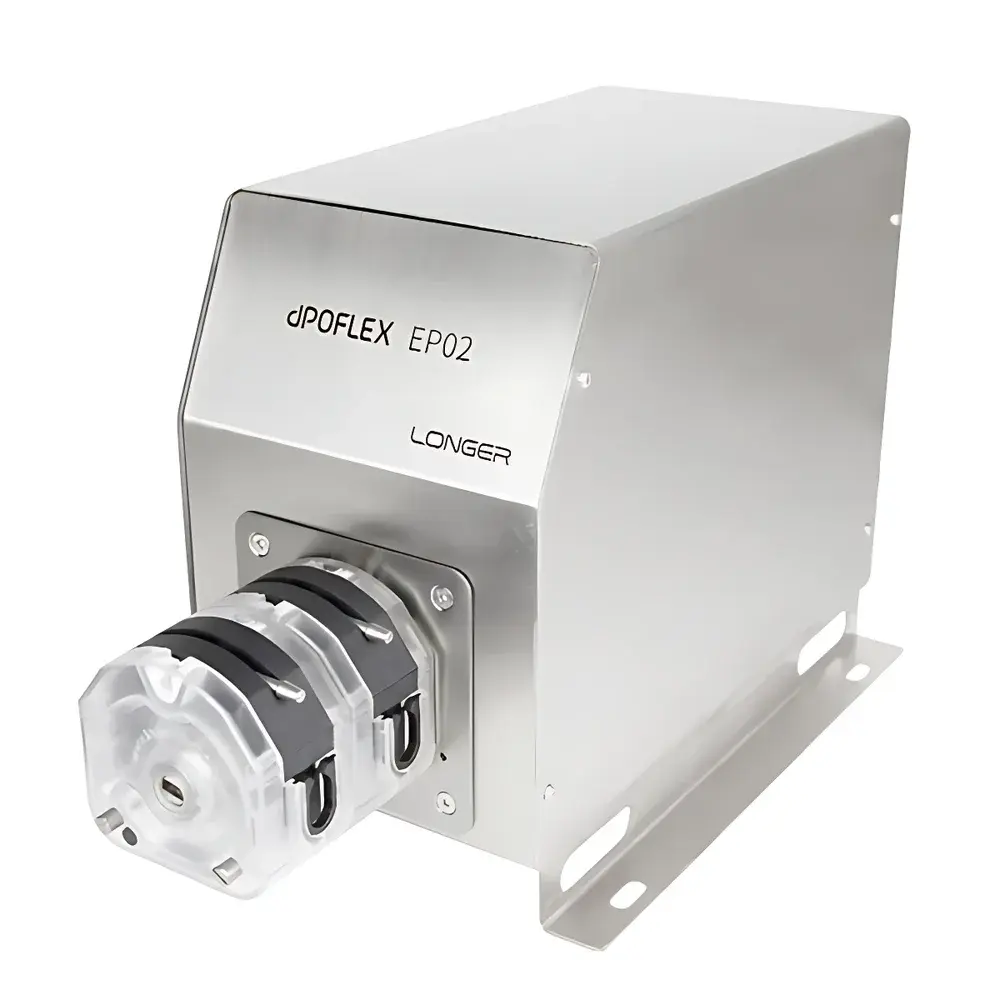
dPOFLEX EP Series Explosion-Proof Motor-Driven Peristaltic Pump
| Brand | LongerPump |
|---|---|
| Origin | Hebei, China |
| Manufacturer Type | OEM Manufacturer |
| Country of Origin | China |
| Model | EP02 |
| Liquid Flow Rate Range | 4 mL/min – 17 L/min |
| Explosion Protection Rating | Ex d IIB T4 Gb |
| IP Rating | IP55 |
| Power Supply | 3-phase 380 V AC or single-phase 220 V AC |
| Control Modes | Manual, 0–10 V / 4–20 mA analog input, RS485 Modbus RTU communication |
| Housing Material | Stainless Steel (optional standard) |
Overview
The dPOFLEX EP Series explosion-proof motor-driven peristaltic pump is an industrial-grade fluid transfer solution engineered for continuous, pulse-free, and contamination-free metering in hazardous environments. Based on the positive displacement principle of peristaltic pumping—where fluid is conveyed by sequential compression and relaxation of flexible tubing—the EP Series eliminates valve wear, seal leakage, and cross-contamination risks inherent in diaphragm or piston-based systems. Designed specifically for Zone 1 and Zone 2 classified areas per IEC 60079-0 and EN 60079-1, the pump integrates a certified flameproof motor (Ex d IIB T4 Gb) and robust stainless steel enclosure (IP55 ingress protection), ensuring safe operation where flammable gases such as propane, ethylene, or hydrogen may be present. Its architecture supports long-term reliability under variable load conditions, with mechanical stability maintained across the full flow range—from low-flow precision dosing (4 mL/min) to high-capacity transfer (17 L/min)—without recalibration or tubing replacement.
Key Features
- Flameproof motor compliant with IEC/EN 60079-1 (Ex d IIB T4 Gb), suitable for Group II B gas atmospheres with maximum surface temperature ≤135 °C
- IP55-rated enclosure with optional stainless steel housing for corrosion resistance and mechanical durability in aggressive industrial settings
- Wide flow range: 4 mL/min to 17 L/min, adjustable via integrated frequency converter with 0.1 Hz resolution and ±0.5% speed repeatability
- Multi-mode control interface: manual potentiometer, analog voltage/current input (0–10 V / 4–20 mA), and RS485 Modbus RTU protocol for PLC integration and centralized SCADA supervision
- Modular pump head design compatible with multiple tube sizes (e.g., 13#, 16#, 25#, 32# PharMed® BPT or Norprene® tubing), enabling rapid reconfiguration for varying viscosity and chemical compatibility requirements
- No internal valves, seals, or wetted metal parts—fluid path limited exclusively to tubing, supporting FDA-compliant and USP Class VI materials for pharmaceutical and food-grade applications
Sample Compatibility & Compliance
The dPOFLEX EP Series accommodates a broad spectrum of liquid media—including aqueous solutions, solvents, slurries, and mildly abrasive suspensions—provided tubing material compatibility is verified per chemical resistance charts (e.g., Norprene® for hydrocarbons; Viton®-lined tubing for ozone or chlorine exposure). The system complies with ATEX Directive 2014/34/EU for equipment placed on the EU market, carries CE marking under the Machinery Directive 2006/42/EC and Low Voltage Directive 2014/35/EU, and meets EMC requirements per EN 61326-1 for industrial environments. While not intrinsically safe (Ex i), its flameproof construction satisfies rigorous third-party certification for use in petrochemical refineries, paint mixing stations, solvent recovery units, and bulk chemical loading bays where ignition source mitigation is mandated.
Software & Data Management
Although the EP02 operates as a standalone unit without embedded firmware-based data logging, its RS485 Modbus RTU interface enables seamless integration into existing process control infrastructure. When connected to a programmable logic controller (PLC) or DCS, real-time parameters—including setpoint, actual speed, direction, fault status, and run time—can be monitored and archived with timestamped audit trails. For facilities operating under GLP or GMP frameworks, this interface supports electronic record integrity when paired with validated supervisory software that enforces 21 CFR Part 11-compliant user access controls, change history, and electronic signatures. Optional external HMI panels provide local visualization and parameter adjustment without compromising explosion safety boundaries.
Applications
- Continuous additive dosing in polymerization reactors and batch mixing tanks within chemical manufacturing plants
- Safe transfer of volatile organic compounds (VOCs) during solvent-based coating, printing, or adhesive application processes
- Controlled feed of catalyst precursors or inhibitors in catalytic cracking units and hydrotreating systems
- Recirculation and sampling loops in explosion-hazardous analytical laboratories (e.g., GC sample introduction, ICP-MS nebulizer supply)
- Wastewater treatment dosing of coagulants or pH adjusters in biogas-handling facilities classified under IEC 60079-10-1
FAQ
What does Ex d IIB T4 Gb signify in practical terms?
It certifies the motor housing as a flameproof enclosure capable of containing internal explosions without igniting surrounding explosive gas mixtures typical of Group IIB gases (e.g., acetone, ethanol) at ambient temperatures up to 135 °C.
Can the EP02 be used in Zone 0 or Zone 20 environments?
No—this model is rated for Zone 1 (gas) and Zone 2 only. Zone 0 requires intrinsically safe (Ex ia) or encapsulated (Ex ma) designs, which are not supported by the EP Series architecture.
Is tubing life monitoring or automatic wear compensation available?
The EP02 does not include built-in tubing wear sensors or adaptive pressure compensation. Tube lifetime must be managed per manufacturer-recommended hours-of-operation guidelines and visual inspection protocols.
Does the pump support 21 CFR Part 11 compliance out of the box?
No—compliance depends on the external control system and software validation. The pump itself provides deterministic, repeatable flow behavior but lacks onboard audit trail generation or electronic signature capability.
What maintenance intervals are recommended for continuous 24/7 operation?
Motor lubrication every 6,000 hours; roller assembly inspection every 2,000 hours; tubing replacement based on flow deviation >±3% or visible fatigue—typically 500–2,000 hours depending on speed, pressure, and tube compound.