
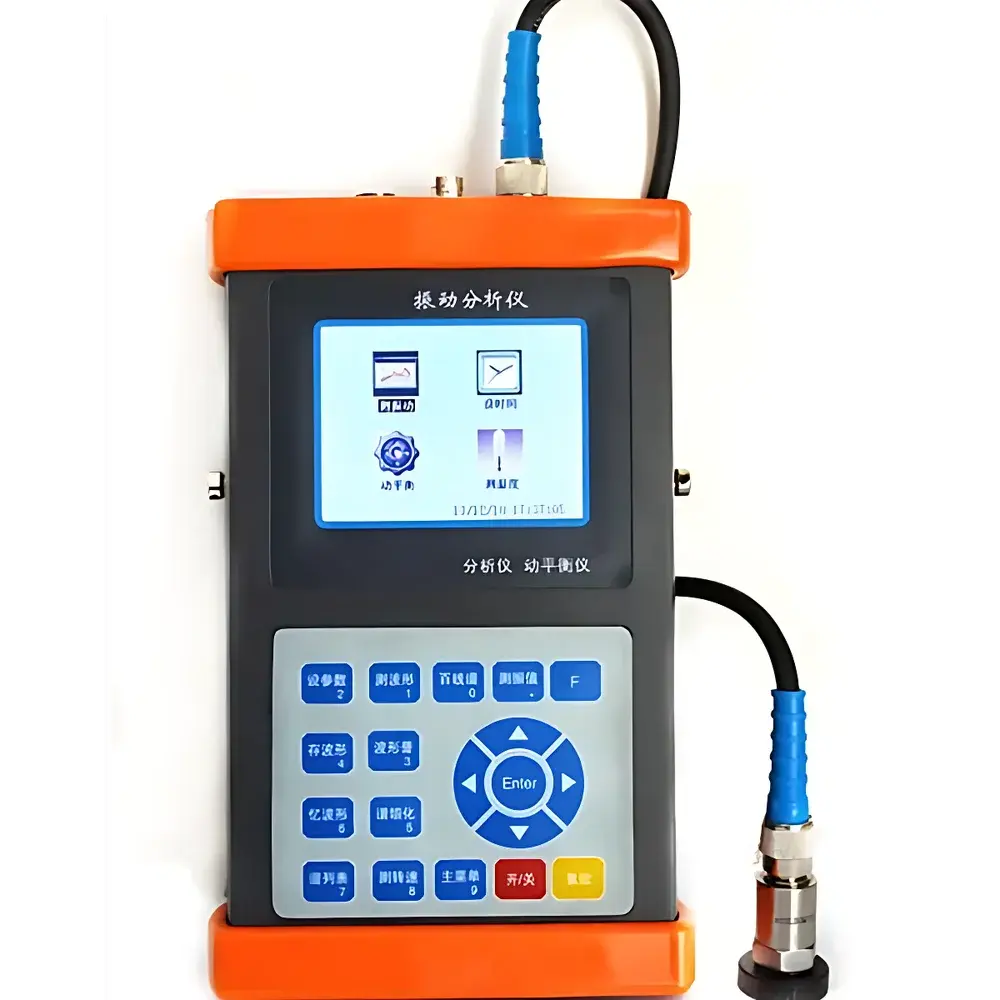
HengaoDe HAD-604A Portable Single-Channel Field Balancing Analyzer with Vibration Waveform & Spectrum Display
| Brand | HengaoDe |
|---|---|
| Model | HAD-604A |
| Origin | Beijing, China |
| Type | Portable Vibration Analyzer & Field Balancing Instrument |
| Frequency Range | 2 Hz – 10 kHz |
| Balancing Speed Range | 120 – 24,000 RPM |
| Spectral Resolution | 400 lines (4× zoom) |
| Measurement Channels | Dual-channel synchronous acquisition |
| Vibration Units | Acceleration (peak, 0.1–250 m/s²), Velocity (RMS, 0.1–200 mm/s), Displacement (peak-to-peak, 1–5000 µm), Envelope (RMS, 0.1–25 m/s²), Voltage (RMS, 0.1 mV–10 V) |
| Accuracy | ±5% for overall vibration values |
| Anti-aliasing Filter | 8th-order elliptic |
| Display | 128×112 dot-matrix LCD |
| Battery Life | Up to 10 hours (rechargeable) |
| Dimensions | 210 × 130 × 40 mm |
| Weight | 1.2 kg |
| Compliance | Supports ISO 10816, ISO 20816, and GB/T 2298–2010 (Mechanical Vibration — Vocabulary) |
Overview
The HengaoDe HAD-604A is a rugged, handheld field balancing analyzer engineered for precision vibration measurement, spectral analysis, and on-site rotor balancing in industrial maintenance environments. It operates on the principle of time-domain waveform acquisition followed by fast Fourier transform (FFT)-based frequency-domain analysis, enabling quantitative assessment of mechanical vibration signatures across rotating equipment—including motors, pumps, fans, and gearboxes. Its dual-channel synchronous sampling architecture supports phase comparison and orbit analysis, while hardware-based envelope demodulation provides early detection of bearing and gear tooth defects via high-frequency resonance energy extraction. Designed for compliance with international machinery condition monitoring standards, the HAD-604A delivers traceable, repeatable data essential for predictive maintenance programs under ISO 13373 and ISO 18436-2 frameworks.
Key Features
- Real-time dual-channel vibration acquisition with hardware-synchronized sampling—enabling cross-channel phase analysis and coherence evaluation.
- 4× spectral zoom capability (400-line resolution) for detailed frequency band inspection, particularly effective for identifying sidebands around gearmesh or bearing defect frequencies.
- Integrated envelope demodulation circuitry optimized for detecting incipient rolling-element bearing faults without reliance on software post-processing.
- Multi-parameter vibration measurement: acceleration (peak), velocity (RMS), displacement (peak-to-peak), envelope RMS, and voltage input—all with automatic and manual range selection.
- Onboard storage for up to 1024-point time waveforms and multiple sets of amplitude-vs-frequency spectra, supporting offline trend analysis.
- Rotational speed measurement via optical tachometer or proximity sensor input, enabling order tracking and critical speed identification.
- Static excitation mode for modal testing—allowing estimation of structural natural frequencies through impact response analysis.
- 128×112 monochrome LCD with cursor-enabled spectral readout and peak-listing functionality for rapid fault signature identification.
Sample Compatibility & Compliance
The HAD-604A interfaces with industry-standard transducers including piezoelectric accelerometers (IEPE and charge output), electromagnetic velocity sensors, and eddy-current displacement probes—ensuring compatibility with legacy and modern sensor fleets. Its 8th-order elliptic anti-aliasing filter meets ANSI S2.67 and IEC 61260 Class 2 requirements for octave-band filtering integrity. The instrument conforms to electromagnetic compatibility (EMC) per IEC 61326-1 and safety standards per IEC 61010-1 (CAT II 300 V). Data integrity aligns with GLP/GMP principles through timestamped storage and non-volatile memory retention. While not FDA 21 CFR Part 11-certified out-of-the-box, audit-ready data export (CSV/ASCII) supports integration into validated laboratory information management systems (LIMS).
Software & Data Management
Data transfer occurs via USB interface to Windows-based PC software (included), supporting waveform playback, spectrum overlay, FFT parameter customization (window type, overlap, averaging), and report generation in PDF or Excel formats. The software includes built-in diagnostic logic aligned with ISO 10816 severity bands and offers customizable alarm thresholds per machine train. All measurements are stamped with date, time, sensor ID, and operator tag—facilitating traceability in regulated environments. Raw binary files preserve full 16-bit ADC resolution for third-party reprocessing in MATLAB or Python-based analytics pipelines.
Applications
The HAD-604A serves as a primary tool in preventive and predictive maintenance workflows across power generation, petrochemical, water treatment, and manufacturing sectors. Typical use cases include: balancing overhung rotors using influence coefficient methodology; diagnosing misalignment via 2× line frequency harmonics; verifying bearing health through envelope spectrum peaks at BPFO/BPFI frequencies; validating structural resonance during commissioning; and performing baseline vibration surveys prior to major overhauls. Its portability and battery operation make it suitable for confined-space inspections, offshore platforms, and remote compressor stations where benchtop analyzers are impractical.
FAQ
Does the HAD-604A support ISO 20816-3 vibration severity evaluation?
Yes—the device measures velocity RMS in mm/s across the standard 10–1000 Hz band and maps results directly to ISO 20816-3 zones A–D for rotating machinery classification.
Can it perform single-plane or two-plane balancing without external software?
Yes—onboard balancing routines guide users through data collection, vector calculation, and correction weight placement for both single- and dual-plane configurations.
Is calibration traceable to national standards?
The unit ships with a factory calibration certificate referencing NIST-traceable reference accelerometers; annual recalibration is recommended per ISO/IEC 17025 guidelines.
What sensor types are supported for envelope analysis?
Only IEPE-type accelerometers with built-in electronics are compatible with the hardware envelope demodulation path; charge-mode sensors require external signal conditioning.
Does it store phase angle data for balancing calculations?
Yes—phase relative to keyphasor input is captured synchronously with amplitude, enabling precise angular placement of correction masses.




