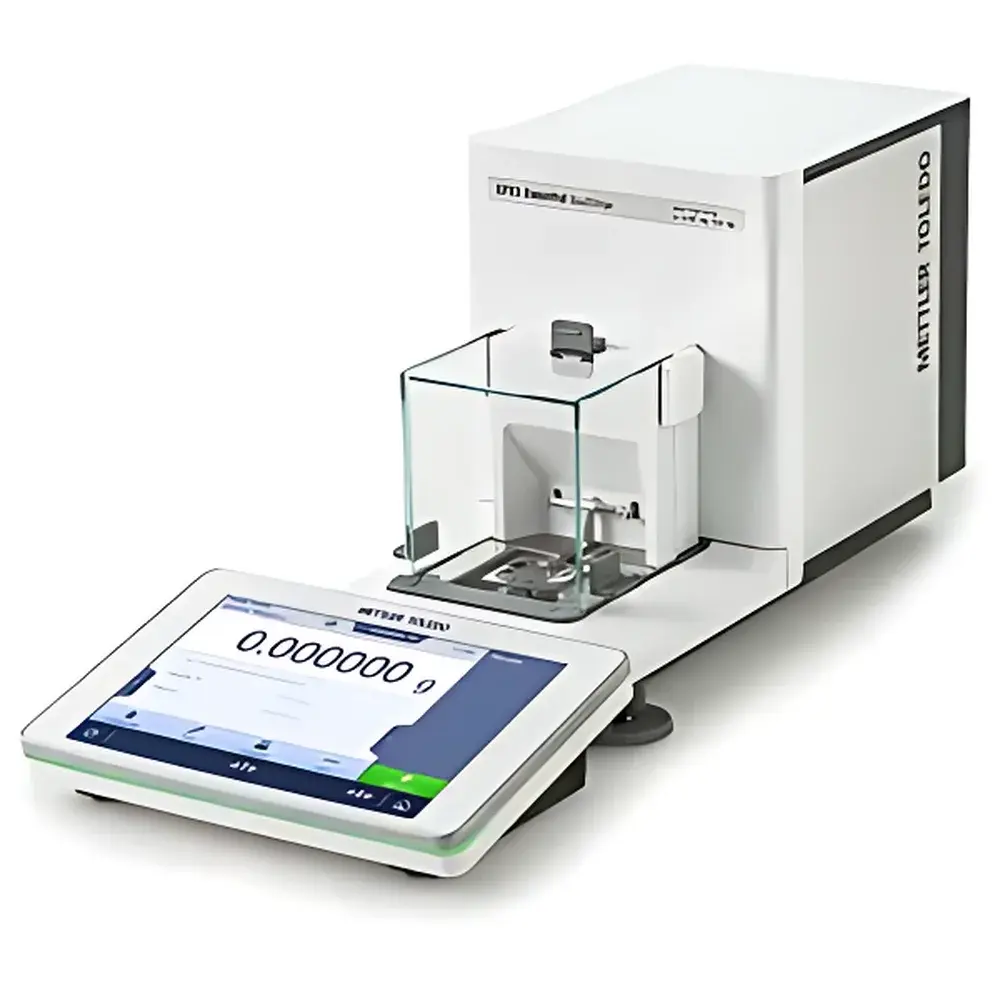
METTLER TOLEDO XPR16DUE/AC Ultra-Micro Balance
| Brand | METTLER TOLEDO |
|---|---|
| Origin | Switzerland |
| Model | XPR16DUE/AC |
| Maximum Capacity | 12 g / 3.2 g |
| Readability | 0.01 mg / 0.001 mg |
| Repeatability (typ.) | 0.0012 mg |
| Minimum Weight (USP, ±0.1%, typ.) | 2.4 mg |
| Stabilization Time | 6 s |
| Pan Dimensions (W × D) | 32 mm × 32 mm |
| Dimensions (H × W × D) | 196 mm × 195 mm × 478 mm |
| Built-in Calibration | FACT (Fully Automatic Calibration Technology) |
| Display | 7-inch color TFT touchscreen |
| Connectivity | RS232 (optional), USB-A, USB-B, Ethernet, Bluetooth (optional) |
| Compliance | 21 CFR Part 11–ready (with LabX), USP <41> & <1251>, ISO/IEC 17025 support |
| User Management | Unlimited users, role-based permissions, audit trail |
| Static Detection | Not integrated |
| Minimum Weight (k=2, U=1%, typ.) | 0.24 mg |
| Balance Class | Ultra-micro |
Overview
The METTLER TOLEDO XPR16DUE/AC is an ultra-micro balance engineered for laboratories requiring trace-level mass measurement with uncompromising accuracy, repeatability, and regulatory compliance. Operating on electromagnetic force compensation (EMFC) principle, it delivers high-resolution weighing performance down to 0.001 mg (1 µg) at its lower range (3.2 g capacity), while maintaining 0.01 mg readability across its full 12 g capacity. Designed for environments where microgram-level precision directly impacts analytical validity—such as active pharmaceutical ingredient (API) quantification, reference standard preparation, catalyst dosing in fine chemical synthesis, or nanomaterial formulation—the XPR16DUE/AC integrates advanced mechanical stability, thermal drift compensation, and real-time environmental monitoring to ensure consistent metrological integrity under variable lab conditions.
Key Features
- Ultra-micro resolution: Dual-range capability supports both 3.2 g @ 0.001 mg and 12 g @ 0.01 mg weighing modes, optimized for applications demanding extreme sensitivity without sacrificing operational flexibility.
- FACT (Fully Automatic Calibration Technology): Internal motorized calibration weights enable temperature-triggered and time-scheduled recalibration, minimizing manual intervention while preserving traceability per ISO/IEC 17025 requirements.
- 7-inch color TFT capacitive touchscreen: Intuitive graphical interface with multi-touch gesture support, customizable home screen layouts, and real-time status indicators (e.g., draft shield status, leveling, environmental stability).
- Regulatory-ready architecture: Native compatibility with LabX software ensures full 21 CFR Part 11 compliance—including electronic signatures, user authentication, permission-based access control, and immutable audit trails for all critical operations.
- Robust mechanical design: Monolithic sensor housing, low-center-of-gravity base, and vibration-damping feet reduce susceptibility to floor-borne disturbances; optional anti-vibration table mounting kits available for high-sensitivity workflows.
- Comprehensive connectivity suite: Standard USB-A (for peripheral devices), USB-B (for PC integration), and Ethernet ports enable seamless data export, remote diagnostics, and centralized fleet management; RS232 and Bluetooth modules available as factory-installed options.
Sample Compatibility & Compliance
The XPR16DUE/AC accommodates a wide range of sample types—from hygroscopic powders and volatile solvents to static-prone nanoparticles—within its 32 mm × 32 mm stainless-steel pan. While the instrument does not feature integrated electrostatic detection, its grounded housing, ionizer-compatible design (when used with external neutralizers), and humidity-resistant internal optics support reliable weighing of challenging materials. It meets essential pharmacopeial criteria: minimum weight validation per USP (±0.1% tolerance) yields a typical value of 2.4 mg, and at k=2, U=1%, the minimum weighable quantity is 0.24 mg—enabling compliant use in GMP-controlled QC labs. Certification documentation (including EC Type Examination Certificate and Declaration of Conformity) is supplied with each unit, affirming compliance with OIML R 76, NIST Handbook 44, and EU Measuring Instruments Directive (MID) Annex MI-001.
Software & Data Management
When paired with LabX laboratory software, the XPR16DUE/AC functions as a validated endpoint within a connected quality system. LabX provides method-driven workflows, automated calculation templates (e.g., % loss on drying, assay dilution series), and direct integration with LIMS and ERP platforms via ODBC or RESTful API. All data—including raw weight values, timestamps, operator IDs, calibration logs, and environmental metadata (temperature, humidity)—are stored in a secure SQL database with version-controlled backups. Audit trail records are tamper-evident and exportable in PDF/A-1 format for regulatory submissions. Standalone operation is fully functional using the onboard interface, with data exportable via USB drive in CSV, XML, or PDF formats—retaining full traceability without software dependency.
Applications
- Pharmaceutical development: Accurate dispensing of potent compounds during pre-formulation studies and reference standard preparation per ICH Q5C and USP .
- Materials science: Precise mass determination of nanocatalysts, quantum dots, and MOF precursors where stoichiometric fidelity governs functional performance.
- Environmental analysis: Weighing of certified reference materials (CRMs) and filter media for trace metal recovery studies (EPA Method 200.8, ISO 17294-2).
- Academic research: High-precision gravimetric analysis in catalysis, electrochemistry (electrode loading), and polymer characterization (residue quantification after solvent extraction).
- Contract manufacturing organizations (CMOs): Fully auditable weighing processes aligned with FDA, EMA, and PMDA expectations for batch record integrity and change control.
FAQ
What is the difference between the 0.001 mg and 0.01 mg readability specifications?
The XPR16DUE/AC operates in two distinct weighing ranges: up to 3.2 g with 0.001 mg resolution, and up to 12 g with 0.01 mg resolution. The lower range prioritizes ultra-micro sensitivity; the higher range balances extended capacity with sub-milligram precision.
Does this balance support automatic static elimination?
No—integrated electrostatic detection or neutralization is not included. However, the balance’s grounded architecture and compatibility with third-party ionizers allow effective mitigation of static-related errors when required.
Is FACT calibration sufficient for GLP/GMP audits?
Yes—FACT enables documented, repeatable, and traceable calibration events that satisfy ISO/IEC 17025 and 21 CFR Part 11 requirements when combined with LabX-generated calibration reports and audit trails.
Can multiple users be assigned different access levels?
Yes—LabX supports unlimited user accounts with configurable roles (e.g., operator, supervisor, administrator), each with granular permissions over methods, reports, calibration, and system settings.
What environmental conditions affect stabilization time?
Stabilization time of ≤6 s assumes ambient temperature stability (±0.5 °C/h), relative humidity <70% RH, and absence of air currents. Draft shields must be fully closed, and the balance must be leveled prior to operation.