
HengaoDe HAD-1005 ISO 1350-2 Compliant Bulk Density Tester for Proppants (Ceramic Sand, Frac Sand, Coated Proppants)
| Brand | HengaoDe |
|---|---|
| Origin | Beijing, China |
| Manufacturer Type | Authorized Distributor |
| Country of Origin | China |
| Model | HAD-1005 |
| Price | USD 92 (FOB Beijing) |
Overview
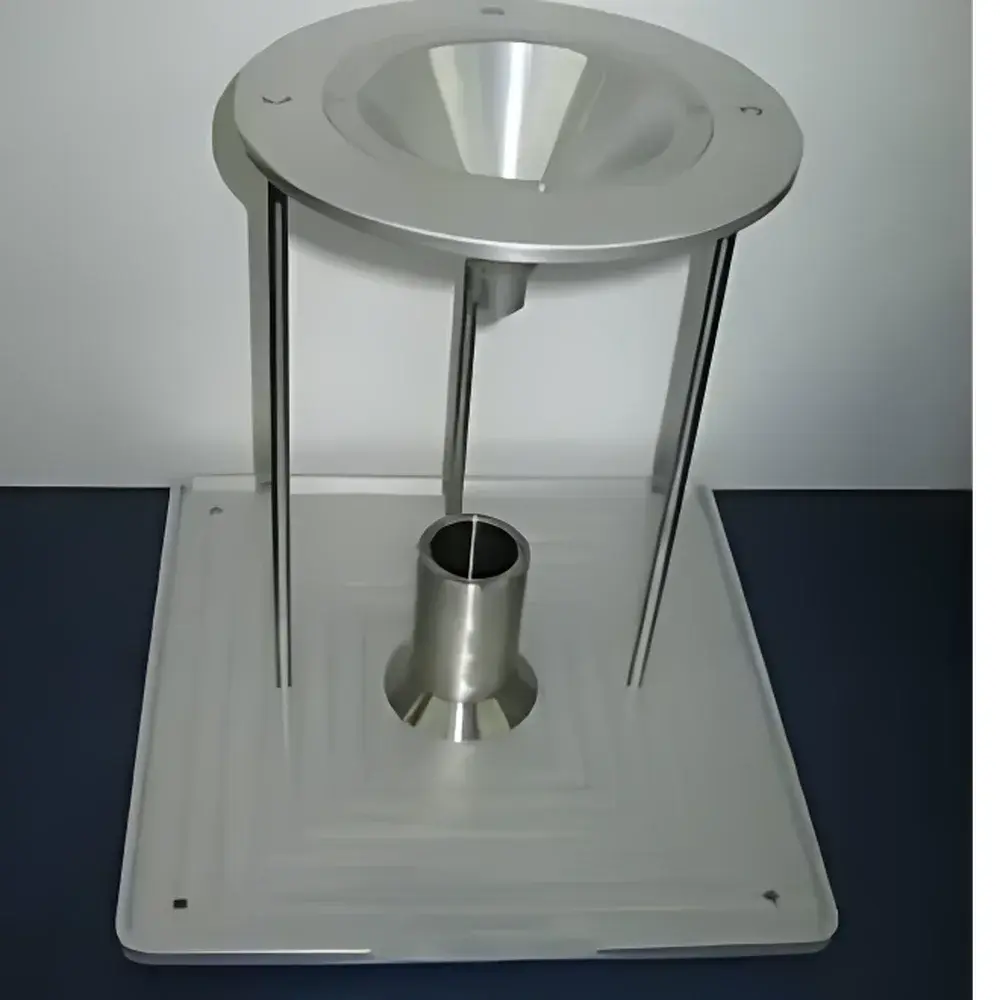
The HengaoDe HAD-1005 Bulk Density Tester is a precision-engineered instrument designed specifically for the determination of bulk density of hydraulic fracturing proppants in accordance with ISO 1350-2:2017 — *Petroleum and natural gas industries — Methods of test for proppants — Part 2: Determination of bulk density*. It implements the standardized funnel-flow method: proppant material is allowed to flow freely under gravity from a calibrated stainless steel funnel into a fixed-volume cylindrical cup mounted on a precision balance. The mass of the settled proppant is recorded, and bulk density (g/cm³ or kg/m³) is calculated as mass divided by cup volume (100 mL). This gravimetric method ensures high reproducibility across laboratories and aligns with industry-standard QC protocols used by major oilfield service providers and E&P operators.
Key Features
- Fully compliant with ISO 1350-2 methodology for proppant bulk density testing
- Stainless steel funnel (top OD: 139.7 mm; ID: 114.3 mm; height: 76.2 mm) with precisely machined 12.7 ± 0.4 mm outlet orifice
- Cylindrical test cup fabricated from corrosion-resistant stainless steel, nominal volume: 100 mL (±0.2 mL tolerance)
- Integrated aluminum base plate and rigid stainless steel support frame (rod diameter: 4.8 mm), ensuring dimensional stability during repeated use
- Fixed vertical geometry: total height from funnel top to cup base = 304.8 mm; drop height from funnel exit to cup rim = 215.9 mm
- Non-magnetic, non-reactive construction eliminates contamination risk during testing of coated (resin-coated) or ceramic proppants
- Compact footprint (304.8 × 304.8 × 304 mm) optimized for benchtop deployment in core labs and field QC units
- Surface-finished components resist oxidation and facilitate cleaning between sample batches
Sample Compatibility & Compliance
The HAD-1005 is validated for all three primary classes of proppants defined in API RP 19C and ISO 1350 series standards: natural quartz sand, sintered bauxite ceramic proppants, and resin-coated variants (including phenolic- and epoxy-based coated sands and ceramics). Its geometry accommodates particle size distributions ranging from 8/12 mesh to 40/70 mesh (2.36–0.212 mm), consistent with common frac design specifications. The device supports routine quality assurance per ASTM D4292 (Standard Test Method for Bulk Density of Proppants) and serves as a critical pre-shipment verification tool in GLP-compliant manufacturing environments. All mechanical dimensions—including funnel taper angle, cup internal diameter (38.1 mm), and rubber stopper ball diameter (30.48 mm)—are traceable to certified metrology calibrations.
Software & Data Management
The HAD-1005 is a standalone mechanical tester requiring no embedded electronics or firmware. However, it is fully compatible with LIMS-integrated workflows: users record mass measurements from external analytical balances (e.g., Mettler Toledo XP204, Sartorius Entris II) and compute bulk density using validated spreadsheets or laboratory information management systems (LIMS). For regulatory compliance, raw mass data and calculation logs may be archived with electronic signatures in accordance with FDA 21 CFR Part 11 requirements when paired with compliant balance software (e.g., LabX®). The instrument itself carries no internal memory or connectivity—ensuring zero firmware obsolescence and long-term operational continuity.
Applications
- Quality control of ceramic proppants prior to wellsite delivery (e.g., 12/18 mesh, 16/20 mesh, 20/40 mesh sintered bauxite)
- Batch-to-batch consistency monitoring in proppant manufacturing facilities
- Field laboratory verification at fracturing job sites (DQ, HQ, or remote locations)
- Research and development of novel proppant formulations, including lightweight ceramics and polymer-enhanced composites
- Third-party certification testing per ISO/IEC 17025-accredited laboratories
- Training and competency assessment for petroleum engineering students and field technicians
FAQ
Is the HAD-1005 certified to ISO 1350-2?
Yes—the mechanical configuration, dimensional tolerances, and procedural workflow are explicitly engineered to satisfy all physical and operational requirements specified in ISO 1350-2:2017.
Can it be used for resin-coated proppants without clogging?
Yes—its smooth-polished stainless steel surfaces and 12.7 mm orifice minimize adhesion and bridging of coated particles; periodic cleaning with isopropyl alcohol is recommended.
Does it include a balance or require external weighing equipment?
It does not include a balance; users must supply a Class I or II analytical balance with ≥0.001 g readability and ≥200 g capacity.
What is the recommended calibration frequency for the test cup volume?
Volume calibration should be performed annually using certified water displacement or volumetric standard spheres, traceable to NIST or equivalent national metrology institutes.
Is operator training required to achieve ISO-compliant results?
Yes—ISO 1350-2 specifies strict handling procedures (e.g., funnel conditioning, flow interruption technique, cup tapping protocol); training is advised per ISO/IEC 17025 clause 6.2.5.




